

As we approach 2026, we are not merely turning a page on the calendar; we are closing the book on an entire era of marketing. For the last decade, B2C marketing was defined by a specific set of rules: the dominance of third-party cookies, the supremacy of the “growth at all costs” mindset, and the reliance on “rented” audiences from Facebook and Google.
That era is over. It didn’t end with a bang, but with a series of structural shifts that have fundamentally altered the physics of digital business.
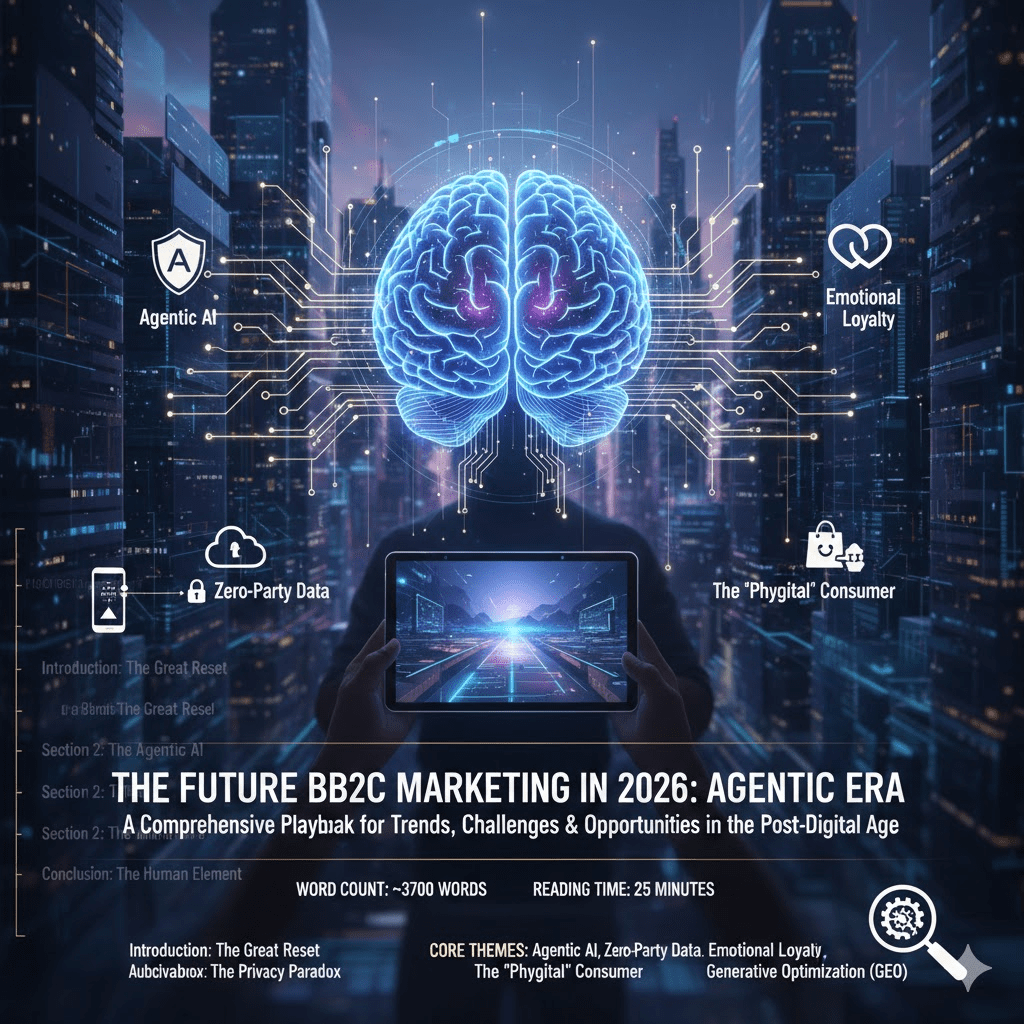
We are now witnessing a “Great Reset.” The convergence of privacy legislation (GDPR, CCPA), the degradation of tracking signals (iOS updates), and the explosive rise of Autonomous AI has created a new reality. In this new world, the old playbook isn’t just less effective—it is a liability.
Consider the economic reality: Customer Acquisition Costs (CAC) have risen by nearly 60% over the last five years. The “arbitrage” of cheap social media ads is gone. Meanwhile, consumer trust is at an all-time low. People are tired of being tracked, targeted, and interrupted. They have installed ad blockers, retreated into private “dark social” communities, and trained their brains to ignore banner ads entirely.
However, for the prepared brand, this is not a crisis. It is the single greatest opportunity in a generation.
The future of 2026 is defined by Intimacy at Scale. It is an era where Agentic AI allows brands to treat a million customers with the same personal attention as a corner store owner treats a single neighbor. It is an era where Data Sovereignty replaces data exploitation, and Emotional Loyalty replaces transactional bribery.
According to
, 75% of consumers now prefer brands that offer personalized experiences. But in 2026, “personalization” doesn’t mean putting a first name in an email subject line. It means predicting a need before the consumer even articulates it.
In this exhaustive guide, we will dismantle the trends shaping 2026, providing you with the deep analysis, strategic frameworks, and actionable checklists needed to build a future-proof brand.
Here are the 2026 trends in “cheat sheet” format- the key takeaways:
- Agentic AI: AI moves from “writing emails” to “managing goals” (e.g., “Clear this inventory by Friday”).
- The AI Gatekeeper: You must optimize for the consumer’s AI bot, which now filters out noisy ads before the human sees them.
- Zero-Party Data: Since cookies are dead, you must get data directly from users via quizzes and transparent “Data Wallets.”
- Emotional Loyalty: Ditch generic points. Build micro-communities and “money-can’t-buy” experiences to foster true fans.
- GEO (Generative Engine Optimization): Focus on original data and unique opinions so AI search engines cite you instead of just summarizing you.
- Anticipatory Shipping: Use AI to ship products to local hubs before the customer even clicks “buy.”
- The Human Premium: As AI content floods the web, real human faces and “IRL” experiences become your most valuable assets.
Section 1: The Macro-Economic Landscape of 2026
Before diving into tactics, we must understand the terrain. The B2C marketer of 2026 operates in a world defined by three massive “Macro-Pressures.”
1. The Attention Recession
We have reached “Peak Content.” Every minute, 500 hours of video are uploaded to YouTube, and millions of AI-generated articles flood the web. The human capacity to consume content is finite, but the supply is infinite.
- The Result: The value of a “view” has plummeted. Brands can no longer compete on volume of content; they must compete on resonance.
- The Shift: We are moving from an “Attention Economy” (getting eyes on screen) to a “Trust Economy” (getting belief in the mind).
2. The “Cookie-Less” Reality
By 2026, the third-party cookie is effectively extinct. Google’s Privacy Sandbox and Apple’s advanced tracking protections have created a “Walled Garden” internet.
- The Impact: “Multi-Touch Attribution” (knowing exactly which ad drove a sale) is mathematically impossible for most brands. Marketers must return to “Media Mix Modeling” (MMM) and econometrics to understand performance.
- The Imperative: You must own your audience. If you rely on Meta to hold your customer data, you are renting your business.
3. The Rise of the “Cyborg Consumer”
The consumer of 2026 is technologically augmented. They use AI assistants to filter their emails, summarize their news, and find products.
- The Gatekeeper: Your marketing isn’t just convincing a human anymore; it has to convince the human’s AI agent. If your product doesn’t make it past the AI filter, you don’t exist.
Section 2: Trend #1 – The Rise of Agentic AI in Marketing Stacks
From “Co-Pilot” to “Auto-Pilot”
The most significant technological leap of 2026 is the evolution from Generative AI to Agentic AI.
What is the Difference?
- Generative AI (2023-2025): The “Creative Intern.” You tell it what to do (“Write a blog post”), and it creates content. It requires constant supervision and prompting.
- Agentic AI (2026): The “Operations Manager.” You give it a goal (“Clear 500 units of inventory by Friday”), and it figures out how to do it. It perceives, reasons, acts, and reflects.
The “Self-Driving” Campaign Architecture
In 2026, a sophisticated B2C tech stack functions like a self-driving car. Here is a “Day in the Life” of an Agentic Marketing System:
- 08:00 AM – Perception: The AI Agent scans global trends, local weather patterns, and internal inventory. It notices that “puffer jackets” are trending on TikTok and a cold front is hitting Chicago. It also sees you have excess inventory of Navy Blue Puffer Jackets.
- 08:05 AM – Reasoning: The Agent calculates that a targeted campaign in Illinois could clear this stock. It decides to offer a “Flash Freeze Sale.”
- 08:10 AM – Action:
- It generates 50 variations of ad creative using Generative AI.
- It launches ads on Meta and TikTok specifically targeting users in Illinois.
- It updates the website homepage for Illinois IP addresses to show jackets first.
- It sends an SMS via The Vital app to Illinois customers: “Chicago is freezing! Grab your jacket for 20% off today.”
- 12:00 PM – Reflection: The Agent notices that “Video B” is performing 30% better than “Image A.” It kills “Image A” and reallocates the budget to “Video B.”
- 05:00 PM – Reporting: The Agent sends the CMO a summary: “Cleared 300 units. ROAS was 4.5. Action complete.”
Strategic Insight: This is not science fiction. The components for this (Zapier, OpenAI, Shopify APIs, Facebook Conversions API) already exist. The trend of 2026 is the seamless integration of these tools into autonomous loops.
The “Service-as-Sales” Revolution
Customer support is no longer a cost center; it is a profit center driven by AI.
Traditional chatbots were frustrating decision trees (“Press 1 for Returns”). 2026 AI Agents are empathetic, context-aware sales associates.
- Scenario: A customer asks, “Is this face cream safe for pregnancy?”
- Agent Response: “Yes, it is pregnancy-safe! It contains bakuchiol instead of retinol. Since you mentioned you have dry skin in your last quiz, I’d recommend pairing it with our Hydration Serum for the best glow. Should I bundle them for a 10% saving?”
Section 3: Trend #2 – The Privacy Paradox & Zero-Party Data
Building the Trust Bridge
A visual representation of ‘Zero-Party Data’ exchange: A glowing digital bridge connecting a consumer’s smartphone (displaying a preference quiz) to a brand’s transparent data vault. The scene symbolizes trust, clarity, and fair value exchange. High-tech, clean, white and gold color palette
The defining conflict of the modern consumer is the “Privacy Paradox.”
- Fact A: Consumers are terrified of surveillance capitalism. They hate feeling “stalked” by ads for products they just talked about.
- Fact B: Consumers expect hyper-relevance. They get annoyed when you show them dog food if they own a cat.
The bridge between these two realities is Zero-Party Data.
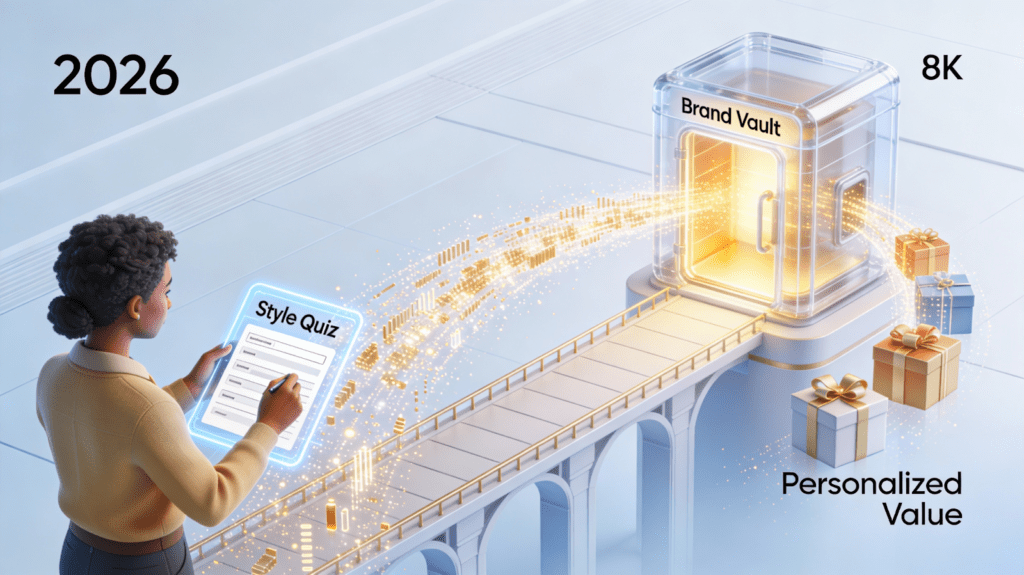
A visual representation of ‘Zero-Party Data’ exchange: A glowing digital bridge connecting a consumer’s smartphone (displaying a preference quiz) to a brand’s transparent data vault. The scene symbolizes trust, clarity, and fair value exchange. High-tech, clean, white and gold color palette
The Hierarchy of Data in 2026
| Data Type | Definition | Example | 2026 Value |
| Zero-Party | Data a user intentionally gives you. | Quiz results (“I have curly hair”), Preferences (“Email me weekly”). | Platinum: High trust, high accuracy. |
| First-Party | Passive behavioral data. | Click history, Purchase history, Time on site. | Gold: Reliable, but requires interpretation. |
| Second-Party | Someone else’s first-party data. | A partnership where an Airline shares data with a Hotel chain. | Silver: Useful for partnerships. |
| Third-Party | Aggregated data bought from brokers. | “User is likely male, aged 25-34.” | Toxic: Unreliable and increasingly illegal. |
Strategy: The “Quiz Funnel” Ecosystem
In 2026, the “Onboarding Quiz” is the most critical asset on a D2C website. It is the digital equivalent of a greeter at a luxury store.
- The Mistake: Asking for data without value. “Sign up for updates.” (Why? Who cares?)
- The Strategy: “Find your perfect shade in 30 seconds.”
- The Mechanics:
- User lands on site.
- Prompt: “Take the Skin Health Quiz.”
- User answers 5 questions (Skin type, Budget, Primary concern).
- Crucial Step: The brand saves these tags into the CRM (like The Vital or Klaviyo).
- The Payoff: The user receives a personalized results page. AND, all future marketing is filtered through this lens. If they said “Oily Skin,” they never see a “Dry Skin” product again.
The “Data Wallet” Concept
Forward-thinking brands are implementing “Customer Data Portals.” This is a section in the user account where the customer can see exactly what the brand knows about them.
- Interface: “We know you like: Silver Jewelry, Size 7 Rings, Minimalist Style. Is this correct? [Update Preferences]”
- Psychology: This radical transparency builds immense trust. It turns data collection from “surveillance” into “collaboration.”
Section 4: Trend #3 – From Transactional to Emotional Loyalty
Solving the “Points Fatigue”
By 2026, the average consumer belongs to 18 loyalty programs but is active in only 3. Why? Because most programs are boring calculators. “Spend $100, get $5.” This is Transactional Loyalty. It works, but it is fragile. A competitor can steal your customer by simply offering “Spend $100, get $6.”
The winners of 2026 are building Emotional Loyalty.
The Three Tiers of Loyalty
- Transactional (Mercenary): “I buy because it’s cheap.”
- Driver: Price.
- Retention: Low.
- Habitual (Convenience): “I buy because it’s easy.”
- Driver: Subscription, saved credit card, Prime shipping.
- Retention: Medium.
- Emotional (Cult): “I buy because it reflects who I am.”
- Driver: Identity, Community, Shared Values.
- Retention: High (The customer becomes a brand defender).
Implementing Emotional Loyalty with Tech
Using platforms like
, brands can operationalize emotional connection.
- Gamification of Advocacy: Don’t just reward spend. Reward engagement.
- +50 Points for following on TikTok.
- +100 Points for posting a photo with the hashtag.
- +200 Points for attending a sustainability webinar.
- Experiential Rewards: The “Redemption Shop” shouldn’t just be discount codes. It should be “Money Can’t Buy” experiences.
- Bad Reward: $10 off coupon.
- Good Reward: 15-minute Zoom coffee chat with the Founder.
- Great Reward: Early access to the new collection 24 hours before the public.
Case Study: The “VIP Circle”
Imagine a coffee brand.
- Old Way: Buy 10 coffees, get 1 free.
- 2026 Way: The “Roaster’s Circle.” Members pay $10/month. They get free shipping, but also a monthly “Tasting Note” video from the head roaster, access to a private WhatsApp group to discuss brewing methods, and a “Members Only” ceramic mug. The value is in the belonging, not just the beans.
Section 5: Trend #4 – The Renaissance of Email & SMS
Hyper-Personalization and “Liquid Content”
Email is the cockroach of the internet—it survives every apocalypse. In 2026, it remains the highest ROI channel, but the nature of the inbox has changed.
AMP for Email: The Website in the Inbox
For 20 years, email was a static digital flyer. You looked at it, clicked a link, and went to a website.
AMP (Accelerated Mobile Pages) has changed this. Emails are now dynamic, interactive apps.
- The Experience: A user receives an email about a new sneaker drop. Instead of clicking “Shop Now,” they can swipe through colorways, select their size, and click “Add to Cart”—all without leaving the email app.
- The Metric: This reduces the “Click-to-Conversion” path by 50%.
The “Liquid Content” Strategy
“Liquid Content” creates a unique email for every single opener at the moment of open.
- Contextual Adaptation:
- It’s raining where the user is? The header image changes to a cozy indoor scene.
- Inventory is low? The email displays a “Only 3 left!” countdown.
- User just bought shoes? The email dynamically swaps the shoe recommendation for a sock recommendation.
- Automation Tools: Apps like
- The Vital
- for Shopify allow merchants to set up these complex “If/Then” flows without coding.
SMS Marketing: The “Concierge” Channel
SMS is a sacred space. It sits next to texts from the user’s mom and spouse. Brands must treat it with reverence.
- The Rule of SMS: “Utility over Promotion.”
- Good SMS: “Hi Sarah, your subscription renews in 2 days. Reply ‘SKIP’ if you have enough coffee for now.” (Helpful, builds trust).
- Bad SMS: “FLASH SALE! 50% OFF! BUY NOW!” (Annoying, leads to unsubscribes).
- Conversational SMS: 2026 is about two-way SMS.
- Brand: “Your order was delivered! How does the shirt fit?”
- User: “A bit tight.”
- Brand (AI Agent): “Oh no! I’ve just emailed you a free return label. Would you like me to ship the next size up immediately?”
Section 6: Trend #5 – The “Phygital” World & Dark Social
Where Online and Offline Collide
The boundary between “e-commerce” and “retail” has dissolved. We are living in a “Phygital” (Physical + Digital) reality.
The Return of the Physical
After years of digital saturation, there is a premium on “Real Life” (IRL) experiences. Digital-native brands are opening “Pop-Up” spaces not to drive revenue, but to drive content.
- The Strategy: The store is a media studio. Every corner is “Instagrammable.” The goal of the physical space is to generate UGC (User Generated Content) that fuels the digital ads.
Dark Social: The Untrackable Majority
80% of sharing happens in “Dark Social”—private channels like WhatsApp, Discord, Slack, and DMs. Analytics tools cannot track this.
- The Strategy: You cannot spy on these conversations. You must be invited in.
- Brand Communities: Smart brands are launching their own Discord servers.
- Example: A skincare brand launches a “Skin Positivity” Discord. They don’t just sell product; they host AMAs with dermatologists, mental health check-ins, and allow users to support each other. The brand becomes the host of the community, not just the vendor.
Section 7: Search Generative Experience (SGE) & GEO
The End of SEO as We Know It
“Ranking #1 on Google” means something very different when the top of the search result is an AI-generated answer, not a list of blue links. This is SGE (Search Generative Experience).
From SEO to GEO (Generative Engine Optimization)
In 2026, you aren’t optimizing for keywords; you are optimizing for Information Gain.
- The Problem: AI summarizes the consensus. If your blog post just repeats what the top 10 articles say, the AI reads it, absorbs it, and gives the user the summary. You get zero clicks.
- The Solution: You must provide something the AI cannot summarize from elsewhere.
- Original Data: “We surveyed 5,000 customers and found…”
- Contrarian Opinion: “Why everyone is wrong about X.”
- Personal Experience: “I tried this for 30 days and here is what happened.”
Optimizing for Long-Tail Conversational Queries
People don’t search “running shoes” anymore. They search: “I’m training for a marathon in a rainy city and I have flat feet, what shoes should I buy?”
- Strategy: Your content strategy must pivot to answer these specific, complex questions. Your FAQ page is your most valuable SEO asset.
Section 8: Implementation Framework
Building the 2026 Tech Stack
You cannot execute a 2026 strategy with a 2016 tech stack. You need a Composable Architecture—a set of best-in-breed tools that speak to each other via APIs.
The 5-Layer Stack
- The Commerce Engine: (e.g., Shopify, BigCommerce). The transaction layer. Must be fast and mobile-optimized.
- The Identity Layer (CDP): (e.g., Segment, TripleWhale). The brain. It collects data from all sources (website, email, ads) and creates a “Single Customer View.”
- The Relationship Layer: (e.g., Retenzy). The heart. Manages loyalty, rewards, referrals, and VIP tiers.
- The Communication Layer: (e.g., The Vital, Klaviyo). The mouth. Sends emails, SMS, and push notifications based on the CDP data.
- The Intelligence Layer: (e.g., Custom AI Agents). The nervous system. Automates inventory, ad buying, and support.
Action Checklist for the CMO
- [ ] Audit Your Data: Do you have a direct line to your customers (Email/SMS), or are you dependent on an algorithm?
- [ ] Define Your Value: Why should a customer remain loyal to you if a competitor is 10% cheaper? If you don’t have an answer, build an Emotional Loyalty program immediately.
- [ ] Test AI Agents: Start small. Implement an AI agent for “Order Status” tickets. Then expand to “Product Recommendations.”
- [ ] Humanize the Brand: Who is the face of the company? In an AI world, people buy from people. Put your founders and employees in front of the camera.
5 highly unique, “Blue Ocean” concepts
1. The Concept of “Algorithmic Shielding” (B2B2C: Business-to-Bot-to-Consumer)
The Insight:
Most 2026 predictions focus on how AI helps consumers find things. The untold story is how consumers will use AI to hide from things. By 2026, consumers will employ “Personal AI Firewalls”—agents designed specifically to filter out marketing noise, unsubscribe from emails, and auto-reject tracking cookies.
The Strategy: “Bot-Optimized Marketing” (BOM)
You are no longer marketing to the human first; you are marketing to their Gatekeeper AI.
- The Shift: Your email subject line isn’t trying to catch a human eye; it’s trying to pass a “Relevance Score” calculated by an AI.
- The Tactic: “Metadata Stuffing.” Future emails and product pages will contain hidden metadata layers specifically for AI readers, detailing ethical sourcing, exact ingredients, and price history—data points that AI Agents prioritize when deciding what to show their human masters.
Actionable Takeaway: Start structuring your site data (Schema markup) not just for Google SEO, but for Personal Agent parsing. If your return policy is buried in a PDF, the AI Agent will flag your brand as “High Risk” and hide you from the consumer.
2. “Synthetic Focus Groups”: Killing the A/B Test
The Insight:
A/B testing on live traffic is expensive and risky (you risk annoying 50% of your traffic with the “bad” version). By 2026, the era of testing on live humans will end for top-tier brands.
The Strategy: The Digital Twin Sandbox
Brands will build “Synthetic Customer Bases”—thousands of AI personas that statistically mirror their real customer segments (e.g., “Angry Suburban Mom,” “Budget-Conscious Gen Z Student”).
- The Workflow: Before launching a campaign, you run it through the Synthetic Sandbox. The AI personas interact with the ad, click the landing page, and offer feedback.
- The Result: You run 10,000 iterations of an ad in 5 minutes for $0 cost. You only launch the “Winning” version to real humans.
Actionable Takeaway: Look for emerging “Synthetic User Testing” platforms. This eliminates the “Creative Fatigue” of constantly showing your audience failing tests.
3. The “Silence as a Service” (SaaS) Loyalty Model
The Insight:
As the digital world becomes deafeningly noisy, silence and disconnection will become the ultimate luxury goods. The “Counter-Trend” to the Metaverse is the “Meatverse” (Physical Reality).
The Strategy: “Disconnect-to-Earn”
Paradoxically, digital brands will reward customers for not using their devices.
- Example: A wellness app or outdoor clothing brand (like Patagonia or North Face) creates a “Digital Detox” loyalty tier.
- Mechanism: The brand’s app verifies that the phone has been in “Airplane Mode” for 4 hours while the user was at a national park.
- Reward: The user earns triple points for this offline time.
- Why it works: It aligns the brand with mental health and “real” experiences, creating deep emotional resonance that screen-based rewards cannot match.
4. “Micro-Community Captains” (The Death of the Mega-Influencer)
The Insight:
The “Influencer Bubble” is bursting due to lack of trust. Consumers know they are being sold to. The replacement isn’t “smaller” influencers; it is Community Captains—actual customers who are deputized to run micro-communities.
The Strategy: The Dunbar Number Strategy
The “Dunbar Number” suggests humans can only maintain ~150 relationships. Communities larger than this become “Audience.”
- The Shift: Instead of one Facebook Group with 50,000 members (which becomes noisy and useless), brands will host 300 WhatsApp/Discord groups of 150 people each, segmented by hyper-niche interests (e.g., “New Moms in Chicago,” “Marathon Runners over 50”).
- The Captain: Each group is led not by a brand employee, but by a “Super-User” (Captain) who is paid in product and status.
Actionable Takeaway: Stop trying to build one giant community. Build a federation of micro-tribes.
5. “Anticipatory Logistics”: Shipping Before the Order
The Insight:
Instant delivery (1-hour) is the standard in 2026. But to achieve this, you cannot wait for the order to be placed.
The Strategy: Predictive Pre-Positioning
Using the Agentic AI mentioned earlier, brands will ship products to local micro-fulfillment centers (or even delivery trucks) before the customer clicks buy.
- The Scenario: Data shows that User X buys coffee every 28 days. It is Day 27. The AI moves a bag of coffee to a delivery truck in User X’s zip code this morning.
- The Magic: When User X realizes they are out and orders at 9:00 AM, the truck is already 5 minutes away.
- The “Opt-Out” Commerce: Eventually, this moves to “Zero-Click Commerce.” The product arrives, and the customer only interacts if they want to return it.
Conclusion: The Human Element in an Automated World
Author’s Verdict & Personal Experience
As we look toward the horizon of 2026, it is easy to get lost in the science fiction of it all. We talk about neural networks, predictive algorithms, and automated agents. It can feel cold. It can feel robotic.
But in my years consulting with top D2C brands, I have learned one immutable truth that gives me hope: Technology changes, biology does not.
Humans are still tribal primates. We crave connection. We crave status. We crave to be understood. We want to feel like we matter.
The brands that win in 2026 won’t be the ones with the most complex AI code. They will be the ones who use AI to clear away the clutter so they can be more human.
- They will use AI to handle the boring logistics, so their support team can spend 20 minutes talking to a distressed customer about their life.
- They will use data not to exploit users for a quick buck, but to save them time and mental energy.
- They will use loyalty programs not to bribe customers, but to say, “We see you. We value you. You are part of us.”
The Final Takeaway:
Don’t build for the algorithm. Build for the human using the algorithm. If you can use technology to make your customer feel like the main character in their own story, you will not just survive the Great Reset—you will define it.