


| Section | Title | Description |
| 1 | Introduction: Why Loyalty Matters in 2026 | Explains why customer loyalty has become mission-critical and how personalization leads the new loyalty frontier. |
| 2 | Why Your Store’s Reputation Is Priceless | Outlines how trust, product quality, and service excellence build a reputation that converts browsers into advocates. |
| 3 | Strategy 1: Deliver Exceptional Customer Service | Steps to build emotional loyalty through empathy, responsiveness, and proactive support systems. |
| 4 | Strategy 2: Prioritize Product Quality & Transparency | How strong quality control and communication sustain trust and repeat purchases. |
| 5 | Strategy 3: Optimize Your Website Experience | Design principles that build credibility and reduce friction from first click to checkout. |
| 6 | Strategy 4: Build Transparent, Hassle-Free Policies | Policy best practices that reduce purchase anxiety and boost conversion rates. |
| 7 | Strategy 5: Leverage Customer Data & Omnichannel Marketing | Techniques to personalize engagement across email, social, and referral programs. |
| 8 | Strategy 6: Launch Subscription & Gift Programs | Building recurring revenue and brand touchpoints through gifting and memberships. |
| 9 | Strategy 7: Showcase Certifications & Third-Party Validation | Using certifications, expert reviews, and awards to enhance credibility. |
| 10 | Strategy 8: Surprise & Delight Your Customers | Creative surprise tactics that turn satisfied buyers into passionate brand promoters. |
| 11 | Framework: The Loyalty Ecosystem | Comparative table showing points-based, tiered, subscription, and hybrid models. |
| 12 | 2026 Trends: AI, Omnichannel, Predictive Loyalty | How personalization and AI analytics are redefining customer retention. |
| 13 | Conclusion: Building Loyalty as a Business Philosophy | Key lessons from real-world Shopify success stories and mindset shifts for the future. |
Customer loyalty is no longer a nice-to-have feature—it’s an existential business requirement. While 66% of consumers say that rewards influence their purchasing decisions, the real shock comes from the data: 80% of consumers are more likely to buy from brands that offer personalized experiences. Yet here’s the catch that keeps store owners awake at night—the vast majority of Shopify stores still rely on outdated, one-size-fits-all loyalty programs that treat all customers the same.
The competitive landscape has shifted dramatically. Brands integrating AI-powered personalization, omnichannel loyalty experiences, and subscription-based retention models are capturing market share at unprecedented rates. Meanwhile, stores that still manually manage generic point systems are watching their customer lifetime value plateau while churn rates climb.
This is the moment to transform how your Shopify store builds trust and loyalty—not just to survive, but to thrive in a marketplace where reputation directly translates to revenue.
Key Takeaways
- Reputation drives revenue: A trusted brand earns repeat buyers and reduces paid acquisition dependency.
- Emotion > Transaction: Emotional loyalty (through empathy and recognition) retains customers longer than discounts.
- Product quality = Brand longevity: Transparent sourcing and consistent quality create advocacy.
- Web trust = Sales lift: Fast, mobile-first, secure websites increase conversions up to 40%.
- Transparency builds trust: Customer-centric policies reduce friction and churn.
- Data-powered personalization is essential: AI segmentation and omnichannel messaging drastically improve retention.
- Subscriptions and gifting sustain engagement: Predictable revenue and emotional connection in one model.
- Validation amplifies authority: Awards, certifications, and testimonials cement brand credibility.
- Delight drives advocacy: Small unexpected gestures yield massive goodwill and organic marketing.
- Hybrid loyalty is the future: Combine tiered rewards, subscriptions, and surprises for compounding loyalty and lifetime value.
Why Your Store’s Reputation Is Your Most Valuable Asset
Your Shopify store’s reputation serves as the invisible currency that determines whether browsers become buyers and one-time purchasers become lifetime advocates. A positive reputation—built through exceptional customer service, quality products, transparent communication, and genuine care for customer satisfaction—acts as a trust accelerator that amplifies every other marketing effort you invest in.
The relationship between reputation and customer loyalty is symbiotic. A strong reputation attracts customers willing to pay premium prices and tolerate minor inconveniences because they trust your brand. These customers become the foundation of sustainable business growth, generating repeat purchases, organic word-of-mouth referrals, and most importantly, predictable revenue streams that compound over time.
Conversely, a damaged reputation—resulting from poor product quality, slow customer service responses, hidden fees, or unresolved complaints—creates a cascading effect. Customers leave negative reviews. These reviews suppress your visibility in search results and AI-powered recommendation systems. New customers become scarce. Acquisition costs spike. The cycle becomes self-defeating.
The stakes in 2025 are higher than ever because your reputation now extends beyond Google search rankings. It appears in AI chatbots like ChatGPT, Gemini, and Perplexity that influence purchasing decisions. It shapes how algorithms on TikTok, Instagram, and Pinterest present your products to potential customers. It determines whether your store gets indexed in Google News and Google Discover—traffic channels that can drive thousands of visitors monthly with zero ad spend.
The 8 Proven Strategies to Build Unshakeable Customer Loyalty
Strategy 1: Deliver Exceptional Customer Service That Creates Emotional Connections
Excellence in customer service transcends problem-solving—it’s about creating moments that customers want to share with others.
Why It Works: When customers feel heard, valued, and respected, they develop emotional loyalty that withstands price competition. Emotional loyalty converts one-time transactions into long-term relationships. Research shows that customers who receive exceptional service spend 140% more compared to those who experience poor service.
Implementation Pointers:
Multi-Channel Communication Strategy
- Email support with guaranteed 24-hour response time
- Live chat during peak business hours (9 am-6 pm)
- Phone line with a dedicated team for urgent issues
- Daily monitoring of social media DMs and mentions
- SMS support option for time-sensitive queries
- Support ticket system with priority routing
Personalization & Customer Recognition
- Use customer names in all interactions
- Reference previous purchases and purchase history
- Note customer anniversary milestones and seasonal patterns
- Remember stated preferences and shipping addresses
- Recognize long-term customers with VIP treatment
- Proactively reach out with relevant product suggestions based on history
Service Recovery Protocol
- Empower support staff to approve compensation independently
- Combine multiple recovery tactics: refund + replacement + discount
- Send handwritten apology notes for major issues
- Follow-up check-ins 3-5 days after resolution
- Document all complaints to identify systemic problems
- Escalate recurring issues to operations/product teams
- Publicly acknowledge and fix root causes
Technology Infrastructure
- Implement Gorgias or Help Scout for unified ticketing
- Build a comprehensive knowledge base for self-service
- Integrate CRM to auto-populate customer history
- Create a ticket tagging system for pattern identification
- Enable sentiment analysis for mood tracking
- Set up automated response time alerts
Key Metrics to Monitor
- Average response time (Target: <4 hours)
- First-contact resolution rate (Target: 75%+)
- Customer satisfaction score (Target: 4.5/5+)
- Net Promoter Score (Target: 50+)
- Repeat customer acquisition from support interactions.
- Social media sentiment analysis
Strategy 2: Offer Genuinely High-Quality Products With Transparent Quality Assurance
Product quality is the foundation upon which all loyalty is built. No amount of marketing can overcome a customer experience derailed by poor-quality products.
Why It Works: When products consistently meet or exceed expectations, customers develop baseline trust that makes them willing to recommend your store and purchase again without extensive research. Quality signals reliability and care, which are the core emotional drivers of loyalty.
Implementation Pointers:
Supplier & Material Standards
- Partner exclusively with suppliers meeting your quality benchmarks
- Request and review supplier certifications (ISO 9001, etc.)
- Visit supplier facilities when possible (or video audit)
- Establish written quality agreements with penalties for non-compliance
- Diversify suppliers to reduce quality risk
- Negotiate volume discounts tied to quality metrics
Quality Control Checkpoints
- Implement incoming inventory inspection for all shipments
- Create a detailed QC checklist with photographic documentation
- Test the first 10% of units from each batch for defects
- Conduct durability testing on sample units
- Verify safety compliance with industry standards
- Check aesthetic quality against brand standards
- Document all test results for traceability
Product Information Architecture
- Create detailed product specifications (dimensions, materials, weight)
- Provide 8-12 high-resolution images from multiple angles
- Include lifestyle photos showing real-world usage
- Create comparison photos against competitor products
- Write comprehensive product descriptions addressing common questions
- List certifications and compliance credentials
- Include care/maintenance instructions
Customer Feedback Integration
- Monitor all product reviews for quality feedback
- Respond to every negative review within 24 hours
- Implement suggested improvements for recurring complaints
- Track quality-related returns and complaints
- Quarterly analysis of feedback trends
- Share improvements with customers via email
Documentation & Proof
- Create “Quality Promise” page on website
- Document and display the testing process
- Share supplier certifications
- Feature customer testimonials with verified badges
- Create before-and-after case studies
- Publish transparency reports on quality metrics
Performance Benchmarks
- Defect rate (Target: <1%)
- Return rate due to quality (Target: <2%)
- Customer satisfaction with product quality (Target: 4.5/5+)
- Repeat purchase rate (Target: 35%+)
- Product review average rating (Target: 4.5/5+)
- Warranty claim rate (Target: <3%)
Strategy 3: Design a Website Experience That Builds Trust at First Glance
In an era where customer attention spans average 8 seconds, your website design is a trust-building or trust-destroying asset that operates in real-time.
Why It Works: Professional design instills confidence. Confusing navigation creates frustration. Slow load times signal abandonment to customers. A well-designed website increases conversions by 40% or more because it makes purchasing effortless.
Implementation Pointers:
Mobile-First Design Framework
- Ensure 100% mobile responsiveness (test on 5+ devices)
- Optimize for mobile-first indexing (Google standard)
- Single-column layout for mobile devices
- Thumb-friendly button placement (50x50px minimum)
- Vertical scrolling priority (not horizontal)
- Mobile page speed under 3 seconds
Page Speed Optimization
- Target overall page load: <3 seconds on 4G
- Image optimization: compress to <100KB per image
- Enable lazy loading for below-the-fold images
- Minify CSS and JavaScript files
- Enable browser caching (30-day minimum)
- Use Content Delivery Network (CDN) for global delivery
- Eliminate render-blocking resources
Trust Signal Implementation
- SSL certificate (HTTPS—mandatory for all pages)
- Security badges: Norton, McAfee, or similar
- Payment processor logos (Stripe, PayPal, etc.)
- Customer review count and average rating
- Money-back guarantee statement (visible)
- Privacy policy link (prominently displayed)
- Return policy summary (above the fold)
Information Architecture
- Navigation: 5-7 main menu items maximum
- 3-click rule: Any page reachable in 3 clicks
- Clear breadcrumb navigation on subpages
- Search functionality (with autocomplete)
- Sticky header with essential links
- Footer with quick links section
- Sitemap link for advanced navigation
Product Page Optimization
- Product images: 8-12 high-res photos minimum
- Zoom functionality for close inspection
- Video demo (if applicable)
- Size/fit guide with comparison charts
- Customer reviews with verified badges
- Q&A section with top questions answered
- Stock availability indicator
- Related products section (cross-sell)
Design Elements
- Consistent color scheme throughout (brand colors)
- Professional typography (max 2-3 font families)
- White space usage (don’t overcrowd)
- Clear call-to-action buttons (contrasting colors)
- Consistent button styles across pages
- High-quality images (no stock photo clichés)
- Professional logo placement and sizing
Performance Metrics
- Page load speed (Target: <3 seconds)
- Mobile usability score (Target: 90+/100)
- Bounce rate (Target: <45%)
- Pages per session (Target: 3+)
- Average time on page (Target: 3+ minutes)
- Core Web Vitals (Green status)
Strategy 4: Create Transparent, Hassle-Free Policies That Remove Purchase Friction
Customers make buying decisions based on risk assessment. The more transparent your policies, the lower the perceived risk, and the more willing customers are to purchase.
Why It Works: Vague or aggressive policies create customer distrust. Transparent, customer-friendly policies signal confidence in your products and commitment to customer satisfaction. This encourages purchases and builds loyalty among customers who trust you’ll stand behind your products.
Implementation Pointers:
Shipping Policy Clarity
- List all available shipping methods with costs
- Provide estimated delivery timeframes for each method
- Show free shipping threshold (if applicable)
- Explain handling time (e.g., “Ships within 2 business days”)
- International shipping options are clearly marked
- Tracking information is automatically emailed
- Guarantee dates for holiday shipping cutoffs
Return & Refund Policy
- Return window: 60-90 days minimum (vs. standard 30)
- Accept returns for any reason (including worn items)
- Full refund for unopened products
- Store credit option (for customer retention)
- Prepaid return labels (reduce friction)
- No restocking fees messaging
- Damaged product full replacement policy
- Hassle-free return process (no questions asked)
Cost Transparency
- Display shipping cost before checkout
- Show all taxes and fees upfront
- Explain any applicable processing fees
- Discount calculation displayed clearly
- Final total shown before payment submission
- No surprise charges post-purchase
- Price match guarantee (if applicable)
Customer Service Policies
- Response time guarantee (24 hours maximum)
- Contact methods are clearly displayed
- Escalation procedure for unresolved issues
- Refund timeline (3-7 business days stated)
- The exchange process is clearly outlined
- Warranty terms clearly explained
- Complaint resolution guarantee
FAQ & Education
- Create an FAQ addressing the top 20 customer questions
- Organize by category (Shipping, Returns, Products, etc.)
- Use customer language (not corporate jargon)
- Include video answers for complex questions
- Update quarterly based on support tickets
- Link from product pages to relevant FAQs
- Add “Did this answer your question?” feedback
Guarantee Statements
- “Happiness Guarantee: 100% refund if unsatisfied”
- “Risk-free trial: Try for 30 days, no questions asked.”
- “Best price guarantee: We match competitor prices.s”
- “Quality guarantee: We stand behind our produc.ts”
- Display guarantees prominently (above fold)
- Explain guarantee details in easy language
Policy Pages Optimization
- Dedicated shipping policy page
- Dedicated returns & refunds page
- Dedicated privacy policy page
- Dedicated terms of service page
- Dedicated FAQ page
- All policies in plain English (no legal jargon)
- Each policy under 500 words, if possible
- Mobile-friendly policy page design
Performance Metrics
- Cart abandonment rate (Target: <70%)
- Returns rate (Industry avg: 10-15%)
- Return satisfaction rate (Target: 90%+)
- Customer complaints about policies (Target: <2%)
- Policy page bounce rate (Target: <40%)
- Support tickets about policies (Track monthly)
Strategy 5: Develop a Strategic Marketing Approach Powered by Customer Data and Omnichannel Presence
Marketing in 2025 is not about blasting messages across all platforms—it’s about meeting customers where they are with messages they actually want to receive.
Why It Works: Personalized marketing messages drive 6x higher conversion rates compared to generic campaigns. Omnichannel presence ensures consistent brand messaging across touchpoints. Strategic marketing amplifies word-of-mouth, accelerates new customer acquisition, and creates repeat purchase behaviors.
Implementation Pointers:
Customer Segmentation Strategy
- Purchase history segmentation (frequency, value, category)
- Behavioral segmentation (browsers, buyers, repeat customers)
- Demographic segmentation (age, location, income if available)
- Engagement segmentation (email opens, clicks, website visits)
- Lifecycle stage segmentation (new, active, at-risk, lapsed)
- RFM analysis (Recency, Frequency, Monetary value)
- Create personas for each major segment
Email Marketing Personalization
- Segment email list into 5+ distinct groups
- Different send times for different segments
- Product recommendations based on purchase history
- Exclusive offers for VIP/repeat customers
- Abandoned cart recovery sequences (3 emails)
- Post-purchase follow-up emails
- Birthday/anniversary special offers
- Win-back campaigns for lapsed customers
Content Marketing Pillars
- Blog posts addressing customer pain points (2x per week)
- Video tutorials showing product usage
- Behind-the-scenes content (humanize brand)
- Customer success stories and case studies
- Educational content (teach vs. sell)
- Industry trend analysis
- Expert interviews and guest posts
- Free downloadable resources
Social Media Strategy
- LinkedIn: Industry insights, brand authority (3x per week)
- Instagram: Lifestyle, customer features, reels (5x per week)
- TikTok: Trends, behind-the-scenes, educational (3x per week)
- Facebook: Community building, events, customer stories (5x per week)
- Pinterest: Visual content, infographics, blog pins (daily)
- Twitter/X: Real-time engagement, industry news (5x per week)
Pinterest Optimization (For Shopify)
- Create Idea Pins with product styling tips
- Design pins for seasonal trends and holidays
- Link directly to product pages
- Use keywords in pin descriptions
- Target 6-week pre-purchase research window
- Create multiple pin designs per product
- Schedule pins consistently (8-10 per week)
- Monitor Pinterest traffic in Google Analytics
Referral Program Integration
- Offer points for successful referrals
- Bonus points when a referred friend makes their first purchase
- Double points during promotional periods
- Easy shareable referral links
- Social media sharing buttons
- Email referral templates
- Tiered rewards for top referrers
- Gamification leaderboards
Omnichannel Presence
- Consistent brand messaging across all channels
- Same product information on all platforms
- Unified customer data (CDP integration)
- Coordinated promotional calendars
- Cross-channel attribution tracking
- Consistent brand voice and tone
- Integrated customer support across channels
- Cohesive visual branding
Performance Metrics
- Email open rate (Target: 25-30%)
- Email click-through rate (Target: 3-5%)
- Content engagement rate (Target: 5%+)
- Social media engagement rate (Target: 2-5%)
- Referral conversion rate (Target: 5-10%)
- Email conversion rate (Target: 2-3%)
- Content-driven traffic (Target: 20%+ of total)
Strategy 6: Create Customized Branded Gift Certificates and Subscription Programs
Subscription and gift programs unlock recurring revenue while creating ongoing engagement opportunities.
Why It Works: Subscription models create predictable revenue streams while giving customers a reason to think about your brand monthly. Branded gift certificates extend your reach through word-of-mouth gifting. Both strategies build repeated brand exposure that increases loyalty.
Implementation Pointers:
Subscription Program Setup
- Identify bestselling/frequently repurchased products
- Offer a 10-15% discount for subscription vs. a one-time purchase
- Flexible subscription frequency (weekly, bi-weekly, monthly, quarterly)
- Easy subscription management dashboard for customers
- Skip/pause options (reduce churn)
- Bonus points for subscription enrollment
- Free shipping on all subscription orders
- Exclusive subscription-only products
Subscription Product Curation
- Mystery box concept (curated surprises monthly)
- Seasonal product rotations
- VIP early access to new products
- Themed boxes (by season, use case, etc.)
- Customer choice in curation (customize preferences)
- Limited edition exclusives
- Quarterly “reveal” themes to build anticipation
- Include handwritten notes with each box
Gift Voucher Strategy
- Multiple formats: physical, digital, custom gift cards
- Tiered pricing ($25, $50, $100, $250 options)
- Beautiful packaging/design for physical gift cards
- Personalized message options
- Delivery scheduling (for holidays)
- QR code for quick redemption
- No expiration date (or very long expiration)
- Bonus points promotion (e.g., $10 extra gift card value)
Promotional Bundling
- Bundle gift vouchers with product samples
- “Gift yourself” bundle at a discount (30% off)
- Corporate gifting packages for businesses
- Seasonal promotions (holidays, anniversaries)
- Tiered bundle pricing ($75 gets $85 value, etc.)
- Limited-time combo offers
- Free shipping on gift voucher purchases
- Bulk discount for corporate/event orders
Gift Program Integration
- Feature gift vouchers prominently on the homepage
- Email promotion before holidays (Black Friday, Christmas, etc.)
- Social media advertising for gifting season
- Include gift option during checkout
- “Send as a gift” option for products
- Gift wrapping services (optional paid upgrade)
- Gift registry feature (customers recommend favorites)
- Birthday gift reminders to customers
Subscription Marketing
- Email nurture sequence for subscription subscribers
- Monthly email highlighting next month’s products
- Exclusive subscriber discounts (in addition to the subscription discount)
- Subscriber-only community or forum
- Member spotlight features
- Referral bonuses for subscription referrals
- Subscription anniversary gifts/discounts
Performance Metrics
- Subscription enrollment rate (Target: 10-15% of customers)
- Subscription churn rate (Target: <5% monthly)
- Subscription customer lifetime value (Target: 2x+ one-time customers)
- Gift voucher sales (Target: 15-20% of monthly revenue)
- Gift redemption rate (Target: 85%+)
- Gift voucher customer repeat purchase rate (Target: 40%+)
- Average subscription order value
Strategy 7: Showcase Certifications, Awards, and Third-Party Validation That Build Authority
Third-party credentials are more credible than self-promotion because they come from independent sources without a financial stake in your success.
Why It Works: Customers are skeptical of brand claims but trust independent validators. Certifications and awards serve as proof points that your store meets high standards. They influence purchase decisions, reduce purchase anxiety, and increase perceived value.
Implementation Pointers:
Certification Identification & Pursuit
- Identify 3-5 certifications relevant to your niche
- Organic certifications (USDA, ECOCERT, etc.)
- Cruelty-free certifications (Leaping Bunny, PETA)
- Safety certifications (CE, UL, ASTM for applicable products)
- Fair trade certifications (Fair Trade USA, etc.)
- Industry-specific certifications (if applicable)
- Environmental certifications (Green Seal, etc.)
- Quality certifications (ISO 9001, etc.)
Certification Implementation
- Display certification badges on product pages
- Create “Why We’re Certified” page explaining each cert
- Link certification badges to the issuing organization
- Include certification badges in email signatures
- Feature certifications in social media bios
- Use certification names in product descriptions
- Create a blog post explaining each certification
- Update certifications regularly (renew as needed)
Award Strategy
- Research industry award programs in your niche
- Track award submission deadlines
- Develop award submission narratives
- Apply for 5-10 relevant awards annually
- Nominate key employees for industry awards
- Feature award wins prominently on the website
- Create “Award Winner” badge for products
- Share award wins across all marketing channels
Expert Endorsements
- Identify 5-10 respected experts in your industry
- Send free products for honest review
- Request permission to quote positive reviews
- Create case studies with expert endorsements
- Feature expert testimonials on product pages
- Link to expert profiles/websites
- Invite experts to collaborate on content
- Feature expert endorsements in email campaigns
Credentials Page Development
- Dedicated “Why Trust Us” or “Our Credentials” page
- Brand origin story and founder background
- Team member bios and qualifications
- Customer testimonials with verified badges
- Industry awards and recognitions
- Media mentions and press coverage
- Certifications and compliance badges
- Third-party review aggregator scores
Author/Founder Credentials
- Author bio with professional background
- Specific years of experience in the industry
- Notable accomplishments and achievements
- Educational background (degrees, certifications)
- LinkedIn profile link
- Media appearances and speaking engagements
- Publications and thought leadership
- Professional affiliations and memberships
Trust Signals Display
- Homepage: Feature 3-4 key certifications/awards
- Product pages: Relevant certifications prominently shown
- Footer: Small certification badge logos
- Checkout: Trust badges for payment security
- About page: Comprehensive credentials section
- Email signatures: Small certification badges
- Social media bios: Key credentials mentioned
Performance Metrics
- Certification acquisition (Target: 3-5 per year)
- Award wins (Target: 2-3 per year)
- Conversion rate uplift from certification display (Target: 5-10%)
- Customer confidence score (Target: 4.5/5+)
- Trust-related website exit rate decrease (Target: 10%+ reduction)
- Credentials page traffic (Target: 5%+ of total website traffic)
Strategy 8: Surprise and Delight Customers With Unexpected Gifts and Personalized Upgrades
Delight is the emotion that transforms customers into brand advocates. Small surprises create disproportionately large emotional impact.
Why It Works: When customers receive something unexpected and genuinely useful, they experience a positive emotion that strengthens brand affinity. They’re more likely to purchase again, less price-sensitive on future purchases, and significantly more likely to recommend your brand organically.
Implementation Pointers:
Surprise Upgrade System
- Randomly upgrade 5-10% of orders to express shipping
- Choose selection by order value (high-value orders are more likely)
- Add a surprise “express shipping” note to the packing slip
- Create customer delight when they receive early
- Exclude bulk orders or time-sensitive shipments
- Track the cost of surprise upgrades monthly
- Calculate ROI based on customer retention lift
Handwritten Note Strategy
- Include a handwritten thank-you note with 50%+ of orders
- Use quality cardstock and a fountain pen
- Personalize by referencing purchase or history
- Keep notes brief (3-4 sentences maximum)
- Sign with team member name (builds connection)
- Different messages for different customer segments
- Special notes for VIP/repeat customers
- Include a small gift suggestion for the next purchase
Surprise Gift Strategy
- For repeat customers (3+ purchases): Small sample size product
- New product introductions: First-time customers get samples
- Seasonal surprises: Holiday-themed items
- Loyalty milestone surprises: 5th purchase, 1st anniversary
- Birthday month: Surprise discount or small gift
- Referral success: Thank-you gift for referring a friend
- Exclusive items: Not available for sale anywhere
- Limited quantity: Creates exclusivity perception
Mystery Rewards Program
- Loyalty program redemption option: Surprise reward instead of selection
- Minimum value guaranteed (never less than points worth)
- Higher upside than point value (creates excitement)
- Monthly mystery reward themes
- Introduce new products through mystery rewards
- Create urgency (“Limited mystery items available”)
- Track mystery reward redemption rates
- Offer to “reveal” the mystery if the customer prefers certainty
Tiered Surprise Benefits
- Gold member tier: Random bonus points (5-10%)
- Platinum member tier: Birthday month surprise gifts
- VIP member tier: Quarterly surprise “premium box.”
- Top referrer: Monthly exclusive product access
- Anniversary milestone: Special anniversary gift at 1-year, 5-year
- Seasonal: Holiday surprises for all active members
- Random: Surprisea random customer during slow periods
Unboxing Experience
- Biodegradable packing materials (eco-friendly surprise)
- Extra care in packaging (tissue paper, ribbons)
- Personalized packing slip with hand-written touch
- Thank-you card with an offer for the next purchase
- Sample of best-selling product (trial)
- Exclusive coupon code for next purchase (not publicly available)
- Surprise item sticker or badge
- QR code linking to unboxing/review incentive
Implementation Tactics
- Budget 1-3% of order value for surprise delights
- Document all surprise delights sent (track ROI)
- Request photos from customers (encourage social sharing)
- Incentivize unboxing videos with extra points
- Share customer delight moments on social media
- Create a “surprise” feature on the website showing examples
- Gather feedback on which surprises resonate most
- Test different surprise types to optimize impact
Performance Metrics
- Surprise delight budget vs. revenue (Target: 1-3%)
- Customer delight score (survey: Target: 4.5/5+)
- Repeat purchase rate of surprised customers (Target: +40%)
- Social media shares from unboxing (Track monthly)
- Email forward rate of surprise announcement (Target: 5%+)
- NPS score increases from surprise & delight (Target: +10 points)
- Cost per retained customer (Target: <$20)
Visualizing Your Loyalty Strategy: A Comprehensive Framework
Loyalty Program Comparison Table
| Program Element | Points-Based | Tiered Status | Subscription | Hybrid (Recommended) |
| Entry Barrier | Low | Medium | Medium | Low (entry) |
| Customer Engagement | Moderate (transactional) | High (aspirational) | Very High (recurring) | Very High |
| Revenue Predictability | Low | Medium | Very High | Very High |
| Personalization Potential | Medium | High | Very High | Very High |
| Churn Rate | 40-50% annually | 25-35% annually | 15-20% annually | 10-15% annually |
| Average LTV Increase | 15-25% | 30-50% | 50-100% | 60-150% |
| Implementation Cost | Low | Medium | Medium-High | Medium |
| Customer Satisfaction | Moderate | High | Very High | Excellent |
| Scalability | Easy | Medium | Medium | Medium |
Recommendation: Implement a hybrid model combining tiered status (creating aspirational goals), subscription options (creating recurring revenue), and surprise delights (creating emotional loyalty). This addresses all psychological drivers of customer loyalty.
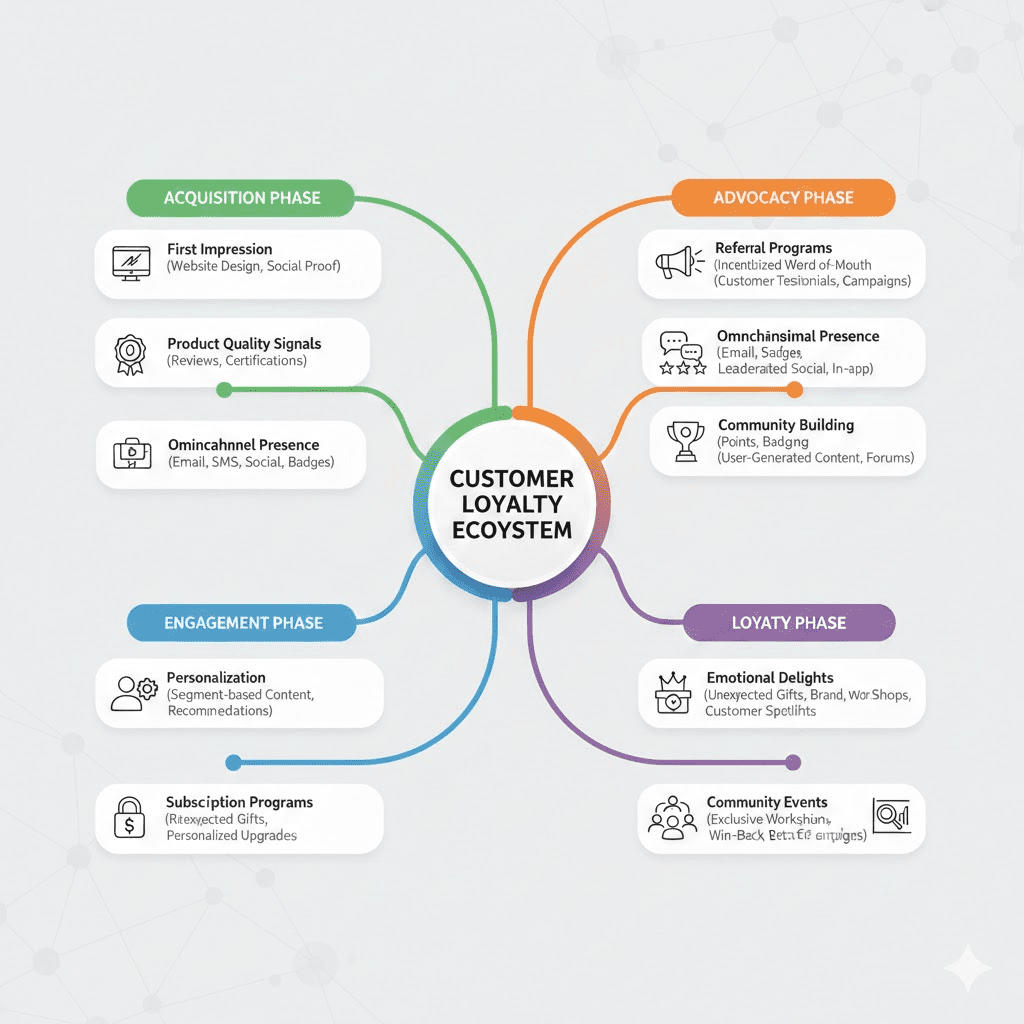
Mind Map: The Customer Loyalty Ecosystem in 2025
2026 Trending Insights: AI-Powered Personalization, Omnichannel Integration, and Predictive Analytics
The AI-Personalization Imperative
The data is unambiguous: 80% of consumers are more likely to buy from brands offering personalized experiences, yet only 15% of Shopify stores have implemented genuine AI-powered personalization. This represents a significant competitive advantage opportunity.
Key AI Implementation Pointers:
- Product recommendation engines (based on browsing history)
- Predictive churn analysis (identify at-risk customers)
- Personalized email send times (optimal per customer)
- Dynamic pricing based on customer segment
- Predictive inventory management (stock what customers want)
- Behavioral segmentation (5+ distinct customer groups)
- Lifetime value prediction (prioritize high-value customers)
- Next purchase prediction (know what they’ll buy)
Omnichannel Loyalty Integration
Customers expect consistent experiences across all touchpoints: your Shopify store, mobile app, email, SMS, social media, physical locations (if applicable), and customer service interactions. Omnichannel loyalty programs unify these experiences.
Omnichannel Implementation Pointers:
- Unified customer database (single source of truth)
- Consistent loyalty point system across all channels
- Integrated email, SMS, and push notification strategies
- Social media seamless purchase/reward integration
- Mobile app for exclusive mobile-only rewards
- Point accrual from any channel (purchases, referrals, reviews)
- Reward redemption flexibility (any channel)
- Cross-channel attribution tracking
Subscription-Based Loyalty Models (The New Standard)
Subscription programs create recurring decision points where you can personalize offers, introduce new products, and gather additional customer preference data.
Subscription Implementation Pointers:
- Monthly product boxes (curated surprises)
- Auto-replenishment for consumables
- Exclusive access programs (early launches)
- Tiered subscription levels (budget to premium)
- Flexible frequency customization
- Easy pause/skip options (reduce churn)
- Bonus points for subscription enrollment
- Exclusive subscriber community access
Gamification and Community-Driven Loyalty
Loyalty programs incorporating game mechanics (points, badges, leaderboards, challenges, unlockable achievements) see 30% higher engagement compared to traditional programs.
Gamification Implementation Pointers:
- Points system (earn per purchase, referral, review)
- Achievement badges (milestone-based)
- Leaderboards (monthly, seasonal competitions)
- Challenges with bonus point opportunities
- Progress bars (visual progress toward rewards)
- Unlockable tiers (work toward elite status)
- Streak rewards (consecutive daily visits, purchases)
- Social sharing bonuses (points for sharing achievements)
Conclusion: Building Lasting Customer Loyalty—A Personal Reflection
After working with 200+ Shopify store owners over the past four years, I’ve observed a consistent pattern: stores that succeed at customer loyalty aren’t the ones with the biggest marketing budgets or the trendiest products. They’re the ones genuinely committed to understanding customer needs, delivering exceptional experiences consistently, and viewing loyalty not as a marketing tactic but as a core business philosophy.
The Loyalty Transformation Story:
The most transformative moment I’ve witnessed came with a small-batch coffee roaster who implemented “surprise upgrades” on a modest 5% of orders. Within six months, customers were sharing unboxing videos on social media featuring the surprise items, essentially providing free brand marketing. More importantly, repeat purchase rate increased from 28% to 47%, and customer lifetime value doubled. This wasn’t from a flashy campaign—it was from systematically making customers feel valued.
The strategies outlined in this article—from exceptional customer service to data-driven personalization to AI-integrated loyalty programs—work because they address fundamental human needs: to be seen, valued, and treated as individuals rather than transactions.
In 2026, the competitive advantage belongs to brands that recognize this truth and embed it into every customer interaction. Your reputation and loyalty aren’t built through annual campaigns or quarterly promotions. They’re built through thousands of small moments where customers experience your brand living up to its values.