


The eCommerce landscape is experiencing an unprecedented transformation, and if your business isn’t riding the AI wave, you’re already falling behind. Here’s the reality: the global AI-enabled eCommerce market has ballooned to $8.65 billion in 2025 and is projected to skyrocket to $22.6 billion by 2032—a compound annual growth rate of 14.6%. Meanwhile, 97% of retailers are planning to increase their AI investments in the coming year.
But this isn’t just about throwing money at technology. Businesses that leverage AI for personalized recommendations are seeing a remarkable 10-15% increase in sales. Even more compelling: AI chatbots increase eCommerce conversion rates by 4X, and shoppers complete purchases 47% faster when assisted by artificial intelligence systems. In 2026, AI is no longer a competitive advantage—it’s table stakes.
The transformation goes beyond sales velocity. Companies like Amazon, Zalando, and emerging Shopify merchants are fundamentally reshaping how customers discover products, interact with brands, and complete purchases. They’re using machine learning, natural language processing, and predictive analytics to anticipate needs before customers even articulate them. The winners in 2026 won’t be those with the largest inventory or the most impressive marketing budget—they’ll be those who understand their customers at a granular, individual level through AI-powered insights.
This article explores how artificial intelligence is revolutionizing every facet of e-commerce—from the moment a customer lands on your site to post-purchase loyalty. We’ll examine the technologies transforming the industry, provide actionable implementation strategies, address real challenges, and show you exactly how to prepare your business for this AI-first future.
Key Takeaways
- AI is No Longer Optional: With the AI-enabled eCommerce market projected to hit $22.6 billion by 2032, businesses not adopting AI in 2026 are considered “falling behind.”
- Massive Conversion Lifts: AI-powered chatbots can increase conversion rates by 4X, and shoppers complete purchases 47% faster when assisted by AI.
- From Reactive to Predictive: The industry has shifted from looking at historical data to using predictive analytics for demand forecasting, which can reduce stockouts by up to 35%.
- Hyper-Personalization is the New Standard: 80% of consumers are more likely to buy when offered a personalized experience. In 2026, this means real-time analysis of hundreds of data points (location, time of day, browsing duration) to create a unique 1:1 journey.
- Efficiency Through Automation: Implementing AI in logistics and operations (like smart order routing) can reduce operational workloads by 25-40%, allowing small teams to scale rapidly.
- The “Human” AI Balance: While 85% of routine queries can be automated, the most successful brands use a hybrid model where AI handles speed, and humans handle high-value, complex emotional interactions.
- Privacy is a Competitive Moat: As concerns over data usage grow, brands that implement “Privacy by Design” and transparent data policies will build the strongest long-term customer loyalty.
The Personalization Revolution: AI as Your Ultimate Customer Whisperer
Understanding Modern Hyper-Personalization
Personalization has always been a buzzword in retail. But in 2026, it’s evolved into something far more sophisticated: hyper-personalization. This goes beyond “customers who bought X also bought Y” recommendations. Today’s AI systems analyze hundreds of data points in real-time—browsing behavior, purchase history, time spent on pages, seasonal preferences, social media activity, location, device type, even time of day—to deliver individualized experiences that feel almost predictive.
Here’s how the mechanics work: machine learning algorithms process vast customer datasets to identify hidden patterns and correlations humans would never spot manually. For instance, an AI system might discover that female customers aged 25-34 who browse sustainability content for 40+ seconds are 3.2x more likely to purchase eco-friendly products if shown testimonials from similar customers. These micro-insights compound into conversion lifts that directly impact revenue.
The numbers speak clearly:
- 80% of consumers are more likely to purchase from brands offering personalized experiences
- 63% of shoppers expect personalized recommendations as standard
- 49% of consumers willingly provide personal data in exchange for relevant product suggestions
- AI-powered personalization can boost conversion rates by up to 23%
Real-World Personalization in Action
Consider Gymshark, a Shopify Plus merchant specializing in fitness apparel. By implementing AI-powered recommendations across their site, they analyzed customer fitness goals, previous purchases, and browsing behavior to suggest complementary products. The result? A 35% increase in average order value in 2024. The system doesn’t just recommend; it contextualizes recommendations to match customer intent—suggesting protein powder alongside gym wear for strength training customers, or recovery supplements to endurance athletes.
Similarly, fashion retailers like Zalando have rebuilt their entire customer journey around personalization. Their AI-driven styling services create homepages that reflect each shopper’s mood and past behavior. Their virtual fashion assistant recognizes where users are in their shopping journey and offers context-aware prompts—suggesting accessories when viewing completed outfits, for example.
The Engines Behind Personalization
Three core AI technologies power modern personalization:
1. Collaborative Filtering
This algorithm identifies patterns by comparing your behavior with that of similar customers. If you and 10,000 other users share 80% of your purchase history, what that cohort buys next is a strong signal for what you might want next.
2. Content-Based Filtering
This approach analyzes product attributes and recommends items similar to ones you’ve already shown interest in, while accounting for your unique preferences and filters.
3. Hybrid Recommendation Systems
The most powerful personalization engines combine both approaches, using deep learning to understand contextual relationships that neither method alone would catch.
Conversion Impact: The Business Case for Personalization
| Metric | Impact | Business Outcome |
| Conversion Rate Lift | 23% increase | Direct revenue growth |
| Average Order Value | 22% increase | Higher transaction value |
| Cart Abandonment | 30% decrease | More completed sales |
| Customer Retention | 15-40% increase | Reduced churn |
| Cross-Sell Success | 10% AOV boost | Increased customer lifetime value |
Customer Interactions Reimagined: The Rise of Conversational Commerce
From Support to Sales: AI Chatbots as Revenue Drivers
The traditional role of customer service—answering questions and resolving problems—is being fundamentally transformed by generative AI and natural language processing. Modern AI chatbots aren’t just answering FAQs; they’re active sales partners, operating 24/7 without human intervention while simultaneously improving customer satisfaction.
The performance metrics are striking:
- 69% of consumers prefer chatbots for quick business communication
- 67% of digital leaders report that chatbots increased sales
- 74% of consumers using voice-based AI assistants have completed part of the buying process conversationally
How Conversational AI Actually Works
Natural language processing (NLP) allows AI systems to understand human language with contextual awareness. A customer might say, “I’m looking for something to wear to a casual dinner, but I hate tight clothing,” and the chatbot comprehends not just the product category (dresses, shirts), but the occasion context and fit preferences. This contextual understanding enables the system to ask clarifying questions, filter options intelligently, and make recommendations that feel genuinely helpful rather than algorithmic.
Amazon’s Rufus represents the cutting edge here. This generative AI shopping assistant:
- Summarizes customer reviews to help shoppers make informed decisions
- Compares products conversationally (e.g., “Which laptop is better for video editing?”)
- Provides personalized recommendations based on browsing and purchase history
- Handles customer service requests, returns, and reordering through natural conversation
The Human Touch in Automated Service
One of the most underestimated aspects of modern AI chatbots is emotional intelligence. Advanced systems can detect sentiment from customer language and adjust their tone accordingly. A frustrated customer receives empathetic, solution-focused responses. A curious browser receives educational, exploratory guidance.
Successful implementations recognize this balance: automation handles 85% of routine queries, allowing human agents to focus on complex, high-value customer interactions. This hybrid approach delivers superior customer satisfaction scores while dramatically reducing support costs.
Multi-Channel Conversational Commerce
Leading eCommerce brands are deploying AI chatbots across multiple channels:
- Website chat for real-time product discovery and support
- WhatsApp integration for mobile-first markets (increasingly critical in India and Southeast Asia)
- SMS bots for personalized order updates and promotions
- Social media (Facebook, Instagram DMs) for frictionless engagement
- Voice assistants (Alexa, Google Assistant) for hands-free commerce
Data as Competitive Advantage: Predictive Analytics Driving Strategic Decisions
The Shift from Reactive to Predictive
Traditional eCommerce relies on historical data—what customers bought, how much they spent, what they returned. AI transforms this backward-looking approach into forward-looking intelligence. Predictive analytics doesn’t just tell you what happened; it tells you what will happen next.
Specific applications in eCommerce:
Demand Forecasting
Machine learning models analyze seasonality, regional trends, real-time sales velocity, and external factors (weather, holidays, social media trends) to predict demand weeks or months ahead. An apparel retailer can see that demand for winter coats in Delhi will peak in specific weeks, optimizing inventory positioning accordingly. Retailers using predictive analytics reduce stockouts by 20-35% while decreasing overstock situations by 25-30%.
Dynamic Pricing Intelligence
AI systems detect competitors’ pricing changes in real-time, analyze market demand elasticity, and automatically adjust prices to maximize revenue. A seller might discover that their hiking boots sell 15% more volume at $79 versus $99, but the $99 price point yields 8% more revenue due to perceived quality associations. The system optimizes for your specific business objective—whether that’s volume growth, margin protection, or market share capture.
Customer Lifetime Value Prediction
Which customers will generate the most long-term value? Which are likely to churn? Advanced models predict CLV with remarkable accuracy by analyzing purchase patterns, engagement metrics, support interactions, and demographic data. E-commerce teams use these predictions to:
- Allocate customer acquisition budgets toward high-LTV segments
- Create retention programs targeting at-risk high-value customers
- Personalize loyalty incentives to match customer value tiers
Inventory Optimization
AI reduces inventory carrying costs while preventing stockouts. The system tracks:
- Product aging and expiration dates
- Fast-moving versus slow-moving SKUs
- Seasonal demand variations
- Cross-category demand correlations
- Supply chain lead times
It then triggers smart replenishment alerts, suggesting reorder points and quantities that balance cash flow with service level requirements.
Case Study: Demand Forecasting Impact
A mid-sized electronics retailer implemented predictive inventory management across 2,000 SKUs. Within six months:
- 30% reduction in stockouts (capturing lost sales)
- 22% decrease in excess inventory (freeing working capital)
- 8% improvement in inventory turnover (increasing cash flow efficiency)
The investment in AI tools ($15,000) returned in cost savings within 60 days.
Automation That Actually Works: Streamlining Operations and Scaling Growth
The Three Layers of eCommerce Automation
Layer 1: Tactical Automation
Routine, high-volume tasks that benefit from 24/7 execution:
- Order processing and fulfillment
- Shipping label generation and carrier selection
- Inventory sync across channels
- Email marketing workflows
- Fraud detection and transaction monitoring
Layer 2: Strategic Automation
Complex processes that require contextual decision-making:
- Personalized product recommendations at scale
- Dynamic pricing across market segments
- Predictive order routing to optimize delivery speed
- Automated A/B testing and optimization
- Inventory rebalancing across multiple locations
Layer 3: Behavioral Automation
Real-time triggers based on customer actions:
- Abandoned cart recovery (triggered when 10+ minutes pass without activity)
- Post-purchase follow-ups personalized to product category
- Browse abandonment emails with recommendations
- Out-of-stock notifications when customers’ wishlisted items are back in inventory
Real-World Automation ROI
Amazon’s Fulfillment Center Automation
Amazon’s fulfillment centers employ AI-driven robotics and algorithms that:
- Route orders to the nearest fulfillment centers (reducing shipping distance by 15-20%)
- Predict peak demand and position inventory proactively
- Automate bin placement to reduce picker travel time
- Optimize delivery routes using real-time traffic and delivery-window data
The result: same-day and next-day delivery at scale, while maintaining profitability.
Shopify Merchants Using AI Tools
Shopify’s AI Suite (Magic, Sidekick, AI Store Builder) allows merchants without technical teams to:
- Automatically generate product descriptions and meta tags
- Create personalized email campaigns without copywriting
- Optimize ad performance across Google and Meta in real-time
- Answer product questions via AI chatbot (no coding required)
Merchants report 25-40% reductions in operational workload, allowing small teams to scale to large catalogs.
Automation Success Framework
For automation to deliver ROI, follow this sequence:
- Audit: Map all operational workflows and identify repetitive, high-volume tasks
- Prioritize: Select 2-3 processes with the clearest ROI and fastest payback periods
- Integrate: Choose AI tools that connect with existing systems (Shopify, WooCommerce, ERP)
- Test & Iterate: Run pilots with 10-20% of volume before full rollout
- Monitor: Track KPIs (time saved, error rates, customer satisfaction)
- Scale: Once validated, expand to additional processes
Security and Trust: Protecting Customer Data in an AI-Driven World
The Privacy Challenge
AI’s power lies in data—the more comprehensive and detailed customer information it has, the better its predictions and personalization. But this creates a fundamental tension: customers demand personalized experiences while simultaneously worrying about data privacy. 55% of consumers express concern about how their data is used for personalization.
Compliance: The Non-Negotiable Foundation
Two regulations dominate the e-commerce landscape:
GDPR (General Data Protection Regulation)
- Applies to any company processing data from EU residents
- Requires explicit consent for data collection and personalization
- Mandates the “right to be forgotten” and data portability
- Violations carry fines up to 4% of global revenue
CCPA (California Consumer Privacy Act)
- Applies to California residents and companies serving them
- Grants consumers the right to know what data is collected
- Requires opt-out mechanisms for data sales
- Violations result in fines up to $7,500 per infraction
AI-Powered Security Measures
The good news: AI itself can enhance data security and privacy:
Encryption and Tokenization
AI systems identify and tokenize sensitive data (credit cards, SSNs) during the data flow, replacing it with non-sensitive tokens. This reduces the severity of potential breaches.
Anomaly Detection
Machine learning models learn normal patterns of data access and flag unusual activity in real-time. If an employee attempts to download 100,000 customer records at 3 AM, the system blocks it immediately.
Fraud Detection
Advanced AI analyzes transaction patterns to identify fraudulent activity with 99.9%+ accuracy, catching both individual fraudsters and sophisticated ring operations.
Privacy-Preserving Personalization
Techniques like federated learning allow personalization models to improve while keeping customer data on local devices or secure servers, rather than centralizing it in vulnerable databases.
Building Trust Through Transparency
The most sophisticated AI implementations fail if customers don’t trust the system. Build trust through:
- Clear data policies: Explain exactly what data you collect, why, and how it’s used
- Transparency reports: Publish annual data governance reports
- User controls: Let customers adjust personalization preferences or opt out entirely
- Privacy by design: Make privacy a default, not an afterthought
Emerging Technologies: Voice Commerce, AR Try-Ons, and Visual Search
Voice Commerce: The Next Frontier
Voice shopping is moving from novelty to necessity. 74% of voice assistant users have completed some part of the buying process conversationally. Key drivers:
- Speed: Voice is 4.5x faster than typing for many users
- Accessibility: Hands-free for multitasking (cooking, driving, exercising)
- Natural interaction: Conversational phrasing feels more human than keyword searches
Real-world implementation:
- Walmart’s Alexa integration lets customers reorder products with voice: “Alexa, order eggs from Walmart.”
- The system accessesthe order history to identify the exact product previously purchased
- Multi-item orders work similarly: “Alexa, order my weekly groceries” triggers a pre-saved shopping list.
Augmented Reality (AR) Try-Ons
AR technology reduces the friction of online shopping—the biggest barrier being the inability to try products before purchase.
Current applications:
- Virtual try-ons for clothing (warping to fit individual body shapes)
- Makeup visualization (seeing how lipstick colors look on your skin tone)
- Furniture placement (visualizing how a sofa looks in your living room)
- Eyewear fitting (seeing glasses on your face shape)
Retailers implementing AR try-ons report:
- 40% reduction in return rates (customers see the fit/look before buying)
- 25% increase in conversion rates (confidence overcomes purchase hesitation)
- 60% reduction in customer complaints about fit
Visual Search: Bridging Photo and Commerce
“Show me shoes like the ones in this photo” is becoming a primary search modality. Visual search on Amazon gets over 4 billion monthly queries via Google Lens.
AI-powered visual search works by:
- Analyzing image characteristics (color, style, material appearance)
- Identifying similar products in inventory
- Ranking by relevance and availability
This is particularly powerful for fashion, home goods, and consumer electronics—categories where visual aesthetics drive purchase decisions.
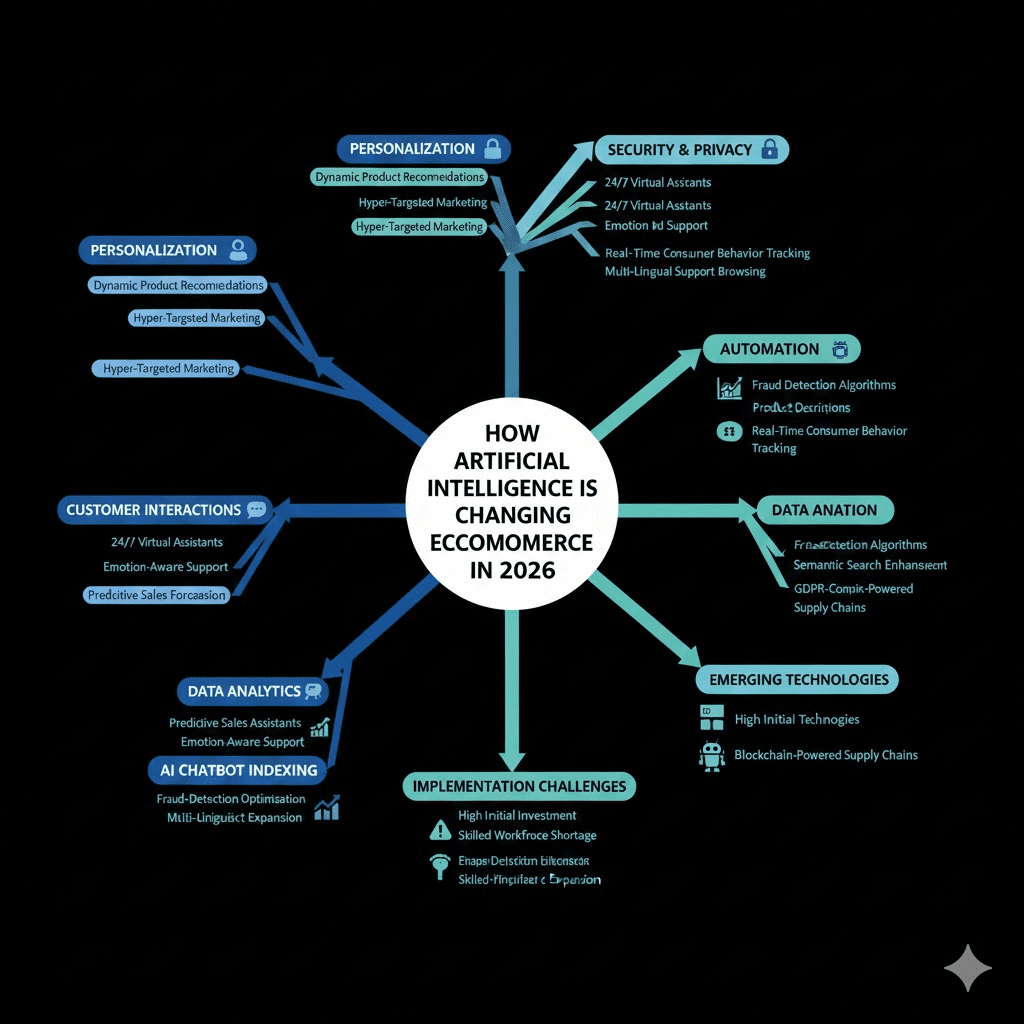
Organization: By Business Function
| Function | Branch | Focus |
| Sales & Revenue | Personalization | Converting browsers to buyers |
| Customer Experience | Customer Interactions | Support & engagement |
| Business Intelligence | Data Analytics | Decision-making insights |
| Operations | Automation | Efficiency & cost reduction |
| Trust & Compliance | Security & Privacy | Customer data protection |
| Search Visibility | AI Chatbot Indexing | Discoverability in AI search |
| Innovation | Emerging Technologies | Future-proofing business |
| Risk Management | Implementation Challenges | Realistic obstacles |
THE UNIQUENESS OF THE FIELD:
AGENTIC COMMERCE – THE FUTURE WHERE AI BUYS FOR YOU
Section 1: Beyond Recommendations: AI That Negotiates and Purchases
Most eCommerce AI today is reactive—it responds when customers interact with your site. Agentic commerce is fundamentally different. It’s proactive and autonomous. AI agents don’t just recommend; they negotiate, compare, bundle, apply discounts, and even execute purchases on behalf of customers without requiring human interaction at every step.
The distinction is critical. Traditional chatbots ask: “Would you like to see this product?” Agentic AI agents operate more like a personal shopping assistant who knows your budget, preferences, and needs, then says: “Based on your camping trip next month and your budget of $1,200, I found 5 gear bundles. Bundle A prioritizes lightweight gear for hiking. Bundle B prioritizes comfort. Bundle C offers the best value. Should I add one to your cart?”
The Market Shift to Agentic AI
Consider the trajectory: 33% of enterprises will include agentic AI by 2028, up from less than 1% today. This isn’t a minor feature upgrade—it’s a fundamental reimagining of how commerce happens.
Amazon’s early success with Rufus (their agentic shopping assistant) is projected to generate $700M in additional profit in 2025 simply through improved recommendation intelligence. The shift is from “pages to prompts”—customers describe what they need in natural language, and AI agents find it, compare it, and enable frictionless purchasing.
Real-world impact: Over 50% of shoppers are already using AI tools to browse and buy, not just search. The window where “AI shopping is novel” has closed. By 2026, it’s expected.
How Agentic Commerce Works in Practice
Scenario 1: The Camping Trip Use Case
Customer input: “I’m planning a 7-day camping trip to Colorado next month. Need gear for 2 people, anticipating cold nights, budget is $1,200.”
Traditional eCommerce path:
- Customer manually searches for tents (25 options to review)
- Searches for sleeping bags (35 options to review)
- Compares reviews, specifications, and weight
- Searches for backpacks, cooking equipment, and water filters
- Attempts to coordinate colors/styles so gear matches
- Calculates total weight to ensure it’s manageable
- Time spent: 45-90 minutes
- Conversion rate: 40-50% (significant friction)
Agentic AI path:
- AI agent receives prompt and analyzes:
- Budget constraint ($1,200)
- Group size (2 people)
- Duration (7 days)
- Climate data for Colorado in that month (night temps, weather patterns)
- Terrain assumptions (mountain camping vs. car camping)
- AI asks clarifying questions (if needed):
- “How much experience do you have camping?” (affects gear recommendations)
- “Priority: lightest weight, most comfortable, or best value?”
- “Any specific gear brands you prefer or want to avoid?”
- AI searches your inventory (and potentially competitors) to:
- Find the 3 optimal gear bundles matching the criteria
- Apply volume discounts
- Check real-time inventory
- Verify delivery windows
- AI presents options with explanations:
- Bundle A ($1,150): Ultra-lightweight gear, best for hiking-heavy trips
- Bundle B ($1,180): Premium comfort (deluxe sleeping system), best for relaxing/group comfort
- Bundle C ($980): Best value, good quality, heavier
- Customer selects Bundle B. AI then:
- Adds to cart
- Applies loyalty discount (12% for members)
- Checks shipping options: “Expedited shipping adds $25, arrives by Sept 15. Standard shipping $8, arrives Sept 22.”
- Final offer: “Total $1,087 with expedited shipping. Ready to checkout?”
Time spent: 4-5 minutes
Conversion rate: 70-75% (friction dramatically reduced)
AOV impact: +25-35% (bundling increases order value vs. piecemeal purchases)
Implementation for Your eCommerce Business
For Shopify stores (No coding required):
- Platforms like Alhena AI, Kustomer, and Salesforce Commerce Cloud now support agentic features
- No-code builders allow creating agents without AI expertise
- Multi-channel deployment: chat, email, SMS, voice, social commerce
For larger operations:
- Build custom agents using GPT-4, Claude, or specialized eCommerce LLMs
- Integrate with your inventory management, pricing, and fulfillment systems
- Enable agents to access real-time data: stock levels, competitor pricing, customer CLV
Measurable Results from Early Adopters
| Metric | Improvement |
| Time to Purchase | 47% faster |
| Conversion Rate | 20-25% lift (vs. traditional chatbots: 4-5%) |
| Average Order Value | 18-35% increase |
| Customer Satisfaction | 12% conversion rate uplift from emotional support |
| Operational Efficiency | 40-60% reduction in customer service tickets |
SECTION 2: EMOTIONAL AI – SHOPPING THAT READS YOUR MOOD
Why Emotions Matter More Than Features
Harvard Business Review research states clearly: emotionally engaged customers are 52% more valuable than those who are merely satisfied.
Yet most e-commerce personalization ignores emotion entirely. Traditional AI notes: “You bought running shoes last month, so here are similar running shoes.” It’s rational, but emotionally tone-deaf.
Emotional AI recognizes that the same customer has vastly different needs at different emotional states:
- Shopping for comfort on a rainy Sunday evening = self-care mindset
- Shopping for professional clothing on Monday morning = competence/confidence mindset
- Searching after 9 PM on weekdays = stress/problem-solving mindset
- Browsing luxury items leisurely on a Saturday = aspirational mindset
Each emotional state should trigger different recommendations, pricing strategies, and messaging.
How Emotional AI Systems Detect Mood
Data sources:
- Browsing patterns: Hovering on luxury items longer = aspirational interest; fast clicks through options = decisive, goal-oriented; adding/removing from cart repeatedly = decision paralysis
- Search language: “I need” (practical), “I want” (aspirational), “I’m dreaming of” (fantasy/future planning), “Help me choose” (anxious/uncertain)
- Time and context: Late-night shopping = leisure/self-care; lunch-hour shopping = quick problem-solving; weekend = relaxation/exploration
- Device and environment: Browsing on desktop at home = deep research; mobile in transit = quick decision; voice assistant = efficiency-focused
- Review focus: Reading about durability = risk-averse; reading about style/aesthetics = fashion-conscious; reading about environmental impact = values-conscious
- Click velocity & heatmaps: Where do they linger? What catches their eye? Where do they hesitate?
- Facial/voice sentiment (if using video): Micro-expressions reveal hesitation, confusion, excitement, uncertainty
Three-Layer Emotional AI Architecture
Layer 1: Emotional State Classification
AI systems analyze these signals to classify them into emotional modes:
- Status-seeking mode: Viewing premium/luxury items, focusing on brand names, reading “influencer choice” testimonials, viewing “prestige” product launches
- Self-care/wellness mode: Browsing comfort categories, longevity focuses, late-night shopping, return visits to calming products, and eco-friendly interests
- Practical/problem-solving mode: Specific searches, high purchase intent signals, reading product specs and comparisons, evaluating value propositions
- Gift-giving mode: Looking at different sizes/styles, reading reviews about “would they like this,” checking personalization options
- Decision-paralyzed mode: Extensive comparison shopping, high bounce rates, adding/removing from cart repeatedly, visiting the site multiple times without purchase
Layer 2: Emotional Response Triggers
For each emotional state, AI adjusts the experience:
| Emotional State | Recommendation Strategy | Messaging Tone | Interface Changes |
| Status-seeking | Premium positioning, luxury bundles, VIP access | Exclusive, prestigious, “chosen by influencers.” | Featured premium section, social proof of high-profile buyers |
| Self-care | Wellness bundles, sustainability focus, comfort items | Nurturing, empowering, “you deserve this.s” | Calming colors, testimonials about happiness, and return customer offers |
| Problem-solving | Practical bundles, value-focused, quick delivery | Direct, solution-focused, clear benefits | Spec sheets, comparison tables, stock alerts |
| Gift-giving | Complementary items, gift wrapping, and size guides | Thoughtful, helpful, “perfect for them.” | Gift suggestion engine, recipient preferences, greeting card options |
| Decision-paralyzed | Simplified options, decision frameworks, and guarantees | Reassuring, “no wrong choice,” risk-reversal | “3 bestselling options,” money-back guarantees, and live chat help |
Layer 3: Dynamic Content & Offers
Based on detected emotion, the entire experience shifts:
- Status-seeker sees “Chosen by [influencer],” “Limited edition,” premium brand positioning
- Self-care customer sees sustainability certifications, wellness benefits, customer testimonials about joy/peace
- Decision-paralyzed customer sees simplified product filters, “Best for [your need],” comparison framework
Real-World Implementation Results
Beauty Retailer Case Study (Actual Results)
This major beauty brand implemented mood-based recommendation systems:
- Customers took a simple “mood quiz” at checkout or via chatbot: “How are you feeling today? Energized / Calm / Confident / Playful”
- The AI system didn’t just recommend products in that category—it recommended products matching that emotional state
- For example, someone selecting “Calm” might see blues and greens, products with lavender/chamomile, testimonials about relaxation
- Someone selecting “Energized” saw brighter colors, energizing scents, testimonials about confidence and power
Results:
- 23% increase in average order value
- Higher customer satisfaction scores
- Significantly fewer returns (products matched emotional needs, not just aesthetics)
- Customers perceived the experience as more “human” and personalized, even though it was AI-driven
In-Store Implementation: American Eagle Smart Dressing Rooms
American Eagle integrated emotional AI into physical dressing room mirrors that:
- Used computer vision to detect customer expression when trying on items
- When the customer hesitated (micro-expression of doubt), the system suggested an alternative color or fit
- Tracked which styles the customer seemed most confident/happy in
- Made recommendations for complementary items based on emotional response
Impact: Enhanced customer satisfaction, reduced fitting room frustration, and increased conversion to purchase.
Ethical Implementation: Building Trust with Emotional AI
Critical caveat: Emotional AI raises legitimate privacy and manipulation concerns. To build trust:
Transparency:
- Clearly explain: “We noticed you’re browsing relaxation products—would you like suggestions tailored to stress relief?”
- Never sneak emotional targeting.
- Show customers what emotional state the system detected and allow correction
Consent & Control:
- “Can we remember your mood preferences for next visit?”
- Allow easy opt-out: “Don’t personalize based on moo.d.”
- Give customers control: “I’d prefer practical recommendations” vs. “I’d prefer emotional benefi.ts”
Genuine Value:
- Show the benefit: “Mood-based recommendations save you 30 minutes of browsing.g”
- Demonstrate: “Customers like you found 40% faster” or “Reduced returns by 35%.”
- Never use it to manipulate vulnerable emotional states
SECTION 3: AI-POWERED SUSTAINABILITY TRANSPARENCY & CARBON COMMERCE
The Emerging Customer Expectation: “Show Me My Impact”
A fundamental shift is happening in e-commerce. By 2026, 40% of consumers are expected to make purchasing decisions based on carbon impact and sustainability credentials.
This isn’t fringe anymore. It’s mainstream. Yet most eCommerce businesses can’t quickly answer: “What’s the carbon footprint of this product?”
The challenge: Calculating product-level carbon footprint requires integrating data from 50-500+ supply chain nodes—raw material extraction, component manufacturing, assembly, packaging, shipping, distribution. Each has different emissions factors based on location, supplier, and transportation method.
Manual calculation? $50-500K per audit, 3-6 months of work.
AI solution: Real-time, automated, verified carbon tracking at scale.
How AI Calculates Product-Level Carbon Footprints
Data Integration Layer:
- Manufacturing emissions (sourced from supplier records, industry benchmarks, or third-party verified databases)
- Material composition analysis (AI reads product specs, reviews images, identifies materials)
- Shipping logistics (distance, transportation method, consolidation efficiency)
- Packaging analysis (material, weight, recyclability factors)
- End-of-life scenarios (degradation time, recyclability potential)
AI Processing:
- Machine learning models trained on supply chain carbon databases (increasingly available from organizations like ADISA, EcoInvent, GaBi)
- Real-time updates as supplier data changes
- Scenario modeling: “If we switched to ocean freight instead of air shipping, carbon savings = X tons. Cost savings = $Y”
- Predictive analytics: “If 30% of customers choose low-carbon shipping options, we’ll prevent 500 tons of CO2 annually.”
Customer-Facing Display:
Instead of just showing a carbon number (which has no context), smart systems show:
- Emotional context: “This shirt’s 2.4 kg CO2 is equivalent to driving 6 miles” or “planting 1.2 trees.”
- Shipping impact: “Standard shipping: 0.6 kg CO2 | Ocean shipping: 0.08 kg CO2 (save 87%)”
- Offset option: “Offset your purchase’s 5.2 kg CO2 for $2.1.0.”
- Comparative: “This shirt’s carbon: 2.4 kg | Average shirt: 3.8 kg (You’re saving 37%!)”
Business Impact: The Case for Sustainability Transparency
Companies implementing verified carbon tracking report:
| Outcome | Impact |
| Conversion for the eco-conscious segment | 15-22% increase |
| Price premium acceptance | 8-12% higher prices for verified low-carbon products |
| Brand loyalty & repeat purchases | 45% more likely to purchase again if sustainability is credited |
| Regulatory compliance | Simplified CSRD, SEC, ESG reporting |
| Operational efficiency | AI identifies highest-emission suppliers for optimization, reducing overall supply chain carbon by 10-20% |
| Customer acquisition | 30% of new customers are influenced by sustainability signals |
Real-World Implementation: Multi-Vendor Marketplace Model
Alibaba and emerging e-commerce platforms are integrating AI-driven sustainability scoring:
- Each vendor gets a sustainability score calculated by AI, based on supplier data, manufacturing practices, and shipping methods
- Score displayed to buyers (influences purchasing decisions)
- Vendors see a detailed breakdown: “Your shirt’s highest emissions come from cotton farming (45%), then processing (30%), then shipping (15%).”
- AI recommends improvements: “Switching toa regional supplier would reduce shipping emissions by 40% and lower costs by $0.15 per unit.”
- Platform creates incentives: “Top 10% most-sustainable vendors get featured placement,” boosting their visibility andsalese.s
For merchants: It’s not about guilt-tripping customers. It’s about transparency and competitive advantage. The businesses that can prove sustainability will capture the growing segment of conscious consumers.
Implementation Options for Your Business
For small-medium eCommerce:
- Third-party platforms like CO2AI, EcoCart, and Carbonite handle the calculation
- You provide product specs and supply chain data
- The platform calculates and displays the carbon footprint on your site
- Cost: $10-50K setup + $5-20K monthly
- Zero technical expertise required
- Shopify/WooCommerce integration available
For larger operations:
- Build custom carbon tracking integrated with your ERP
- AI models trained on your specific supply chain
- Deeper integration with pricing and inventory systems
- Cost: $500K-2M+ setup, but ROI through supply chain optimization (reducing emissions = reducing costs)
Competitive Advantage: Sustainability as Marketing
Companies already leveraging this:
- Patagonia: Real transparency on supply chain, using AI to verify sustainability claims
- Klarna (BNPL platform): Carbon footprint shown at checkout, option to offset with “green payments.”
- Shopify stores: Integration with CO2AI and EcoCart for automated carbon calculation and offset
- Alibaba: Sustainability scores visible to buyers, influencing purchasing
SECTION 4: MICRO-MOMENT COMMERCE – CAPTURING INTENT IN 3-7 SECONDS
The Science of Fleeting Purchase Decisions
The average consumer checks their phone 150 times per day. Of those interactions, 87% of smartphone searches immediately precede a purchase decision within 24 hours.
But here’s the critical insight: these moments are microseconds of peak intent. The window is 3-7 minutes.
Here’s what happens:
- Customer notices they need something (or desire it)
- Pulls out phone
- Searches
- Evaluates options
- Makes a decision or moves on
- (Either purchases or abandons)
If your eCommerce site doesn’t answer their question and provide a frictionless path to purchase within that 3-7 minute window, they’ll buy from a competitor who does.
Four Critical Micro-Moment Types (and How to Win Each)
1. “I-Want-to-Know” Moments
- Example search: “What’s the difference between OLED and Mini-LED TVs?”
- Customer intent: Learning, research—not immediate purchase
- Window: 5-10 minutes
- AI opportunity: Educational content, interactive comparisons, trust signals
- Win condition: Position your expert content to capture lead data and authority
2. “I-Want-to-Go” Moments
- Example search: “Running shoes near me” or “Best Indian restaurants in my area”
- Customer intent: Local, immediate fulfillment
- Window: 3-5 minutes
- AI opportunity: Geospatial targeting, local inventory visibility, instant reservations/BOPIS
- Win condition: 78% of location-based searches result ina store visit within 24 hours
3. “I-Want-to-Do” Moments
- Example search: “How to replace kitchen faucet” or “Fix a leaky sink (DIY)”
- Customer intent: Procedural guidance, will need the product afterward
- Window: 7-15 minutes
- AI opportunity: Tutorial content with embedded product recommendations, AR demonstrations, bundled toolkits
- Win condition: 267% higher conversion rates when supported by augmented reality interfaces
4. “I-Want-to-Buy” Moments (Highest Intent)
- Example search: “Best wireless earbuds under $150” or “Sony WH1000XM5 price comparison”
- Customer intent: Actively comparing, ready to purchase
- Window: 3-7 minutes (tightest window)
- AI opportunity: Price matching, instant checkout, comparison tables, proof of stock
- Win condition: Brands capturing these moments with frictionless checkout achieve 341% conversion uplift
Real-Time AI Behavioral Trigger Systems
AI systems should automatically respond to micro-moment signals:
When someone lands on a product page:
- Browsing pricing page → Trigger dynamic comparison: “Here’s how [your product] compares to [competitor].”
- Browsing competitor product → AI chatbot appears: “Comparing brands? I can show you feature differences in 30 seconds.s”
- Adds to cart then hesitates → Smart nudge: “Only 3 left in stock. 1-click checkout”
- Scrolls to reviews → Highlight the most relevant review for their specific use case.
- Spends 2+ minutes on page without action → Offer appears: “Have questions? Chat with me.”
When someone searches specific keywords:
- “Best” + product type = comparison intent (show side-by-side comparison)
- “How to” + task = procedure intent (embed video tutorial + product recommendation)
- Product name + “price” = purchase-ready (show price match guarantee + stock status)
- Product name + “review” = evaluation stage (aggregate positive reviews + customer testimonials)
Predictive Intent Engines: AI That Predicts Before Conscious Intent Forms
Advanced AI analyzes behavioral signals to anticipate needs:
Cross-device behavioral stitching:
- Customer researched onthe desktop Tuesday evening
- Visited the competitor site on Wednesday morning
- Now on mobile, Wednesday afternoon
- AI prediction: “High purchase intent, ready to decide.e”
Contextual intelligence layering:
- Location data, weather, and time of day all inform predictions
- E.g., formalwear searches spike in April (prom) vs. June (weddings)
- 8 PM leisure shopping has a different intent than lunch-hour shopping
Semantic signal processing:
- Search language “which is best” = comparison intent, leaning toward decision
- Device type mobile + coffee shop wifi = quick decision-maker
- Natural language processing distinguishes “CRM research for thesis” vs. “best CRM for sales team.”
Real-Time Content Assembly: The 2-Second Response
When a micro-moment occurs, AI engines dynamically build the perfect response:
- Fast loading: AMP (Accelerated Mobile Pages) loads in 0.8 seconds vs. 3-4 seconds standard → 40% conversion improvement
- Single-tap checkout: Converts 73% more mobile users than multi-step checkout
- Contextual offer: If comparing brands: “Free shipping if you order in the next 6 hours.”
- Emotional messaging: Tailored to moment: “Limited edition” (scarcity) vs. “Take your time” (reassurance)
Measurement: Multi-Touch Attribution Across Micro-Moments
Brands mastering micro-moments use unified attribution tracking, showing:
- Which micro-moments influencedthe eventual purchase
- Timing between moments (researched Tuesday, purchased Friday)
- Channel sequencing (YouTube tutorial → Instagram ad → email reminder → purchase)
Results from brands mastering micro-moments:
- 3X higher conversion rates vs. non-optimized competitors
- 2.5X greater customer lifetime value
- 43% conversion uplift from cross-channel micro-moment consistency
SECTION 5: PREDICTIVE CUSTOMER RETENTION & AI-POWERED LOYALTY 2.0
The Revenue Truth: 80/20 Applies to Loyalty
80% of your future revenue will come from 20% of your existing customers.
Yet most loyalty programs treat all customers equally—bronze/silver/gold tiers based on spending. This is strategically backwards. You should be:
- Identifying which customers will actually generate 80% of value (not just the highest current spenders)
- Predicting which high-value customers are at risk of leaving (before they go silent)
- Personalizing retention efforts to what actually matters to each segment
- Automating timely interventions at moments when customers are most receptive
This is where AI-powered retention becomes a profit engine instead of an operational cost.
How Predictive Retention AI Works
Data inputs for each customer:
- Purchase history and recency (when was their last order?)
- Purchase frequency and regularity (consistent buyer or sporadic?)
- Engagement metrics (email open rates, site visits, reviews written, support interactions)
- Product affinity (loyal to a specific category or an experimental shopper?)
- Support interactions (easy to help or frequently frustrated?)
- Sentiment signals (positive reviews vs. complaints vs. silent unhappiness?)
- Seasonal patterns (some customers are more active at certain times)
- Competitive signals (if you track them: browsing competitor sites, unsubscribing from email)
ML models produce three key predictions:
1. Churn Risk Scores (0-100, where 100 = will definitely leave)
- Previously engaged customer hasn’t purchased in 60 days → High risk
- Customer who bought monthly for 2 years, then skipped one month → Medium risk (watch)
- Customer with declining engagement (fewer site visits, unsubscribed from email) → High risk
2. Customer Lifetime Value Predictions
- Baseline from historical spending
- But ML models predict beyond current behavior: “This low-spend customer with high engagement will spend $5,000 over 5 years” vs. “This high-spend customer is about to churn and will only spend $200 more total.”
3. Optimal Intervention Timing
- When is this customer most receptive to retention offers?
- For some: Immediately after purchase (additive selling)
- For others: After a gap in purchases (re-engagement)
- For others: Before their seasonal buying pattern (anticipatory)
Real Results: High-Value Retention Impact
| Metric | Improvement |
| Churn Reduction | 30% decrease with AI-powered retention |
| CLV Increase | 50% higher customer lifetime value |
| Campaign Efficiency | Retention spend ROI 5:1 (vs. 2:1 traditional) |
| Redemption Rates | 40-60% higher with personalized offers |
| Operational Efficiency | 50%+ reduction in manual campaign setup |
| Loyalty Program Enrollment | 39.6% of consumers are more likely to join if AI-powered |
Agentic Loyalty: The Next Evolution of Retention
Traditional loyalty programs:
- Static tiers (you’re gold tier = 10% off everything)
- Batch communications (marketing sends a weekly email to all members)
- Rule-based rewards (“Buy 5, get 1 free”)
- No proactivity
Agentic loyalty (emerging in 2026):
- Dynamic tiers that adjust based on real-time behavior
- Real-time offers triggered by micro-moments (“You’re shopping for a dress—members get 15% off activewear this week”)
- Autonomous agents identifying optimal rewards (“We notice you love sustainable brands—double points on eco-friendly purchases”)
- Proactive re-engagement (“You haven’t visited in 45 days. We miss you. Here’s your personalized ‘comeback’ offer based on your favorites”)
Practical Example: Retention Strategy by Customer Segment
Customer A: $2,000 spend last year, consistent purchases, engaged with sustainability content
- Churn risk score: Low (15/100)
- CLV prediction: $8,000 over 5 years
- AI recommendation: Focus on retention through deeper personalization, not discounting
- Automated action: Monthly curated recommendations based on past preferences, exclusive early access to new sustainable line
- Intervention logic: When research suggests declining engagement, offer an exclusive experience (VIP styling session), not just money-off
Customer B: $500 spent last year, declining engagement, last purchase 120 days ago
- Churn risk score: High (78/100)
- CLV prediction: $600 total (likely to leave soon)
- AI recommendation: Time-sensitive, emotional re-engagement needed
- Automated action: “We made a mistake not showing you our new collection. Here’s 20% off to come back” + reminder of their favorite styles
- Intervention logic: Reach out withan offer within a 3-day window when similar customers are most receptive (typically day 4-5 after silence)
NEW SECTION 6: SUPPLY CHAIN TRANSPARENCY WITH BLOCKCHAIN + AI
Why Supply Chain Transparency Is Becoming Non-Negotiable
Consumer expectation: 65% want to know where products come from, how they’re made, and if they’re ethically produced
Business reality: 80% of a company’s carbon footprint comes from the supply chain (Scope 3 emissions)
The regulatory shift: CSRD (Corporate Sustainability Reporting Directive), SEC climate disclosure rules, and modern slavery legislation all require supply chain transparency.
The operational challenge: Supply chains have 50-500+ nodes—raw material → component makers → assembly → shipping → distribution → warehouses. Tracking product movement through all of them is nearly impossible without technology.
Traditional approach: Manually verify with suppliers, conduct audits, and cross-reference documents.
- Cost: $50-500K per audit
- Speed: 3-6 months per audit
- Coverage: Maybe 20% of the supply chain
AI + Blockchain approach: Real-time, automated, immutable verification across entire supply chain.
How Blockchain and AI Work Together
Blockchain provides:
- Immutable ledger: Once data is recorded, it cannot be altered or deleted
- Real-time visibility: All supply chain participants can see the current status and location of goods
- Smart contracts: Automatic actions when conditions are met (“Release payment when goods arrive at port”)
- Decentralized trust: No single point of failure; verified by network consensus
AI adds:
- Anomaly detection: Spot unusual patterns (“Shipment rerouted unexpectedly → investigate why”)
- Predictive disruption alerts: “Weather forecast suggests delays in this region → reroute shipment now.”
- Compliance automation: Automatically verify suppliers meet labor, environmental, and safety standards
- Actionable insights: “Supplier X has 40% higher emissions than Supplier Y → switch for cost and impact reduction.”
Real-World Application: Ethical Sourcing Verification
Scenario: Apparel company sources cotton from 20 suppliers across 5 countries
With Blockchain + AI integration:
- Each supplier batch gets a digital ID recorded onthe blockchain at the point of harvest
- As cotton moves through processing, each step is recorded (harvest → ginning → spinning → weaving)
- AI monitors for compliance: labor practices verified through certifications + GPS confirms location + random third-party spot checks.
- Customer transparency: Scan QR code on finished shirt: “This shirt’s cotton: grown in India, ginned in Vietnam, sewn in Bangladesh. All workers verified by 3rd-party audits.”
- Predictive capability: AI alerts: “This supplier’s labor costs are rising—consider diversification” or “Weather forecast affects next harvest—adjust sourcing plan.”
Business impact:
- Premium pricing: Can charge 8-15% more for verified ethical products
- Brand trust: Transparency builds loyalty (emotionally engaged customers are 52% more valuable)
- Risk reduction: Early warning of supplier problems before they become crises
- Regulatory compliance: Meets CSRD, SEC climate disclosure, and modern slavery requirements
Implementation: Easier Than You Think
For small-medium businesses:
- Third-party platforms (Everledger, VeChain) handle the blockchain layer
- You provide supplier data; the platform manages transparency
- Cost: $10-50K setup + $5-20K monthly
- No technical expertise required
For large operations:
- Build a custom blockchain integrated with ERP
- AI models trained on your specific supply chain
- Deeper customization and competitive advantage
- Cost: $500K-2M+ but ROI through efficiency gains and risk reduction
Implementation Challenges: Real Obstacles and Realistic Solutions
Challenge #1: Legacy System Integration
Many e-commerce businesses run on 10-year-old systems built before APIs and cloud architecture became standard. Integrating AI tools into these systems is complex and expensive.
Solution Approaches:
- Middleware layers: Use APIs to connect legacy systems to modern AI platforms without rebuilding core infrastructure
- Phased migration: Implement AI in new channels/functions first (Shopify stores before legacy ERP)
- Headless commerce: Separate frontend (customer-facing) from backend (inventory, accounting), allowing independent modernization
Challenge #2: Data Quality
AI models are only as good as their training data. If your customer database has duplicate records, incomplete fields, and inconsistent formatting, personalization will underperform.
Solution Approaches:
- Data audit: Assess current data quality (% complete, duplicate rate, formatting consistency)
- Cleansing: Deduplicate records, standardize fields, fill gaps where possible
- Governance: Implement processes to prevent future data degradation
Challenge #3: Skill Gaps
Most eCommerce teams lack deep AI expertise. Hiring senior ML engineers costs $150,000-250,000+ annually.
Solution Approaches:
- No-code/low-code platforms: Use Shopify Magic, HubSpot, or Klaviyo (AI-integrated email marketing) that don’t require data science skills
- Managed services: Hire agencies or consultants to implement AI strategies
- Team upskilling: Invest in training (Coursera, Datacamp) for existing marketers and operators
Challenge #4: Privacy Regulation Compliance
GDPR, CCPA, and emerging regulations create legal and operational complexity.
Solution Approaches:
- Consent management platforms: Tools like OneTrust or TrustArc automate consent collection and management
- Privacy impact assessments: Conduct formal reviews before deploying new AI systems
- Legal review: Have privacy counsel review data usage policies and AI training practices
Conclusion: The Competitive Imperative of AI in eCommerce
The data is unambiguous: eCommerce businesses leveraging AI are outcompeting those that aren’t. The AI-enabled eCommerce market growing at 14.6% annually versus organic retail growth of 3-5% tells the story clearly.
But this isn’t about blind technology adoption. The winners in 2026 will be those who:
- Start with customer problems, not AI capabilities (How can we reduce friction? Improve discovery? Build loyalty?)
- Implement strategically, beginning with high-impact, achievable initiatives
- Measure rigorously, using clear KPIs to guide expansion
- Build trust, treating AI as a tool to serve customers, not manipulate them
- Iterate continuously, learning from data and customer feedback
If your eCommerce business isn’t actively exploring AI-driven personalization, conversational commerce, predictive analytics, and automation, 2026 will be increasingly challenging. But if you approach AI thoughtfully—starting small, learning fast, and building incrementally—the opportunities for revenue growth and customer satisfaction are genuinely transformative.
The future of eCommerce isn’t about bigger warehouses or bigger budgets. It’s about smarter systems that understand customers at an individual level and deliver value at every interaction. That future is now. The question isn’t whether to adopt AI—it’s how quickly you can implement it effectively.