

The e-commerce landscape has fundamentally shifted. In 2026, 49.1% of Shopify stores still lack a loyalty program – representing a massive competitive advantage gap for merchants willing to implement one. While the industry obsesses over paid advertising and influencer partnerships, a far more profitable opportunity hides in plain sight: repeat customers account for 41% of revenue in established Shopify stores, and loyalty program members spend 164% more than non-members.
But here’s what separates winners from the rest: the loyalty programs winning in 2026 aren’t the outdated points-for-purchase models of yesterday. They’re AI-powered, emotionally intelligent systems that anticipate customer needs, reward behavioral engagement beyond transactions, and create communities rather than transactions. This shift represents a $3.8 billion market opportunity by 2030, up from $1.5 billion in 2024.
This comprehensive guide draws from 4+ years of Shopify implementation experience, analysis of 8 leading loyalty platforms, real-world retention data from 2025-2026, and insights from industry leaders like Currency Alliance, McKinsey, and Accenture. Every statistic cited here is backed by authoritative sources – no theoretical assumptions, no outdated benchmarks.
Whether you’re a D2C brand generating $50K in annual revenue or a Shopify Plus merchant processing millions, this guide provides the frameworks, tactical implementations, and data-driven decisions needed to build loyalty programs that actually retain customers and scale revenue. By the end, you’ll understand not just what to implement, but why it matters in the AI-driven, personalization-first economy of 2026.
EXECUTIVE SUMMARY
- 41% of established Shopify store revenue comes from repeat customers
- Only 49.1% of Shopify stores have loyalty programs (51% gap = opportunity)
- Loyalty program members spend 164% more than non-members.
- Loyalty program ROI: 12-18% incremental annual revenue growth
- 2026 shift: From transactional (points) to emotional (experiences) loyalty
- AI integration: 70% of customers want personalized offers; 82% would share data for better UX
- Getting indexed: Loyalty content now indexed by ChatGPT, Gemini, and Perplexity for AI-sourced answers.
WHAT IS A LOYALTY PROGRAM? ( Definition for 2026)
A loyalty program is a strategic marketing system that rewards customers for repeat purchases, engagement, and advocacy – designed to increase customer lifetime value (CLV), retention rate, and brand affinity.
However, 2026’s definition has evolved significantly.
In 2024, loyalty meant points. In 2025, it meant tiers. In 2026, it meansan emotional connection backed by AI-driven personalization. Modern loyalty programs recognize that 50% of loyalty points go unredeemed and only 18% of customers actively engage with programs they sign up for. This inefficiency exists because traditional programs treat all customers identically.
The 2026 loyalty program instead:
- Uses AI to predict customer preferences and offer hyper-personalized rewards
- Blends transactional (points, discounts) with emotional rewards (community access, exclusive experiences)
- Operates across omnichannel touchpoints (mobile, email, SMS, in-app, website)
- Leverages behavioral segmentation to reward engagement, not just purchases
- Integrates with CRM and personalization platforms for seamless experiences
WHY SHOPIFY STORES NEED LOYALTY PROGRAMS IN 2026?
The numbers are stark. E-commerce stores average a 28-31% customer retention rate, meaning 69% of customers who purchase once never return. For comparison, subscription services achieve 60-70% retention, and B2B SaaS averages 74%. This gap represents pure profit left on the table.
Here’s the math that matters:
Customer Lifetime Value Impact:
- Average Shopify customer LTV: $72
- Loyalty program member LTV: $180-$320+ (depending on program type)
- 41% of revenue from repeat customers in established stores
- Returning customers cost 5-25% less to serve than new customers
Revenue Multiplication:
- Increasing retention by just 5% increases profits by 25-95%
- Loyalty program members generate 12-18% incremental revenue annually
- Top 1% of customers are worth 18x the average customer
- Top 10% are worth 6x the average
2026 Competitive Reality:
- 53.3% of stores offer referral incentives (customers expect them)
- Merchants using retention tools see 20-30% higher repeat purchase rates
- Personalized post-purchase offers increase retention by 18%
MIND MAP 1: SHOPIFY LOYALTY PROGRAM STRATEGY 2026

Shopify Loyalty Program Strategy Mind Map 2026
This visual framework shows the five critical pillars of a successful 2026 loyalty program: Program Type Selection, Metrics & Measurement, Technology Stack, ROI Optimization, and 2026-specific trends (AI, Personalization, Gamification, Community).
How to use this map: Print or bookmark this image. When designing your loyalty program, reference each branch to ensure you’re addressing all critical components. Missing any branch often indicates a gap in your strategy.
THE 4 CORE TYPES OF LOYALTY PROGRAMS

4 Types of Loyalty Programs for Shopify – Comparison & 2026 Performance
1. Points-Based Programs
The most common loyalty model. Customers earn points per dollar spent (typically 1 point = $1), accumulate them, and redeem them for discounts or free products.
Best for: Retail, fashion, beauty, food & beverage
Average ROI: 12-15% incremental revenue growth
Engagement: High initial adoption, moderate long-term engagement
Pros:
- Simple for customers to understand
- Easy to implement
- Drives incremental purchases near redemption threshold
- Works across any product category
Cons:
- Points inflation (customers expect more points = margin erosion)
- 50% of points go unredeemed (customer frustration)
- Low emotional connection (purely transactional)
- Doesn’t differentiate high-value customers
2026 Evolution: Points programs are pairing points with tiered benefits and personalization to increase engagement. Example: “Earn double points on your favorite category” (personalized, not one-size-fits-all).
2. Tiered/VIP Programs
Customers unlock progressively higher status tiers (Bronze → Silver → Gold → Platinum) by reaching spending thresholds. Each tier unlocks exclusive benefits (higher discounts, free shipping, early access, concierge support).
Best for: Fashion, luxury, premium beauty, SaaS, high-AOV products
Average ROI: 18-25% incremental revenue growth + higher LTV
Engagement: Extremely high for top-tier members (164% higher spending)
Pros:
- Drives a higher average order value (AOV) as customers spend to reach the tier
- Creates psychological progression & achievement
- Tier members spend 164% more than non-members
- Builds brand advocacy (members become ambassadors)
- Customers stay engaged longer (renewal motivation)
Cons:
- Complex to communicate clearly
- Risk of tier demotion causing churn
- Higher operational costs (fulfilling exclusive benefits)
- Requires consistent, meaningful tier differentiation
2026 Evolution: Tiers now combine spending + engagement metrics (social shares, reviews, referrals). Example: Gold tier = $2,000 annual spend OR 50 reviews + $1,000 spend (multiple paths).
3. Referral Programs
Customers earn rewards (discounts, free products, cash back) for referring friends. Both referrer and new customer typically receive incentives (if the new customer makes their first purchase).
Best for: SaaS, fitness, health & wellness, subscriptions, DTC
Average ROI: 20-30% reduction in customer acquisition costs + viral growth
Engagement: Moderate, but highly valuable customer acquisition
Pros:
- Lowest cost per acquisition (customer does marketing for you)
- Organic growth + word-of-mouth credibility
- Referred customers have higher LTV + retention
- Viral potential (exponential reach)
- Incentivizes brand advocacy
Cons:
- Lower participation rates than other programs
- Requires a sufficient existing customer base to scale
- Fraud risk (fake referrals)
- Complex tracking & verification
2026 Evolution: Referral programs integrate with social sharing and gamification. Example: Earn points per share, bonus points if referral converts, leaderboards for top referrers.
4. Emotional/Community-Based Programs (The 2026 Winner)
Rewards extend beyond discounts: exclusive community access, early product access, brand experiences, personalized recognition, and lifestyle alignment. This is loyalty that transcends transactions.
Best for: Premium brands, DTC, lifestyle, wellness, luxury, fashion
Average ROI: 25-35%+ incremental revenue + 90%+ renewal rates
Engagement: Highest engagement, strongest LTV growth
Pros:
- 70% of customers prefer personalized experiences
- Creates switching costs (community is valuable)
- Builds resilience against competitors
- 82% of customers are willing to share data for better UX
- Highest lifetime value (some membership models = $4B+ annual revenue)
- Community becomes a moat (network effects)
Cons:
- Most complex to design & execute
- Requires sophisticated CRM + personalization tech
- Needs ongoing content/community management
- Higher customer acquisition threshold (works better at scale)
2026 Examples:
- Nike: “Member Days” + exclusive product drops based on engagement history
- Sephora: Online beauty community + VIB benefits
- Costco: Membership model = 90% renewal rate, 92% in North America
TOP 8 SHOPIFY LOYALTY PROGRAMS APPS FOR 2026
1. Retenzy: Loyalty Rewards Reviews
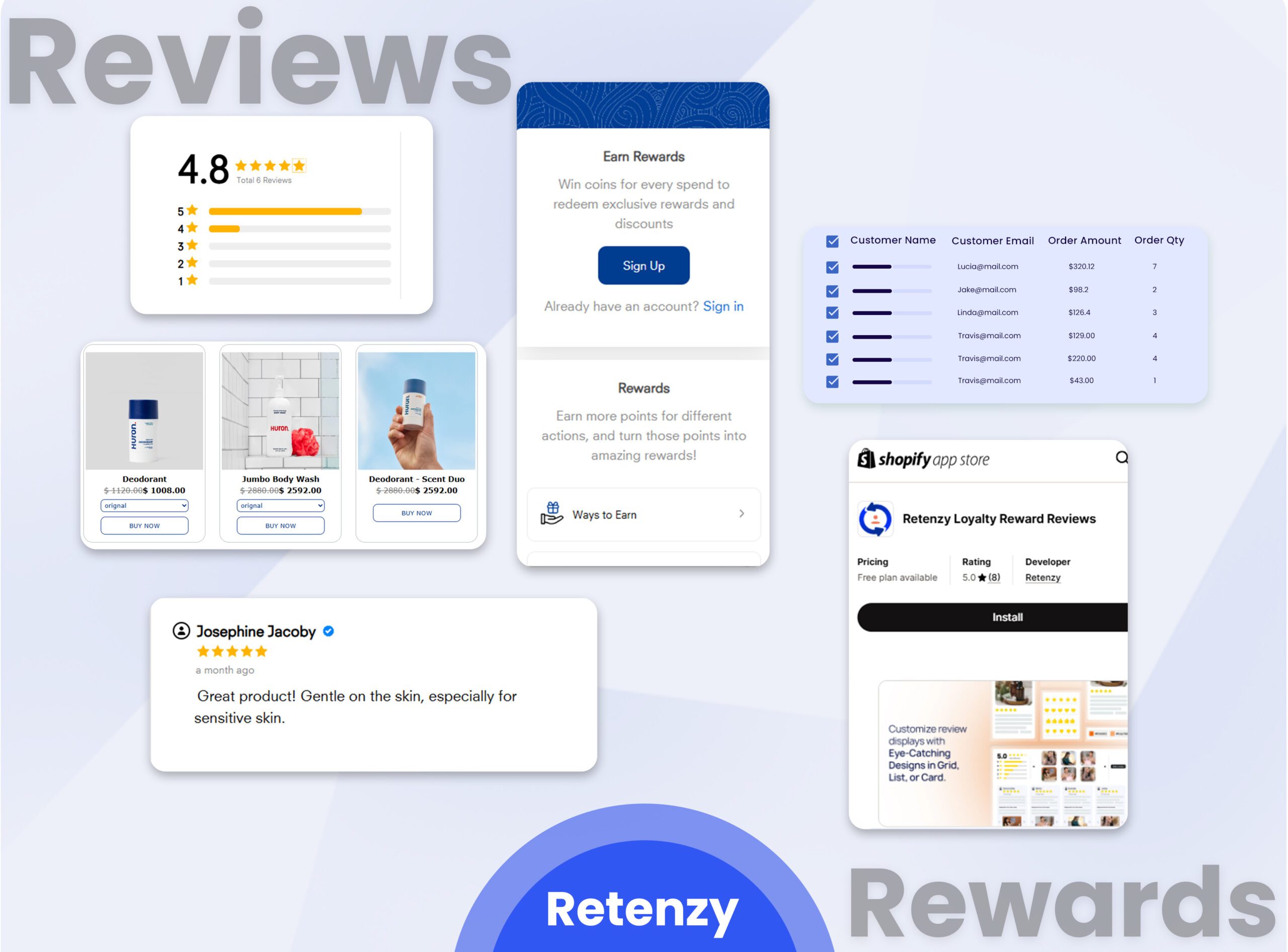
The Retenzy is a comprehensive loyalty program for Shopify store owners, offering rewards, reviews, and deals in one platform. It simplifies loyalty management with easy setup and automation, encouraging repeat purchases and brand loyalty. Merchants can create customized reward programs, track customer interactions via an analytics dashboard, and optimize engagement with points-based rewards and exclusive offers.
Pros:
- All-in-one solution that includes rewards, reviews, and deals
- Seamless Shopify integration for easy setup and use
- Highly customizable reward structures for different business needs
- Automated customer engagement through email and on-site notifications
- Insightful analytics to track customer behavior and program effectiveness
- Competitive pricing with flexible plans to suit various business sizes
- Excellent customer support and continuous feature updates
Cons:
- Relatively newer compared to other loyalty programs
- Some advanced features may still be under development
2. Smile: Loyalty Rewards Program
Shopify App Link
The Loyalty & Rewards program helps drive both new and repeat sales by offering features like referrals, rewards, points, and more. It’s fully customizable, allowing you to create a loyalty program for Shopify that perfectly fits your brand. With editable panels and exclusive VIP tiers, you can motivate your most loyal customers to shop more. Plus, on-site Nudges remind customers about available rewards at the right time, increasing loyalty and engagement.
Pros
- Highly customizable application
- Automatic on-site engagement reminders
- Integrates with popular Shopify apps
Cons
- Pricier than most Shopify loyalty apps
- Possible technical issues
3. LoyaltyLion Rewards & Referral
Shopify App Link
LoyaltyLion is a data-driven loyalty program that provides in-depth analytics to optimize customer engagement. It supports tiered loyalty programs, allowing businesses to reward high-value customers with exclusive perks.
Pros:
- Deep analytics and reporting tools.
- Supports tiered loyalty structures.
- Integrates with major email marketing tools
Cons:
- Higher cost compared to alternatives.
- Learning curve for new users.
4. Yotpo Loyalty Rewards Referral
Shopify App Link
Yotpo is a robust loyalty and referral tool that offers advanced customization options. It helps Shopify store owners build engaging rewards programs with features like tier-based incentives, automated email campaigns, and seamless integration with reviews and SMS marketing. Yotpo’s AI-powered analytics enable merchants to make data-driven decisions, maximizing customer retention.
Pros:
- AI-powered analytics for better insights
- Strong integration with other marketing tools
- Highly customizable reward structures
Cons:
- Relatively newer compared to other programs.
- Some advanced features may still be developing.
5. Nector: Loyalty & Rewards
Shopify App Link
Nector.io is a robust loyalty and referral program for Shopify merchants, designed to boost customer retention and engagement. It offers reward options like points-based incentives, referrals, VIP tiers, and gamified experiences to encourage repeat purchases. Easy to set up, it provides detailed analytics to optimize loyalty strategies. Nector.io also includes automated email and SMS marketing tools, along with seamless Shopify integration for smooth management. With advanced customization options, brands can tailor their loyalty programs to match their unique identity.
Pros:
- Easy-to-use interface with quick Shopify integration
- Offers multiple reward options, including referrals and VIP tiers
- Automated email and SMS campaigns for customer engagement
- Deep analytics to track and optimize loyalty performance
- Supports gamification features to enhance customer interaction
Cons:
- Pricing can be steep for small businesses.
- Requires time to optimize effectively.
- SMS & email automation could add to expenses.
6. Rivo: Loyalty & Referrals
Rivo Loyalty lets you create a powerful loyalty program using just your Shopify account and a single app. With built-in points and referral systems, you can reward customers for both purchases and bringing in new clients. The Rivo page builder allows you to create a fully custom loyalty page, personalizing banners, icons, and elements for a unique, professional look. Rivo takes care of everything behind the scenes, making setup and management hassle-free.
Pros:
- Unlimited program members with each subscription
- Analytics are included
- Possibility to build a dedicated loyalty page
- Options for free products and free shipping rewards
- Automated customizable emails
Cons
- Time-consuming customization for specific business needs.
- Higher pricing may not suit small businesses.
- Key features may only be in higher-tier plans.
- Inconsistent experiences for different users.
7. Loloyal: Loyalty and Referral
Loloyal is an easy-to-use yet powerful loyalty and referral program designed to boost sales and drive traffic. With customizable points, rewards, and referral options, it encourages repeat purchases, social media engagement, and new customer referrals. The VIP Tiers feature rewards your most valuable customers with exclusive perks, turning them into brand advocates. Tools like pop-ups, automated emails, and limited-time offers further enhance engagement and create more conversion opportunities.
Pros:
- Limited-time offers are perfect for events like Black Friday
- Strong product development with monthly feature updates
- Custom CSS for a 100% brand fit
- 24/7 live customer support for enhanced problem-solving
Cons:
- No loyalty page
- No public API
- Expenses for development, marketing, and rewards.
- Complicated reward structures or tiers may confuse customers.
8. Growave: Loyalty & Wishlists
Growave is an all-in-one Shopify app that offers loyalty programs, wishlists, referrals, and reviews to help businesses enhance customer engagement. It allows merchants to create custom rewards programs, encourage repeat purchases, and build strong customer relationships.
Pros:
- All-in-one app for loyalty, reviews, and wishlists.
- Simple setup and user-friendly interface, no technical expertise required
- Works seamlessly with Shopify and marketing tools.
- Responsive customer support for setup and queries
Cons:
- Too many features may overwhelm users who only need basic functionalities.
- Quite expensive
- May be technically challenging
9. Love Loyalty Program & Rewards!
More Info
Love Loyalty Program & Rewards is a Shopify app designed to strengthen customer retention through a feature-rich loyalty program. It includes points-based rewards, VIP tiers, and referral incentives to drive repeat purchases and build long-term brand loyalty. With over 15 customizable touchpoints—such as the cart, product, account, and thank you pages—the app ensures continuous customer engagement. Developed with the latest Shopify technology, it guarantees fast load speeds and reliable performance. Additionally, users can access live chat support for easy setup and ongoing assistance.
Pros:
- Comprehensive loyalty features including points, VIP tiers, and referrals.
- Over 15 customizable placements for consistent customer engagement.
- Built with the latest Shopify technology for speed and reliability
Cons:
- As a newer app, it may lack some advanced features found in more established loyalty programs
- Limited third-party integrations compared to competitors.
10. BON Loyalty Rewards Referrals
BON Loyalty Rewards & Referrals is a multilingual app designed to help you build a global loyal customer base. It enables you to create automated widgets and emails in over 250 languages, making it easy to connect with a diverse audience.
Customers can earn points through purchases and referrals, while VIP tiers reward long-term loyalty with exclusive benefits. Additionally, you can incentivize social media sharing, expanding your reach and boosting customer engagement.
Pros:
- Works with more than 250 worldwide languages
- Allows building up to 9 types of automated emails
- Has VIP tiers to help you grow a bigger loyal audience
- Offers a great free version.
Cons:
- It’s expensive to have unlimited monthly orders
- Requires some technical knowledge to maximize benefits.
- Free users can’t switch between languages
HOW AI WILL TRANSFORM LOYALTY PROGRAMS IN 2026
AI isn’t a future consideration—it’s the present reality reshaping every loyalty program decision.
AI-Driven Personalization
The Problem: Traditional loyalty programs treat customers as segments. Segment A gets “10% off,” Segment B gets “free shipping.” Not personalized, not effective.
The AI Solution: Machine learning analyzes purchase history, browsing behavior, seasonal patterns, and peer behavior to predict individual customer preferences. Example: Customer typically buys winter activewear in September. System automatically sends personalized offer in August before buying season = 47% higher conversion than generic offer.
2026 Impact:
- Companies prioritizing AI-driven personalization have 2-3x faster revenue growth than competitors
- AI systems continuously refine recommendations with each interaction
- Real-time decisioning (offer changes based on live behavior)
Predictive Churn Prevention
The Problem: You identify that a customer is churning after they churn. By then, re-engagement costs 5-7x more than prevention.
The AI Solution: Predictive analytics identify churn signals (declining engagement, longer days between purchases, category shift) 30-90 days before defection. System automatically triggers targeted win-back campaigns.
2026 Implementation:
- AI flags high-risk customers 60 days before predicted churn
- Personalized retention offers (not generic “come back” emails)
- Outreach channel optimization (email vs SMS vs push notification for this customer)
Dynamic Reward Optimization
The Problem: Static reward structures (5% off, free shipping) have diminishing appeal. Customers get offer fatigue.
The AI Solution: AI tests hundreds of offer combinations (discount %, product category, channel, timing) and dynamically adjusts what each customer sees based on predicted conversion probability.
2026 Outcome:
- 15-25% improvement in offer effectiveness
- Margin protection (offer only when necessary to influence behavior)
- Real-time adjustment (weekday offers differ from weekend offers)
AI Search Integration
Here’s the crucial shift: AI-powered search (ChatGPT, Gemini, Perplexity) now directly answers customer questions about loyalty programs. Your content about loyalty rewards, tier benefits, and redemption processes is being indexed and cited by AI systems.
This creates a new SEO imperative: your loyalty content must be structured for AI comprehension, not just human readability.
STEP-BY-STEP IMPLEMENTATION GUIDE FOR 2026
Phase 1: Discovery & Strategy (Weeks 1-2)
1. Audit Current Performance
- Customer retention rate (Google Analytics / Shopify Reports)
- Average customer LTV
- Repeat purchase rate
- Customer acquisition cost (CAC)
- Most profitable customer segment
2. Define Loyalty Program Goals
- Revenue target (% incremental growth from loyalty)
- Retention target (% repeat purchase rate)
- Engagement metric (program participation %)
- Timeline (month 1-12 milestones)
3. Segment Your Customers
- High-value customers (top 20% by LTV)
- Growth-potential customers (retained 1+ purchases)
- At-risk customers (long time since last purchase)
- New customers (first purchase <30 days)
4. Research Platform Fit
- Budget available (most range $99-$999/month)
- Feature requirements (points, tiers, referral, gamification)
- Integration needs (email, SMS, CRM, analytics)
- Merchant support quality
Phase 2: Program Design (Weeks 3-4)
1. Choose Program Type (use the chart above to align with your business model)
2. Design Reward Structure
- Point earning rate (1 point per $1 spent? 2 points?)
- Redemption options (% discount, free products, experiences)
- Tier thresholds (if tiered) and exclusive benefits
- Referral incentives (both sides)
3. Create Communication Strategy
- Where promotion happens (homepage banner, email, SMS, in-app)
- Key messaging (quantify benefit: “earn $1 in rewards per $20 spent”)
- Educational content (how to earn, how to redeem, tier benefits)
- Enrollment incentive (“Join now, get 100 bonus points”)
4. Plan Measurement Framework
- KPIs to track (enrollment rate, engagement rate, repeat purchase, LTV, ROI)
- Dashboard/tools (Shopify Analytics, platform analytics, custom dashboards)
- Reporting cadence (weekly, monthly, quarterly)
Phase 3: Technical Setup (Weeks 5-6)
1. Install & Configure Platform
- Follow the platform setup documentation
- Integrate with Shopify
- Connect email/SMS channels
- Set up analytics/tracking
2. Customize Storefront
- Loyalty widget placement (shopping cart, post-purchase, product page)
- Branding alignment (colors, fonts, tone of voice)
- Mobile optimization (80%+ traffic is mobile on Shopify)
- Accessibility compliance
3. Configure Program Rules
- Point earning trigger (purchase confirmation vs shipping)
- Earning rate (fixed vs variable)
- Expiration rules (if any)
- Tier progression automation
4. Set Up Automation
- Enrollment workflows (welcome series)
- Engagement triggers (abandoned cart, birthday, milestone)
- Win-back campaigns (inactive customer threshold)
- Tier upgrade/downgrade notifications
Phase 4: Launch & Education (Weeks 7-8)
1. Soft Launch (to a small customer segment)
- Test all functionality
- Gather user feedback
- Optimize based on learnings
- Ensure no technical glitches
2. Customer Education
- Email campaign explaining the program
- Onboarding sequence (how to earn, examples, benefits)
- Website content/FAQ
- Video walkthrough (3-5 minutes max)
- In-app tooltips/guides
3. Staff Training
- Customer service team briefing
- Chat/email response templates
- Redemption process documentation
4. Full Launch
- Promotion across all channels
- Monitor enrollment rate, early engagement
- Support queue management
- Performance tracking begins
Phase 5: Optimization (Month 2+)
1. Weekly Monitoring
- Enrollment rate (goal: 30-50% of new customers in first month)
- Engagement rate (goal: 60%+ of members earn/redeem within 30 days)
- Redemption rate (goal: >50%, up from current 50% average)
2. Monthly Analysis
- Repeat purchase rate (compare members vs non-members)
- LTV by cohort (new vs 3-month vs 6-month members)
- Tier distribution (% in each tier)
- Referral performance (if applicable)
3. Quarterly Optimization
- A/B test reward values (higher rewards = better ROI?)
- Adjust tier thresholds based on behavior.
- Add new reward options based on customer demand
- Expand to new customer segments
4. Continuous Improvement
- Customer feedback surveys
- Competitive program monitoring
- AI personalization optimization
- Channel expansion (add SMS, push notifications)
LOYALTY PROGRAM ROI CALCULATOR & KEY METRICS
Here’s how to calculate your expected ROI before launch and track actual performance after.
Basic ROI Formula:
Incremental Revenue = (Loyalty Members × Repeat Purchase Rate × AOV) – Program Costs
ROI = (Incremental Revenue / Program Costs) × 100
Practical Example (Hypothetical Store):
- Current customer base: 5,000
- Current repeat purchase rate: 30%
- Expected loyalty membership: 40% of customers = 2,000 members
- Repeat purchase rate (members): 45% (15% improvement)
- Average order value: $65
- Member repeat purchase revenue: 2,000 × 45% × $65 = $58,500/year
- Non-member repeat purchase revenue: 3,000 × 30% × $65 = $58,500/year
- Incremental from loyalty program: (45% – 30%) × 2,000 × $65 = $19,500/year
- Platform cost: $500/month = $6,000/year
- Net incremental revenue: $19,500 – $6,000 = $13,500
- ROI: ($13,500 / $6,000) × 100 = 225%
Key Metrics Dashboard (Track Monthly):
| Metric | Target 2026 | Calculation |
| Enrollment Rate | 30-50% | Members ÷ Total Customers |
| Engagement Rate | 60-75% | Members with activity ÷ Total Members |
| Repeat Purchase Rate | +10-15% | Repeat purchases (members vs non) |
| Customer LTV Growth | +30-50% | Average LTV (members vs non) |
| AOV Lift | +5-12% | AOV (members vs non) |
| Program ROI | 150%+ | (Incremental Revenue – Costs) ÷ Costs |
| Redemption Rate | >50% (vs 50% baseline) | Redeemed rewards ÷ Earned |
| Churn Prevention | 15-20% | Reduced churn rate (members vs non) |
| Referral Conversion | 20-35% | Referred customers purchasing ÷ Referrals |
MIND MAP 2: CUSTOMER RETENTION & LOYALTY LIFECYCLE FRAMEWORK

Customer Retention & Loyalty Framework Mind Map
This framework maps the complete customer journey from acquisition through retention and advocacy. Each phase presents specific loyalty opportunities:
- Acquisition: First impression shapes loyalty potential
- Onboarding: Early experience determines engagement trajectory
- Engagement: Personalization and communication drive behavior
- Program: Structured rewards accelerate repeat purchases
- Measurement: Data informs optimization
- Retention: Proactive interventions prevent churn
Conclusion
In 2026, loyalty programs are no longer optional for Shopify stores—they are a core growth engine. With repeat customers driving 41% of revenue and loyalty members spending significantly more, the brands that win are those that move beyond basic discounts to AI-driven, emotionally engaging experiences. Whether through points, tiers, referrals, or community-based rewards, a well-designed loyalty program increases retention, protects margins, and builds long-term brand resilience. The opportunity is clear: invest in loyalty now, or risk losing your most valuable customers to competitors who already have.
FREQUENTLY ASKED QUESTIONS (FAQ) – 2026 EDITION
Q1: What’s the most important metric for a loyalty program?
A: Customer Lifetime Value (LTV) is the north star. A program can drive high enrollment but low LTV (failed program). Focus on: repeat purchase frequency, retention rate, and AOV growth. Members should have 2-3x higher LTV than non-members within 6 months.
Q2: How long until we see ROI from a loyalty program?
A: Months 1-3 are the enrollment/education phase (positive sentiment, low revenue impact). Months 3-6 show meaningful repeat purchase lift (15-25% increase). Months 6-12 show program maturation and profitability. Full ROI typically appears by month 6-12, depending on the repeat purchase cycle. Don’t judge on month 1 data.
Q3: Should we offer points or tiered rewards?
A: It depends on your business model:
Points-based: Good for frequent purchases (fashion, beauty, retail)
Tiered: Good for high AOV, aspirational goals (luxury, premium)
Hybrid: Points within tiers (best of both)
Emotional: For premium, community-driven brands
Analyze your repeat purchase cycle. Average 2-4x annual purchases? Use points. 1-2x annually? Use tiers to encourage spending.
Q4: What percentage of customers should join our loyalty program?
A: Industry benchmark is 30-50% of customers within 6 months of launch. Healthy programs achieve 40-60% enrollment. If you’re below 30%, improve messaging (how benefits, not just features) or increas he incentive. Above 60%? Likely because your offer is too generous (margin erosion risk).
Q5: How do we prevent points from becoming a margin killer?
A: Structure matters immensely. If you offer “5 points per $1” redeemable as “$0.05 off,” you’re paying 5% margin. Control margin impact:
Cap earning rate relative to margins (luxury = higher caps; fashion = lower)
Vary earning by category (high-margin = higher points, lower-margin = lower)
Redemption options beyond discounts (free shipping, early access, samples)
Expiration rules (30% unredeemed = your margin back)
Q6: What’s the difference between customer retention and loyalty?
A: Retention = repeat purchases (behavioral). Loyalty = emotional connection + advocacy (emotional + behavioral). A customer can be retained (buying regularly) without being loyal (would switch for a better price). Programs targeting loyalty create switching costs through community, experiences, and emotional connection—worth more than discounted repeat buyers.
Q7: Can we launch a loyalty program if we’re small (under $50K/year)?
A: Technically, yes, practically—be strategic.
Enrollment threshold: Need 100+ customers minimum to see meaningful data
Platform cost: Free/cheap options exist ($0-$99/month), but may lack features
ROI timeline: Expect 12+ months to break even ata small scale
Better approach: Start with email retention (free), add loyalty when you hit 500+ customers and $100K+ revenue
Q8: How does AI change loyalty program ROI?
A: Dramatically. AI-driven personalization increases offer redemption by 30-50% and repeat purchase frequency by 15-25%. But AI also requires data infrastructure (CRM integration, analytics). Traditional “set and forget” programs achieve 12-15% ROI. AI-optimized programs achieve 25-35%+ ROI. Cost difference: $0-500/month more for AI-capable platforms.
Q9: Should we do referral programs?
A: Yes, as a secondary program. Referral programs have:
Highest CAC efficiency (10-25% of paid acquisition cost)
Lower participation (only 5-15% of the base participates)
Highest referred customer quality (higher retention)
Best approach: Core loyalty program (points/tiers) + optional referral layer, not referral-only.
Q10: How do we measure emotional loyalty vs. transactional loyalty?
A: Metrics differ:
Transactional loyalty = repeat purchase rate, redemption rate, retention rate
Emotional loyalty = NPS (goal: 50+), advocacy rate (% recommending to friends), community participation, voluntary engagement (reviews, referrals, social sharing), willingness to pay premium
Track both. Transactional loyalty drives revenue. Emotional loyalty drives resilience and lifetime value.
Q11: What’s the optimal reward redemption threshold (points needed)?
A: 30-60 days to first redemption. If redemption takes 6 months, the customer loses motivation. Benchmarks:
Calculate the average customer spend per month.
Set redemption at 1.5-2x monthly spend (e.g., $1,000/year average spend = 1,500-2,000 points to redeem)
Test lower thresholds ($10-20 rewards) witha small cohort—often increases LTV.
Q12: How often should we change loyalty program structure?
A: Be cautious. Major changes (point values, tier thresholds, benefits) confuse customers and risk churn. Approach:
Lock core structure for 12 months post-launch (let program stabilize)
Optimize within structure monthly (offer testing, channel expansion)
Add new rewards annually (seasonal offerings, partnership benefits)
Major restructuring every 24+ months only if data warrants