
- Features
Features



In 2025, the e-commerce landscape shifted. Winning isn’t just about attracting traffic; it’s about micro-conversions. The distance between “I want this” and “It’s in my cart” must be zero.
With global Shopify cart abandonment rates hovering near 70.19% and mobile abandonment spiking to 85.2%, the humble “Add to Cart” button has become the most critical real estate on your site. If customers don’t reach that point easily, your sales won’t grow, no matter how effective your ads are.
Whether it’s sticky buttons that follow the user’s scroll, slide-out drawers with AI-recommended upsells, or “skip-to-checkout” flows, the right app optimizes conversion paths and reduces friction.
We tested dozens of solutions to bring you the 10 top-performing Shopify Add-to-Cart apps for 2026, ranked by speed, feature density, and ROI.
This guide provides a comprehensive roadmap for Shopify merchants to optimize the most critical stage of the buyer journey: the transition from product discovery to the cart.
Before diving into the tools, let’s look at the why. The psychology of the “Add to Cart” button is rooted in reducing cognitive load.
Based on official Shopify App Store data, here’s a detailed guide to the leading add-to-cart and cart modification apps available for Shopify merchants in 2026.
Best For: Brands seeking a comprehensive cart transformation with advanced upselling capabilities.
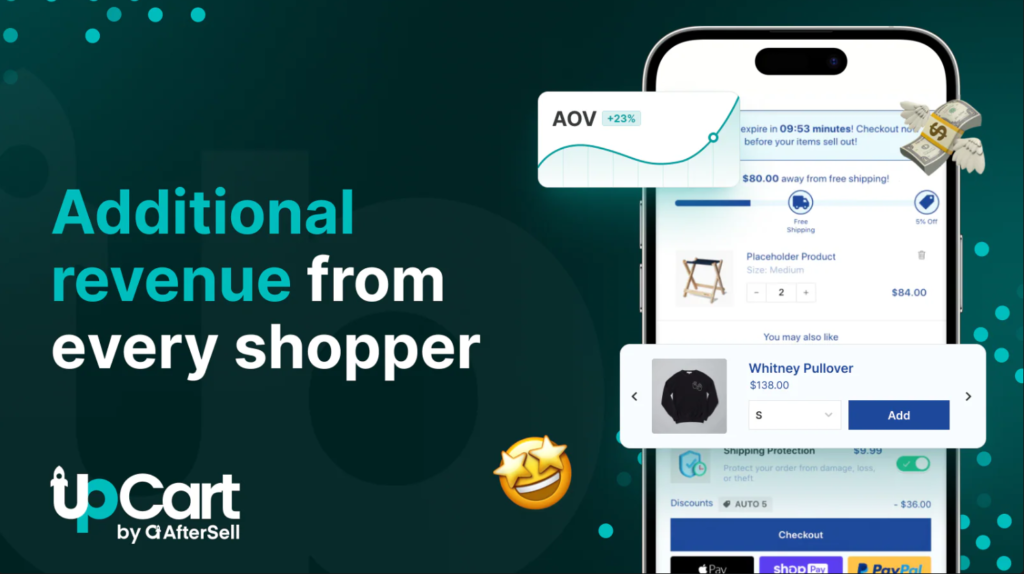
UpCart replaces the default cart with a customizable slide-out drawer that maintains brand consistency. The app includes an in-cart upselling and cross-selling module, free shipping progress bars, add-on options (such as shipping insurance), an announcements module, and a sticky cart button for improved visibility. Merchants can create a fully branded cart experience with custom HTML and CSS options.
Which add-to-cart button app offers the most comprehensive cart experience?
A: UpCart replaces the default cart with a fully customizable slide-out drawer that maintains brand consistency. Merchants get modular features, including in-cart upselling, free shipping progress bars, add-on options (shipping insurance), announcements, and sticky cart buttons. The extensive design settings allow complete brand alignment with custom fonts, colors, and layouts.
Pricing: Free for development stores; plans range from $29.99/month (0-200 orders) to $54.99/month (501-1,000 orders), with a 14-day free trial available.
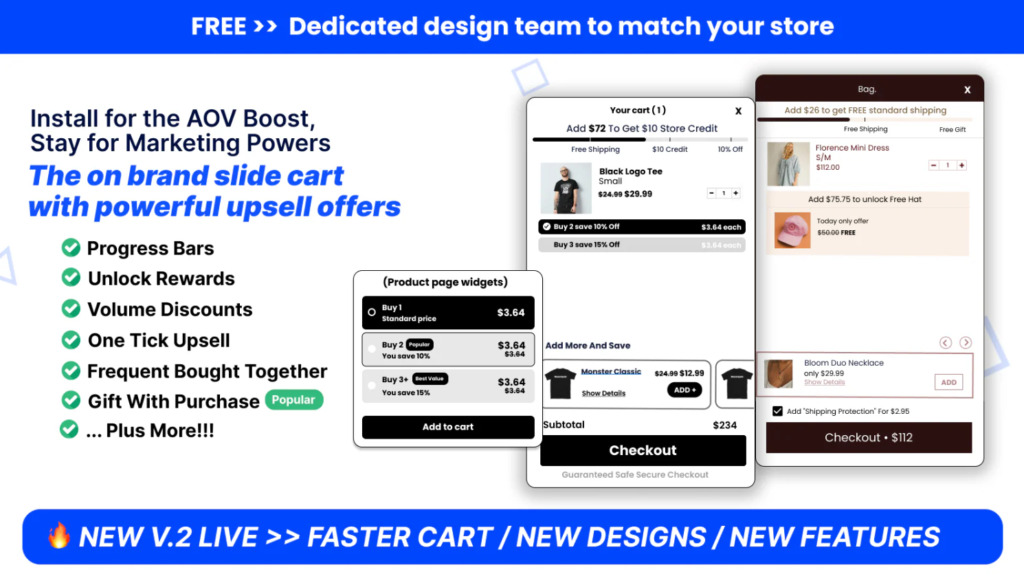
Best For: Stores focused on gamification and average order value (AOV) growth.
Monster Cart emphasizes the psychology of “unlocking” rewards, transforming the cart into an interactive experience where customers work toward tiers for gifts or incentives.
What upsell strategies does Monster Cart support?
A: One-tick upsell offers (shipping protection, priority processing), Buy More Save More tiered discounts, frequently bought together recommendations using ML, and countdown timers for urgency.
The app provides a customizable slide cart drawer, “Add to Unlock” progress bars with gifts and discounts, one-tick upsell offers (shipping protection, priority processing, warranties), Buy More Save More tiered discounts, frequently bought together recommendations with machine learning or manual selection, and countdown timers for urgency.
Pricing: Free plan available; Starter plan at $12.99/month (up to 50 orders) and Scaler plan at $21.99/month (51-200 orders), with a 10-day free trial.
Best For: Amazon-style product bundling and cross-selling strategies.
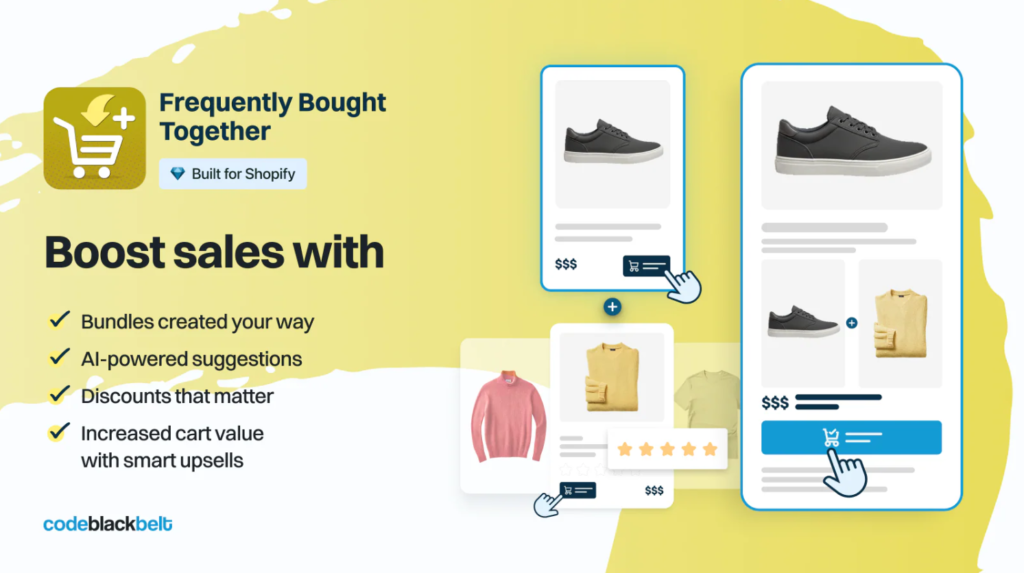
This app fundamentally changes how customers add items to cart by enabling multi-product bundle purchases with a single click, drastically reducing the path to purchase.
How does Frequently Bought Together increase conversion rates?
A: Using AI trained for years, this app displays “Customers who bought this also bought…” bundles with one-click add-to-cart functionality. This pattern is trusted by shoppers (familiar from Amazon) and dramatically reduces friction—customers buy complete solutions instead of individual items.
AI-driven product recommendations trained continuously for years, one-click bundle add-to-cart functionality, manual bundle creation options, four different bundle discount types, out-of-the-box theme compatibility, and customizable styling. The app works with popular review apps and integrates smoothly with any number of products, orders, or traffic levels.
Pricing: Free plan for development stores and trial users; Professional plan at $19.99/month (or $199.90/year with 17% savings) for unlimited products, orders, and traffic, with a 30-day free trial.
Best For: Simple, lightweight sticky buttons without complex upselling features.
Uplinkly focuses on ensuring the “Add to Cart” button remains visible while customers scroll through product pages, eliminating friction from lengthy product descriptions.
What’s the difference between a sticky button app and a cart drawer app?
A: Sticky button apps keep the “Add to Cart” button visible while scrolling—eliminating friction from long product descriptions. Cart drawer apps replace the entire cart experience. Uplinkly focuses purely on button visibility and accessibility.
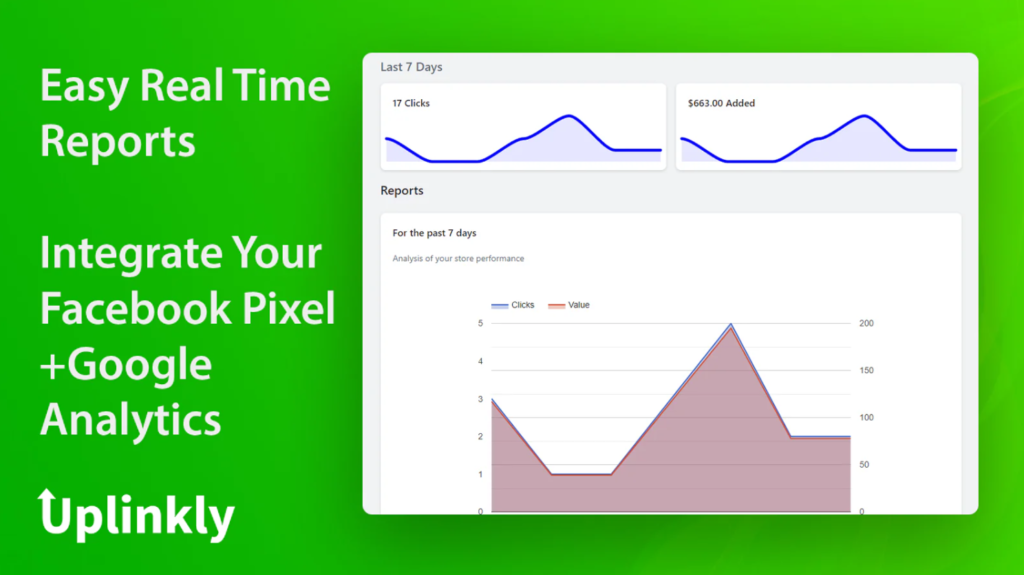
A permanently visible sticky add-to-cart button that matches store theme automatically, button animator with 10+ attention-grabbing styles, customizable text and positioning (top or bottom), mobile, desktop, and tablet responsiveness, unlimited impressions and clicks, one-click installation, and built-in reporting with Google Analytics and Facebook Pixel integration.
Pricing: Free Basic Plan with unlimited support; Professional Plan at $9/month with expert reporting, professional templates, real-time tracking, free customization, and smart countdown timers, with a 7-day free trial.
Best For: All-in-one conversion features at budget-friendly prices.
Supercart combines cart drawer functionality with shipping protection and other add-on services, creating an additional revenue stream for merchants.
What comprehensive features does Supercart include?
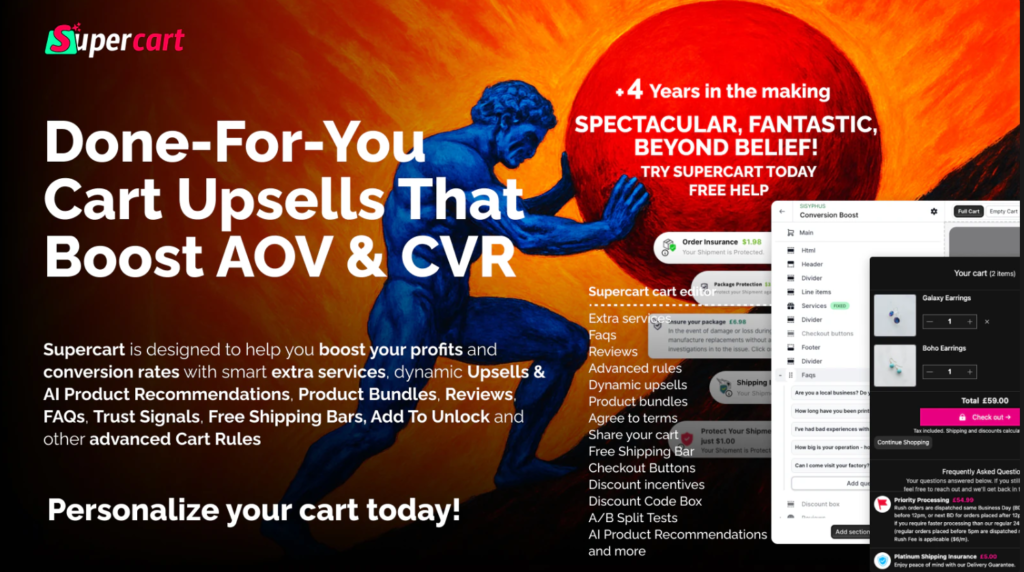
A: Cart drawer with shipping protection, rush processing, handling fees, gift packing, auto gifts, AI upsells, product bundles, free shipping bar, cart FAQs, discount codes, terms checkbox, countdown timers, save/share cart, A/B split testing, and easy-to-use cart editor.
Cart drawer with shipping protection (insurance), rush processing, handling fees, gift packing options, auto gifts, AI upsells, product bundles, free shipping bar, cart FAQs and reviews, discount code box, terms checkbox, countdown timers, save and share cart functionality, and A/B split testing with easy-to-use cart editor. All features are available across all pricing tiers.
Pricing: Free plan (up to 15 orders/month or $1,000 additional revenue); Growth 2 at $9.99/month (16-99 orders); Growth 3 at $18.99/month (up to 299 orders); Growth 4 at $27.99/month (up to 499 orders), with 14-day free trials on paid plans.
Best For: Merchants prioritizing beautiful design and “Free Gift” logic.
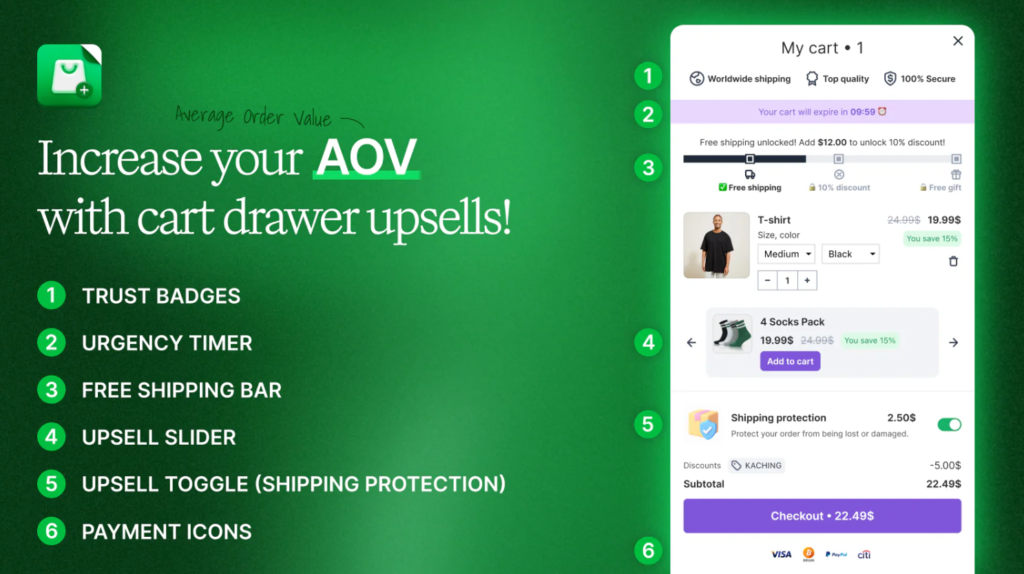
Slide Cart is renowned for its visual aesthetics and robust gift mechanics (e.g., “Add $10 more to get a free hat”), making it a competitor to UpCart with emphasis on design quality.
How important is cart design to conversion?
A: Highly. A beautiful, professionally-designed cart maintains customer confidence. Slide Cart Drawer is renowned for stunning default templates and consistent design—studies show design quality influences purchase psychology.
Slide-out cart drawer, announcement bar in cart, discount code box with stacking capability, floating cart icon, progress bars for free shipping and discounts, gift options (Buy X Get Y logic), frequently bought together recommendations, sticky cart drawer, discount code functionality, and terms and conditions checkbox. The visual editor allows extensive customization while maintaining theme compatibility.
Pricing: Free plan with basic functionality; Starter at $19.99/month; Growth at $39.99/month; Pro at $49.99/month (includes Buy X Get Y and Free Gift), with 7-day free trials on paid plans.
Best For: Quick purchasing directly from collection pages.
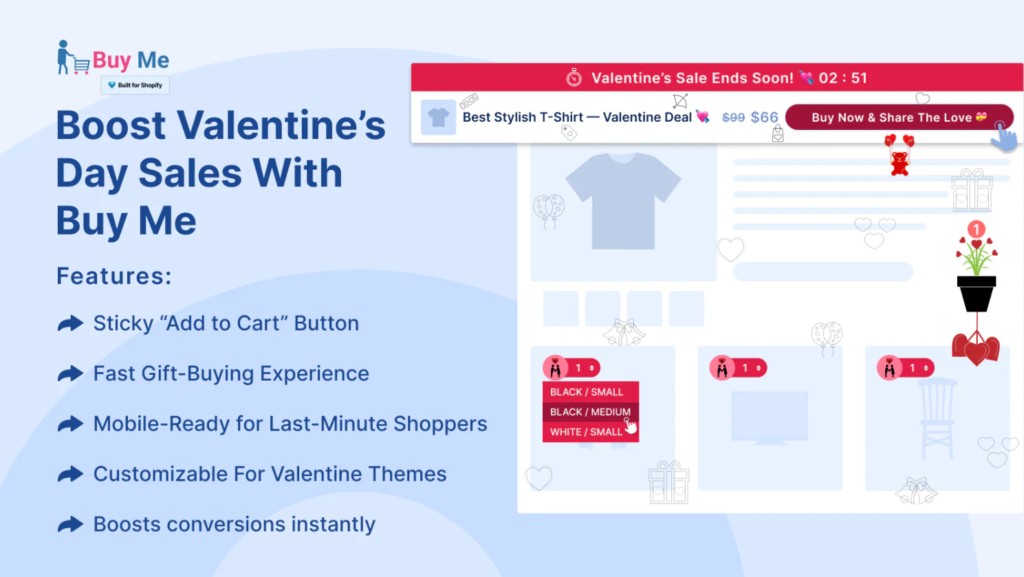
Buy Me is distinctive in allowing customers to add products to the cart directly from collection and listing pages, bypassing the product page entirely if desired.
What multi-device capabilities does Buy Me offer?
A: The “Remember My Cart” feature syncs carts across devices when users return. Over 50% of e-commerce shoppers use multiple devices; Buy Me captures this behavior.
Quick Buy widget for collection pages, sticky add-to-cart bar on product pages, sticky floating cart, social sharing options, product review display options, Christmas countdown timer for urgency, remember my cart functionality across devices, seasonal theme options, and Facebook Pixel integration for tracking.
Pricing: Free plan (up to 50 add-to-carts per month); Small at $2.95/month (up to 250); Medium at $4.95/month (up to 750); Large at $6.95/month (unlimited), with 14-day free trials on paid plans.
Best For: Multi-device shopping journeys and cart recovery.
Persistent Cart addresses a critical pain point: over half of e-commerce shoppers use multiple devices, and carts are typically lost during device switching. This app syncs carts across devices when users log in.
Who benefits most from Persistent Cart?
A: Stores with high engagement and logged-in user bases. Guest checkouts don’t benefit since cart sync requires a login.
Automatic cart syncing across devices upon login, intelligent item merging between devices to prevent loss, optional auto-clear on logout (GDPR-friendly), one-click installation, background operation requiring zero maintenance, seamless cart recovery without emails or pop-ups, and increased average order value through cart persistence.
Pricing: Tiered by Shopify plan: $4.99/month (Basic plan), $8.99/month (Shopify plan), $24.99/month (Advanced plan), $99.99/month (Plus), with 30-day free trials.
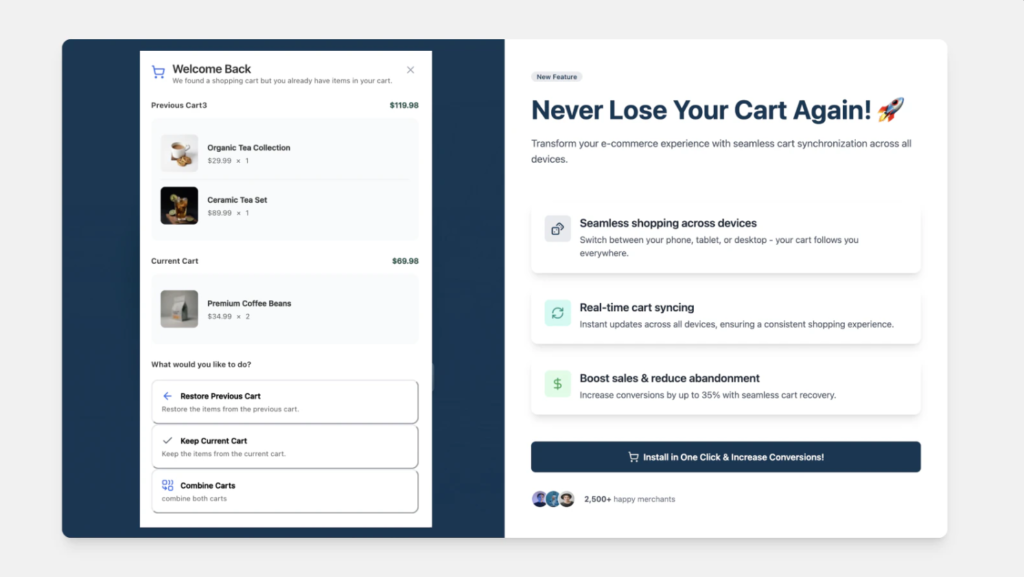
Best For: Hybrid approach combining sticky button + drawer functionality.
Qikify provides a 2-in-1 solution offering both a sticky add-to-cart bar and a slide-out cart drawer, giving merchants comprehensive cart optimization in one app.
What’s the advantage of a 2-in-1 sticky button + drawer solution?
A: Two major conversion features in one app = simplified implementation, lower cost, and unified design. Customers get button visibility AND a rich cart drawer.
Sticky add-to-cart button that appears when scrolling, slide-out cart drawer, floating cart button, note box for customer messages, terms and conditions checkbox, cart upsell with frequently bought together recommendations, free shipping progress bar, discount code box, estimate shipping rate calculator, announcement bar, progressive shipping bar, trust badges, and full customization options.
Pricing: Free plan with all basic features; Premium at $14.99/month (or $143.90/year with 20% savings), including cart upsells, announcements, shipping calculations, and no branding, witha 7-day free trial. Shopify Plus pricing is at $99.99/month.
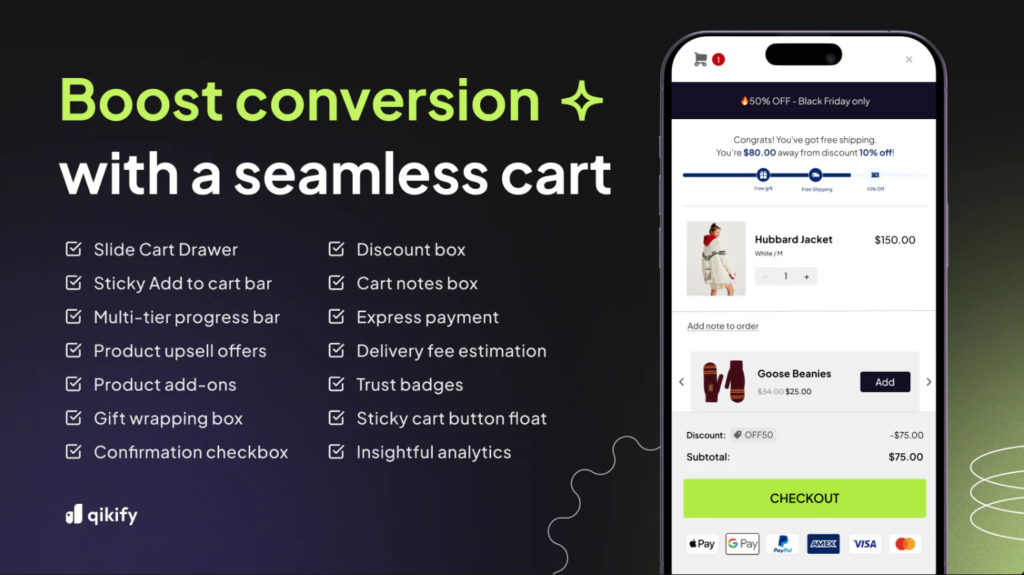
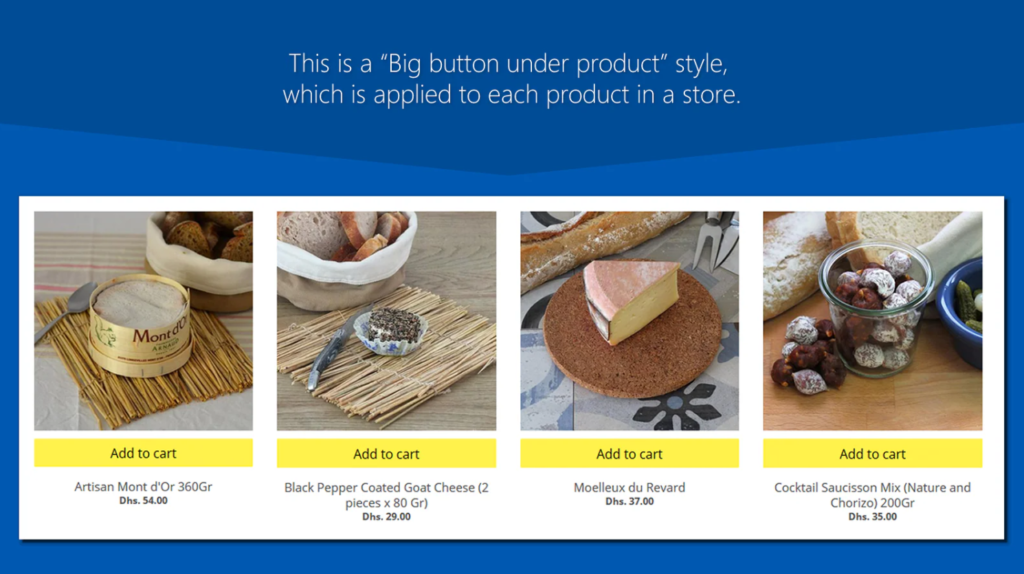
Best For: Visual visibility enhancement and button animations.
FoxCart focuses on ensuring the add-to-cart button is never missed through strategic placement and eye-catching animations.
What’s FoxCart’s core specialization?
A: Ensuring add-to-cart buttons are never missed through strategic placement and eye-catching animations. It does one thing exceptionally well without feature bloat.
Floating sticky cart button with customizable animations, add-to-cart buttons on collection pages, sticky add-to-cart bar on product pages, quantity field selectors, multiple style options, notification displays, direct checkout option, and various animation styles to draw customer attention.
Pricing: $12.99/month flat rate with 5-day free trial. Includes add-to-cart buttons, sticky bar, sticky cart, quantity fields, animations, notifications, and multiple styles.
| App | Best For | Pricing | Key Strength | Key Limitation |
| UpCart | Complete cart transformation | $29.99–$54.99/mo | Comprehensive upselling | Volume-based pricing |
| Monster Cart | Gamification & AOV | $12.99–$21.99/mo | Intuitive, psychology-driven | Can feel busy |
| Frequently Bought Together | Product bundling | $19.99/mo flat | AI-driven recommendations | Needs order history |
| Uplinkly | Simple sticky buttons | Free–$9/mo | Lightweight, no-code | Limited functionality |
| Supercart | Budget all-in-one | Free–$27.99/mo | Revenue-generating insurance | Usage-based pricing confusion |
| Slide Cart | Beautiful design | Free–$49.99/mo | Professional aesthetics | Advanced features on higher tiers |
| Buy Me | Quick collection page buying | Free–$6.95/mo | Reduces page loads | Potential CLS impact |
| Persistent Cart | Multi-device sync | $4.99–$99.99/mo | Privacy-focused, passive | Requires customer login |
| Qikify | Hybrid sticky + drawer | Free–$14.99/mo | 2-in-1 functionality | Design less modern |
| FoxCart | Button visibility | $12.99/mo | Pure simplicity | No upselling features |
The average Shopify store leaves enormous revenue on the table. However, merchants using optimized add-to-cart apps, cart recovery systems, and conversion-focused tools can recover 10-20% of abandoned carts and see meaningful AOV increases of 20-30% through strategic bundling and upsells.
Why Customers Abandon Carts (And What to Fix)
What unexpected costs cause cart abandonment?
Answer: Nearly half of shoppers abandon their carts due to surprise charges—primarily shipping costs, taxes, and processing fees that weren’t transparent during product browsing. Customers expect all-inclusive pricing upfront or a clear disclosure of additional charges.
Solution: Implement apps like UpCart or Supercart that display free shipping progress bars directly in the cart drawer (e.g., “You’re $15 away from free shipping”). Make shipping costs visible on product pages using dynamic checkout buttons and calculators.
How does forcing account creation before checkout hurt conversion?
Answer: One in four shoppers abandons when required to create an account. First-time buyers want to test the purchasing experience before committing personal information. This friction is especially damaging on mobile, where form filling is tedious.
Solution: Enable Shopify’s native guest checkout option. Use apps like Shop Pay integration to offer one-click purchasing for returning customers without forcing account creation.
What trust signals reduce cart abandonment?
Answer: Customers lack confidence when they see outdated designs, missing SSL certificates, unclear policies, or unfamiliar checkout processes. This psychological friction causes 1 in 4 shoppers to exit.
Solution: Implement visible trust badges in your cart drawer using apps like Qikify or UpCart. Display payment logos (Visa, Mastercard, PayPal), security seals, clear return policies, and “Secure Checkout” indicators.
Why do long delivery times cause cart abandonment?
Answer: Modern consumers expect fast shipping. When delivery timeframes aren’t visible or seem slow, customers abandon them to check competitors. Speed expectations have accelerated dramatically—2-3 day delivery is now baseline.
Solution: Use apps like Supercart with built-in shipping rate calculators. Show estimated delivery dates on product pages and in checkout.
What checkout complexity hurts conversion?
Answer: Multi-step checkouts with excessive form fields frustrate customers. Studies show ideally 3 steps or fewer. Each additional step increases abandonment exponentially.
Solution: Implement sticky cart buttons that keep the “Proceed to Checkout” CTA visible while scrolling. Use address autocomplete and prefilled fields where possible.
Question: Why is transparent pricing critical?
Answer: Hidden costs create surprise and suspicion. When customers can’t see the final total until late checkout, they often abandon.
Solution: Cart drawer apps display itemized totals immediately. UpCart, Supercart, and Qikify all show running totals as customers modify their cart.
How does the return policy affect purchase confidence?
Answer: Unclear or restrictive return policies signal low confidence in product quality. High-risk purchase categories (fashion, electronics) see abandonment when return policies aren’t prominent.
Solution: Include return policy links in your cart drawer using trust signal modules in apps like Slide Cart Drawer.
How do page speed and crashes impact abandonment?
Answer: A one-second page load delay drops conversions by 7%. Checkout crashes instantly destroy trust and lose sales.
Solution: Use GTmetrix or TinyIMG to optimize page speed. Monitor performance continuously.
Why do payment method options matter?
Answer: Customers have preferred payment methods. When their option isn’t available, they abandon. Buy Now Pay Later (BNPL), digital wallets, and local payment methods are increasingly expected.
Solution: Enable multiple payment gateways through Shopify Checkout: Apple Pay, Google Pay, Shop Pay, PayPal, and BNPL providers.
The “Add to Cart” button is no longer a simple CTA—it’s the gateway to your revenue. The merchants winning in 2026 aren’t throwing traffic at the problem. They’re obsessing over the 15-pixel space where “I want this” becomes “It’s in my cart.” Mobile abandonment at 85.2% signals customers are trying to buy but encountering obstacles.
The Strategic Reality: Every frame, every click, and every micro-friction point matters. A one-second delay costs 7% of conversions. Unclear pricing costs 21%. An account creation wall costs 26%. These aren’t marginal losses—they’re revenue hemorrhages.
Key Implementation Insight: Your store type determines which app to prioritize:
The Implementation Roadmap: Week 1 audit baseline metrics → Week 2-3 run free trial with one app → Week 4 measure impact → Month 2 layer complementary features → Month 3 scale based on data.
Bottom Line: With 70% cart abandonment being an optimization opportunity rather than a tragedy, recovering just 10-15% of abandoned carts through better UX grows revenue 7-10% without additional ad spend. A realistic $100K/month store could see $10K-$15K incremental monthly revenue within 90 days through optimized cart apps.