
Customer Acquisition Strategies for Sustainable Growth and How to Reduce CAC
Ecommerce CAC has jumped 40% since 2023, but the fix isn’t just bigger ad budgets. This guide breaks down how referrals, loyalty programs, content/SEO, and retention lower your effective CAC by extracting more value per customer – plus the Acquire-Engage-Retain framework smart brands use to grow sustainably.

- Customer Acquisition: Why Ecommerce Growth Is Getting More Expensive
- What Is Customer Acquisition Cost (CAC) and How Do You Measure It?
- Why Is Your Customer Acquisition Cost Increasing?
- Customer Acquisition Strategies for Sustainable Growth
- The Acquire–Engage–Retain Lifecycle
- How Retenzy Helps Reduce Customer Acquisition Cost
- Conclusion
Quick Answer: Ecommerce brands reduce customer acquisition cost (CAC) by improving marketing efficiency and maximising customer value. In practice, this means optimizing ads and conversion funnels, but especially focusing on referrals, loyalty, and content. Referred customers convert at much higher rates and require about 25% less spend per acquisition. Meanwhile, owned channels like content marketing and SEO deliver huge ROI (median ~748% return), and email marketing delivers 45:1 ROI. By raising repeat purchases and turning customers into advocates, you effectively spread the original CAC investment over more revenue, lowering your effective CAC.
Customer Acquisition: Why Ecommerce Growth Is Getting More Expensive
Customer acquisition is getting tougher for ecommerce brands. Competition for online shoppers has surged, privacy changes have reduced targeting, and ad platforms are more expensive. In 2026, average ecommerce CAC (blended across channels) is around $68–$84 per customer– roughly 40% higher than in 2023. Similarly, Shopify’s Global Commerce Report found CAC jumped from $274 to $318 (a 16.1% increase) for retail brands between 2023 and 2026.
Factors driving this rise include:
- Higher ad costs: Google Ads CPCs rose ~12.9% in 2025, and social ad auctions are extremely competitive.
- More competition: More brands are chasing the same audience, bidding up costs for channels like Meta and Google.
- Tracking headwinds: Privacy and iOS updates have reduced targeting accuracy and attribution, making ads less efficient.
- Rising creative costs: Larger teams, agencies, and higher production value push up marketing budgets.
Instead of assuming cheap ads will continue, brands must adapt. That means not just spending more, but improving how each marketing dollar works and increasing the value per customer.
What Is Customer Acquisition Cost (CAC) and How Do You Measure It?
Customer acquisition cost (CAC) is the average spend required to acquire one new customer. The formula is straightforward:
CAC = Total Customer Acquisition Cost / Number of New Customers acquired in a period.
For example, if a store spends $15,000 on marketing in a month and gets 200 new customers, the CAC is $75. (CAC can be calculated channel by channel or as a blended total.)
What costs to include: CAC can include all marketing expenses (ad spend, agency fees, influencer pay, software costs, creative production) and sometimes even sales team labour. Some brands calculate blended CAC (all channels combined) while also monitoring channel CAC (e.g., Facebook CAC, Google CAC) for deeper insight.
Why measure CAC carefully: Often, brands understate their CAC by only counting ad spend. One study found 68% of DTC brands underestimate true CAC by 20–40%, since many ignore creative, staffing, and platform fees. The real “full stack” CAC for many small ecommerce brands is in the $60–$120 range per customer.
Example: Calculating CAC by Channel
Illustrative example: In this scenario, a retailer spends $17,500 across channels and gains 450 new customers for a blended CAC of ~$39. Changing the mix (e.g. improving email conversion) could lower this further. (As a check, use the formula: $17,500 ÷ 450 = $38.89.)
Beyond CAC: Note that CAC alone is only part of the story. You should also track Customer Lifetime Value (LTV) and the LTV: CAC ratio. A common ecommerce rule is to aim for LTV at least 3× CAC, ensuring each customer generates significantly more revenue than they cost to acquire. Other important metrics include repeat purchase rate, retention rate, and payback period (how long to recoup CAC through profit). In short, CAC should be considered alongside how long and how much each customer spends after the first purchase.
| Channel | Spend | New Customers Acquired | Implied CAC |
|---|---|---|---|
| Facebook Ads | $10,000 | 200 | $50.00 |
| Google Ads | $5,000 | 100 | $50.00 |
| Email Marketing | $500 | 50 | $10.00 |
| SEO/Content (estimate) | $2,000 | 100 | $20.00 |
| Total / Blended | $17,500 | 450 | $38.89 |
Why Is Your Customer Acquisition Cost Increasing?
If you have noticed CAC creeping up, it’s usually for one or more of these reasons:
- Ad Costs Are Rising: Digital ads have become more expensive. Google Ads CPCs rose ~12.9% in 2025, and social networks frequently increase bidding competition. If you spend the same amount and get fewer clicks or conversions, your CAC goes up.
- Less Targeting Precision: Privacy regulations and tracking limitations mean you often target broader audiences or pay for “raw” impressions. Lower-quality leads require more spend to convert.
- More Competition: Every new DTC brand enters the online ad auctions. If rivals aggressively bid for similar audiences, you pay more for the same eyeballs. Even small increases in bid prices can double ad budgets over a year.
- Low Conversion Rates: Sometimes CAC rises even if ad spend is flat because your conversion rate fell. Any friction (weak landing page, poor offer, confusing checkout) means fewer sales per ad dollar, raising CAC. Improving site conversion is often cheaper than boosting budgets.
- Weak Retention: If a customer only buys once, you must spend fully to get the next one. Low repeat purchase rates mean each customer’s future revenue is low, so the initial CAC is more burdensome. (By contrast, if customers buy again, the effective CAC per lifetime dollar is lower.)
- Single-Channel Dependence: Relying heavily on one channel (e.g. only Facebook) can be risky. When that channel’s costs increase or performance drops, overall CAC spikes. Diversifying methods (email, SEO, referrals, etc.) spreads risk.
In short, rising CAC often signals that something is broken in the funnel, whether higher costs, poorer targeting, or insufficient follow-up. The solution isn’t always spending more; it’s to optimize where you spend, and to start extracting more value from each acquired customer.
Customer Acquisition Strategies for Sustainable Growth
Reducing CAC for sustainable growth means balancing efficient acquisition with maximizing customer value. Below are key strategies framed in the Acquire → Engage → Retain lifecycle.
Customer Referrals and Referral Programs
Referral programs turn loyal customers into new customer sources. A referred customer arrives with trust in your brand, so they convert at much higher rates (often 3–5× higher). According to industry data, referred customers have 16% higher LTV and 37% better retention than non-referred customers. In practice, this means fewer ad dollars per sale: referral programs can reduce effective CAC by about 25%.
Why referrals work: They leverage word-of-mouth. When customers share discount codes or referral links with friends, both the advocate and the new customer feel rewarded. Since 92% of people trust personal recommendations, referred traffic converts far more efficiently than cold traffic.
- Example tactics: Offer double-sided rewards (points or discounts for both referrer and friend). Promote your program via email and on-site banners. Make sharing easy (one-click, social media links).
- Impact: If just 5–10% of your customers refer a friend, you could generate a substantial number of new customers at almost no ad cost. (For instance, 1000 customers with a 5% referral rate and a 20% conversion on those referrals yields 100 new customers for free.)
By actively turning customers into advocates, you create a self-sustaining acquisition channel. Paid ads bring people in, and referrals bring in even more people through a trusting network.
Value-Add Marketing and Content Marketing
Creating valuable content (blogs, guides, videos) is a long-term CAC reducer. High-quality content attracts search traffic and social shares, and it can educate customers to buy. Key points:
- SEO and blogs: Organic content ranks in search over time and doesn’t require pay-per-click. SEO-driven leads close at 14.6% vs ~1.7% for cold outbound. The median SEO ROI is 748%, meaning ~$7.50 gained for every $1 spent. In fact, many marketers rank website/blog/SEO as their top ROI channel.
- Email & Newsletters: Owned channels like email have very low incremental CAC. As noted, email marketing CAC in retail is only about $8–$15, with ROI often 45:1. Regular newsletters and drip campaigns keep customers engaged without incremental ad spend.
- Educational content: Product tutorials, comparison charts, and industry tips help potential buyers find and trust you. They provide value at no extra ad cost, and they can improve conversion rates (a better-informed visitor buys more often).
Over time, content compounds. A blog post published today can keep generating traffic and customers for years. This ongoing organic acquisition reduces dependence on paid channels. As one analysis notes, half of marketing-lead content ROI comes years after it is created.
Brand Communities
Building a brand community (forums, Facebook groups, Discord, in-person events) strengthens customer relationships and accelerates referrals. Strong communities:
- Boost loyalty: Community members feel connected to your brand story. They engage more, post user-generated content, and often become repeat buyers.
- Generate word-of-mouth: Engaged customers are likelier to enthusiastically recommend products to friends and social media followers.
- Improve feedback: Direct interaction helps improve products, which improves the customer experience and conversion.
As one e-commerce analysis points out, “brand communities boost loyalty… leading to more purchases, higher LTV, and better retention, and they also turn customers into advocates who reduce acquisition costs”. In practice, a community member’s word-of-mouth is a free referral. By incentivising participation (exclusive events, early access, loyalty points for engagement), you both retain customers and lower your future CAC.
Customer Loyalty and Retention
The cheapest customer is often the one you already have. Even a modest lift in retention dramatically improves your LTV: CAC ratio. For example, a 5% increase in retention can boost profits by 25–95%. Key tactics:
- Loyalty programs: Points, tiers, and VIP perks encourage repeat purchases. Retenzy, for example, emphasizes points programs and VIP tiers that reward returning buyers.
- Subscriptions/memberships: If your products allow, subscriptions lock in recurring revenue and raise customer lifespan.
- Post-purchase engagement: Email follow-ups, feedback requests, and personalized recommendations increase repeat sales.
- Rewards on reviews: Encouraging reviews with points or discounts not only adds social proof (see below) but also re-engages customers.
By boosting the number of purchases per customer, you spread the CAC over more revenue. This lowers effective CAC. Retention spend (points, email content, small discounts) tends to cost a fraction of paid ads. According to industry data, retaining a customer can cost 5–25× less than acquiring a new one.
Strategic Advertising
Paid ads should still be part of a growth strategy, but with a smarter approach:
- Audience segmentation: Target more precisely with lookalikes or high-intent keywords.
- Creative testing: Continuously A/B test headlines, images, and offers to improve conversion.
- Retargeting: Use ads to re-engage site visitors and past customers rather than only cold audiences.
- First-party data: Leverage email lists and website behavior for cheaper, higher-quality targeting.
The goal is to make paid ads more efficient, not abandon them. By layering first-party data (like loyalty members) on ad platforms, or retargeting past buyers, you raise the conversion rate of those ads, effectively lowering the CAC per new customer. Paid campaigns should be optimized by the same metrics of LTV and ROI as other channels. In an expensive ad environment, every percentage point of better conversion counts toward reducing your CAC.
The Acquire–Engage–Retain Lifecycle
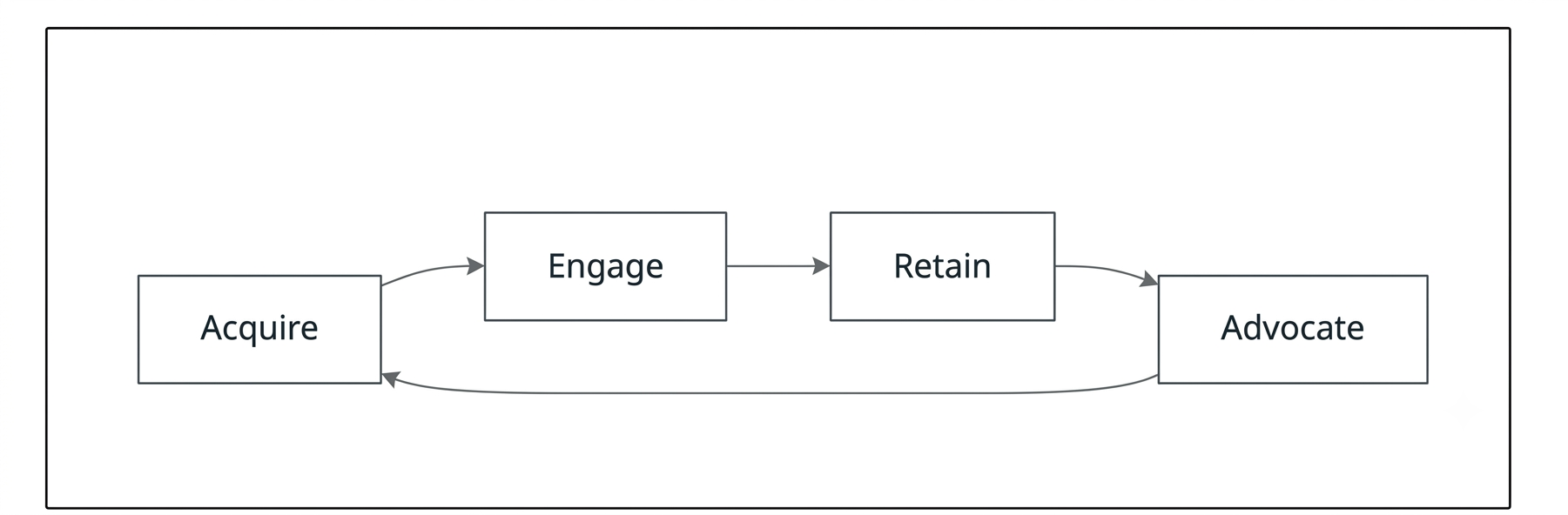
An effective CAC strategy considers the full customer journey. One useful framework is Acquire → Engage → Retain → Advocate.
| Stage | Primary Goal | Tactics | Business Impact |
|---|---|---|---|
| Acquire | Attract new customers | Paid Ads, SEO, Referrals, Content | Generates new customers (front of funnel) |
| Engage | Build relationships | Email campaigns, Reviews, Community | Keeps customers connected, boosts loyalty |
| Retain | Encourage repeat purchases | Loyalty programs, Subscriptions, VIP tiers | Increases Customer Lifetime Value (LTV) |
| Advocate | Turn customers into promoters | Referral programs, Social sharing | Drives additional acquisitions organically |
- Acquire: These tactics bring customers in. But each new customer is an investment.
- Engage: Once acquired, engage them with value (newsletters, content, events). Engagement increases satisfaction and opens up upsell opportunities.
- Retain: The aim is for customers to buy again. Loyalty points, VIP tiers, and subscriptions keep revenue flowing without repeated CAC.
- Advocate: Satisfied, engaged customers who buy repeatedly are your best advocates. They leave reviews and refer friends, which acquires new customers at minimal cost, feeding back into the cycle.
Framing growth this way ensures that acquisition dollars are just one part of the story. By focusing equally on engagement and retention, each acquired customer drives more long-term value, effectively lowering the long-term CAC.
How Retenzy Helps Reduce Customer Acquisition Cost
Retenzy is built to support the above lifecycle. It doesn’t make ads cheaper, but it improves what happens after you acquire a customer, increasing loyalty, referrals, and reviews to extract more value. Here’s how Retenzy’s platform aligns with the Acquire–Engage–Retain model:
Turn Customers Into Referral Sources:
Retenzy lets you run easy referral programs integrated with your loyalty points. For example, a brand using Retenzy might see up to 3× more referrals after launching a program. (In contrast to the ~2–3% of customers who normally refer friends, incentives can raise that rate significantly.) More referrals means more new customers without additional ad spend. Since referred leads have about 4× higher conversion and 25% lower CAC, Retenzy-driven referrals can substantially offset rising ad costs.
Encourage Repeat Purchases With Loyalty:
Retenzy’s points, milestones, and VIP tiers reward customers for every purchase and action. Brands earn points for purchases, reviews, and referrals, motivating them to return. Suppose a loyalty program increases your repeat purchase rate by 10%. A customer you spent $40 to acquire now comes back and spends an extra $4 (10% more revenue). That means you recoup 10% of that CAC on the second sale, effectively lowering CAC per lifetime dollar. (Even a modest repeat lift has outsized impact: a 5% retention increase can raise profits 25–95%.)
Leverage Reviews for Social Proof:
Retenzy’s review incentives encourage customers to leave feedback. More positive reviews improve conversion rates for new visitors (and boost SEO). If higher ratings and social proof raise your overall conversion by 5–10%, you effectively lower CAC (fewer ad impressions needed per sale). Plus, reviews feed back into referrals: friends of happy customers who see positive reviews are more likely to convert if referred.
Connecting Acquisition with Retention:
By integrating referrals and loyalty in one system, Retenzy closes the loop: each new customer can be quickly enrolled in a loyalty journey. For instance, a new customer might get bonus points for signing up, driving their second purchase sooner. Simultaneously, inviting them to refer friends taps into advocates early. This synergy means acquisition spend is amplified.
Conclusion
Reducing customer acquisition cost in ecommerce isn’t about spending less on ads alone; it’s about getting more value from the customers you acquire. Paid ads will only get more expensive, so the smartest brands focus on the acquire–engage–retain lifecycle. They balance targeted advertising with strategies that boost customer lifetime value and word-of-mouth.
In practice, this means building robust customer acquisition strategies for sustainable growth: encourage referrals, publish valuable content, foster communities, and implement loyalty programs. Each tactic makes your acquisition investments work harder. A new customer who buys again, refers a friend, or writes a positive review dramatically lowers the effective CAC relative to someone who never returns.
Tools like Retenzy facilitate this approach by tying referrals, loyalty, and reviews into one platform. Rather than trying to cut ad prices, Retenzy helps you improve the economics after the first purchase. When each customer is worth more to your business, your allowable CAC effectively rises (you can afford to spend more to acquire them), or conversely, your current CAC yields more value.
Ultimately, the goal isn’t a one-time low CAC number, but a durable growth model: acquire customers efficiently, keep them engaged, and retain them so they buy again and refer others. This sustainable growth model creates a virtuous cycle where each acquisition fuels the next.
Add points, referrals, and VIP rewards to your Shopify store in under 5 minutes.