
Most loyalty apps for small businesses on Shopify let you set earning rules and run bonus rewards, but the details vary. Before you plan a campaign, check whether your app supports multipliers, product-specific rules, spend thresholds, audience targeting and scheduled start and end dates, since each one changes which of the 8 ideas you can run.
8 Bonus Points Campaign Ideas to Lift Sales in Slow Months
It’s the third week of January. Traffic looks normal, but the orders that came easily in November have slowed to a trickle, and another 20% off sale feels like handing away margin. A bonus points campaign gives your loyalty members a reason to buy now while your prices stay exactly where they are. Below are 8 ideas for slow sales months, plus how to pick, run and measure the right one.
Table of contents
- Key takeaways
- What is a bonus points campaign?
- Which bonus points campaigns drive orders right away?
- Which bonus points campaigns increase average order value?
- Which bonus points campaigns bring customers back?
- How do you choose the right bonus points campaign?
- How do you run a bonus points campaign on Shopify?
- What mistakes should you avoid with bonus points?
- Make your next slow month work harder
Key takeaways
- Match each campaign to one goal: orders, order value or win-backs.
- A 2X points weekend can cost a fraction of a 10% discount.
- Set spend thresholds just above your typical order.
- Target lapsed customers instead of your whole list.
- Measure the weeks after the campaign, not just during it.
What is a bonus points campaign?
A bonus points campaign is a limited-time loyalty promotion that gives members extra points for purchases or other actions, such as 2X points for a weekend or 500 bonus points on orders over $75. Customers pay full price, and the incentive goes into their points balance instead of coming off the order total.
Here’s how the math works in a simple example program where members earn 1 point per $1 and 100 points are worth $1 off. A customer who spends $75 normally earns 75 points. During a 2X campaign, they earn 150 points, so the extra reward is worth $1.50 toward a future order. A 10% discount on the same order costs you $7.50, right now, whether or not that customer ever comes back.
The reward is smaller, it’s delayed and it gives customers a reason to return. The catch is that bonus points only stay special with a clear goal, a defined audience and a firm end date. Run them every month and they become a discount nobody notices.
Which bonus points campaigns drive orders right away?
When you simply need more orders this week, use a short multiplier with a deadline. A double points weekend creates urgency fast, a longer 1.5X multiplier covers a slow stretch of several weeks, and product-specific bonuses steer that demand toward the items you most want to sell.
1. Run a double points weekend
A double points weekend is the simplest bonus points campaign to launch. Pick a 48 to 72 hour window, set the multiplier to 2X and tell members exactly when it ends: “Earn 2X points on every order from Friday to Sunday.”
Announce it a few days ahead, send a reminder on the last day and let the multiplier switch off when the window closes. In the example program above, doubling points adds about 1% of each order in future rewards, which most stores can afford, but check it against your own margins first.
2. Stretch a 1.5X multiplier across a slow month
If sales soften for several weeks instead of a single weekend, a smaller multiplier over a longer window usually fits better. Try 1.5X points for 14 days under a name like “Beat the January Slowdown.”
A 1.5X multiplier adds half the extra points of 2X, so you can run it for longer. Match the length to your buying cycle: a coffee brand with a 3 week reorder cycle needs at least 2 weeks, while a weekend is plenty for impulse buys.
3. Give extra points on selected products
You don’t have to multiply points across your whole catalog. Product-specific bonuses send demand where you need it: 3X points on a new launch, 500 bonus points on a bundle or extra points on items with excess stock or healthy margins.
For a skincare store launching a new serum, “20% off” trains customers to expect a lower price, while “Earn 3X points on our new serum this week” invites them to try it at full price.
Which bonus points campaigns increase average order value?
Spend thresholds work best when your goal is bigger baskets, not just more orders. A single “spend $75, get 500 points” offer gives shoppers one clear target, while a points ladder rewards each extra step up. Base every threshold on your real order data, never on a number that just looks neat.
4. Use a spend-and-earn bonus
A spend-and-earn bonus rewards customers once they cross an order value: “Spend $75, get 500 bonus points.” A shopper with a $61 cart suddenly has a reason to add one more item.
The right threshold sits just above what customers already spend, so check your average and median order value first. If your average order is $72, a $75 threshold asks for almost nothing extra. If it’s $35, a $100 threshold feels out of reach.
5. Build a “buy more, earn more” points ladder
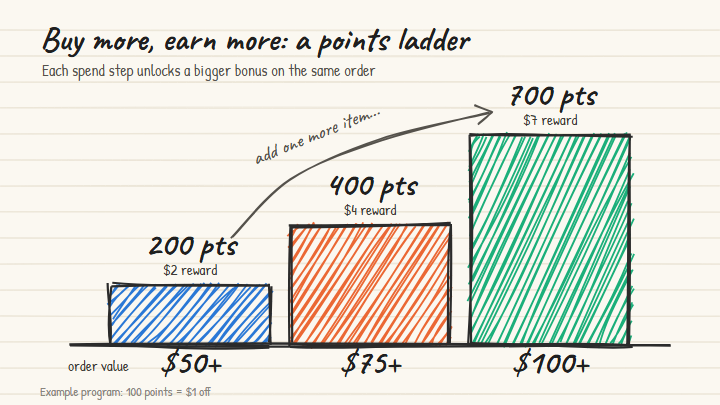
A points ladder adds several levels so customers can see what each extra step unlocks. Build the levels around where your orders naturally cluster. If most orders land near $40, $65 and $90, set thresholds just above those points.
| Order value | Bonus points | Reward value (100 pts = $1) |
|---|---|---|
| $50 and up | 200 | $2 |
| $75 and up | 400 | $4 |
| $100 and up | 700 | $7 |
Which bonus points campaigns bring customers back?
To win back lapsed buyers or earn a second order, target the offer instead of sending it to everyone. A reactivation bonus goes only to customers who’ve gone quiet, a next-order bonus turns today’s purchase into a reason to return, and action-based bonuses keep members engaged even when they aren’t buying.
6. Send a targeted reactivation bonus
Not every slow-month campaign needs to reach your entire list. A “We miss you: earn 500 bonus points on your next order” email can go only to customers who haven’t bought in 60 or 90 days, repeat buyers who’ve gone quiet or members sitting on unused loyalty points.
A sitewide offer pays bonuses to people who would have bought anyway. If 10,000 members get the offer but only 1,500 have lapsed, sending it to just those 1,500 cuts costs and shows clearly whether the bonus brought people back.
7. Reward the next purchase, not just this one
A slow month doesn’t have to be about maximizing one order. You can design the campaign around the next one: “Order this week and unlock 300 bonus points toward your next purchase within 30 days.”
Here’s how that plays out in the example program. A customer places a $60 order, earns 60 regular points and unlocks the 300 point bonus, bringing their balance to 360 points ($3.60). A follow-up email a week later, “You have 360 points waiting,” gives them a reason to come back before the bonus window closes. You can also set an automatic milestone bonus, so a customer’s second or fifth order earns extra points without a manual campaign.
8. Pair bonus points with a specific action
Bonus points don’t have to be tied to purchases. A quiet month is a good time to boost actions that help your store long term, such as 2X points for referrals, 250 bonus points for a verified product review or extra points for completing a profile.
A “Slow Month Review Boost” can fill product pages with fresh social proof before your busy season. Keep the reward neutral, so any star rating earns the same points, and credit them when the review is submitted.
How do you choose the right bonus points campaign?
Start with the problem you’re trying to solve, then pick the campaign built for it. Short-term orders call for a double points weekend, bigger baskets call for a threshold or ladder, and lapsed customers call for a targeted bonus. One campaign, one goal keeps both the offer and the results easy to read.
| Your goal | Best campaign | Example offer |
|---|---|---|
| More orders this week | Double points weekend | 2X points, Friday to Sunday |
| Steady demand for several weeks | Slow-month multiplier | 1.5X points for 14 days |
| Sell specific products | Product-specific bonus | 3X points on the new serum |
| Higher average order value | Spend-and-earn bonus | 500 points on orders over $75 |
| Bigger baskets at every level | Points ladder | 200, 400 or 700 points by spend |
How do you run a bonus points campaign on Shopify?
Running a campaign takes five steps: pick one goal, choose the audience, set the bonus, fix a start and end date, and tell members before it starts. Most loyalty apps for small businesses on Shopify let you set earning rules and audiences, so the real work is in planning and communication.
1. Pick one goal. More orders, higher order value, reactivation, product sales or engagement. Trying to move all of them at once makes the results impossible to read.
2. Choose the audience. All members, new members, VIP members or lapsed customers each change the cost. A bonus limited to one VIP tier costs far less than a sitewide one and makes top customers feel recognized.
3. Set the bonus. Use a multiplier, a flat bonus, a spend threshold, a ladder or an action-based bonus.
4. Fix the dates. Set an exact window, such as Friday at 8:00 AM to Sunday at 11:59 PM, and end on schedule. A real deadline is what gets people to act.
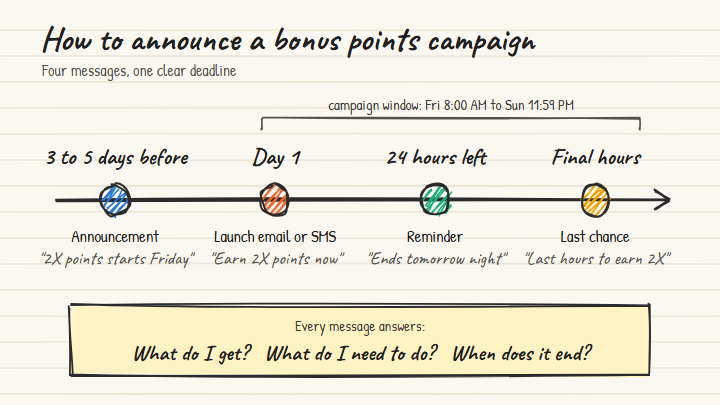
5. Tell members early. Send an announcement 3 to 5 days before, a launch message on day one, a 24-hour reminder and a last-chance message. Each one should say what members get, what they need to do and when it ends.
What mistakes should you avoid with bonus points?
The biggest mistakes are running bonuses so often they lose their pull, writing rules nobody can follow and judging success only by sales during the campaign. A few simple habits keep each campaign profitable and worth repeating.
- Running promotions constantly. If members see 2X points every month, they’ll wait for it.
- Making the rules complicated. “3X points on selected products, except clearance, between 6 PM and midnight” is hard to follow. Customers should get the offer in one read.
- Rewarding people who’d buy anyway. Sitewide bonuses pay for existing demand. Targeting lapsed customers keeps the spend on new orders.
- Ignoring point liability. Every point issued is a future reward, so work out the redemption cost before launch.
- Measuring only campaign-week sales. A campaign can pull orders forward instead of creating new ones. Compare the 30 days after against a normal month in your loyalty analytics.
Make your next slow month work harder
The best bonus points campaign is the one built around a single change you want to see, whether that’s more orders this weekend, bigger baskets or lapsed customers coming back. Pick one idea from this list for your next quiet stretch, set a firm end date and check your results 30 days after it closes. That one habit will tell you which campaigns deserve a spot on next year’s calendar.
Your next step: open last year’s sales report, mark your two slowest weeks and schedule a bonus points campaign for the first one today.
FAQ
What is a bonus points campaign in a loyalty program?
A bonus points campaign is a limited-time promotion that gives loyalty members extra points, such as 2X points on every order or 500 bonus points over a set spend. Customers pay full price and the extra value goes into their points balance, which encourages a future visit instead of lowering the price of today’s order.
How long should a double points weekend last?
Most double points weekends run 48 to 72 hours, usually Friday to Sunday. That’s long enough for members to see the email and plan a purchase, but short enough to feel urgent. If your customers buy on a longer cycle, such as every three or four weeks, a 1.5X multiplier over 14 days often works better.
Are bonus points better than discounts during slow sales months?
Often, yes. A discount lowers the price on every order immediately, while bonus points cost you only when members redeem them later. In a program where 1 point equals $1 spent and 100 points equal $1 off, 2X points on a $75 order costs $1.50 in future rewards, compared with $7.50 for a 10% discount.
How often should you run a bonus points campaign?
Plan three to five bonus points campaigns a year, timed to your slowest weeks. Running them monthly trains members to wait for the next one, which shifts orders around instead of adding new ones. Keep a calendar, avoid repeating the same offer back to back and change the format between campaigns.
Do loyalty apps for small businesses support bonus points?
Increase Repeat Orders with Retenzy
Add points, referrals, and VIP rewards to your Shopify store in under 5 minutes.