
Most stores should start with retention, because a first-time buyer needs a reason to come back before any deeper relationship can form. Focus on the gap between the first and second order. Once customers return regularly, add loyalty tactics like points for engagement, VIP tiers and referrals to turn that habit into real preference.
Customer Loyalty vs Customer Retention: What’s the Difference?
Your Shopify dashboard says repeat customers are up. Nice. Then a competitor runs a 20% off sale, and a chunk of those regulars quietly disappears. So were they ever loyal? That question sits at the heart of customer loyalty vs customer retention. They sound like twins, but they measure different things, and mixing them up leads to the wrong strategy. Here’s how to tell them apart and grow both.
Table of contents
- Key takeaways
- What’s the difference between customer loyalty vs customer retention?
- What is customer retention, and how do you measure it?
- What is customer loyalty?
- Are loyal customers vs repeat customers the same thing?
- Why can you have retention without loyalty?
- How should Shopify stores measure loyalty vs retention?
- Win the second order, then earn the preference
Key takeaways
- Retention means customers come back. Loyalty means they prefer you.
- Repeat purchases prove retention, not loyalty.
- Discounts and convenience can fake loyalty.
- Measure retention with behavior and loyalty with engagement.
- Use retention to earn the second order, then loyalty to keep it.
What’s the difference between customer loyalty vs customer retention?
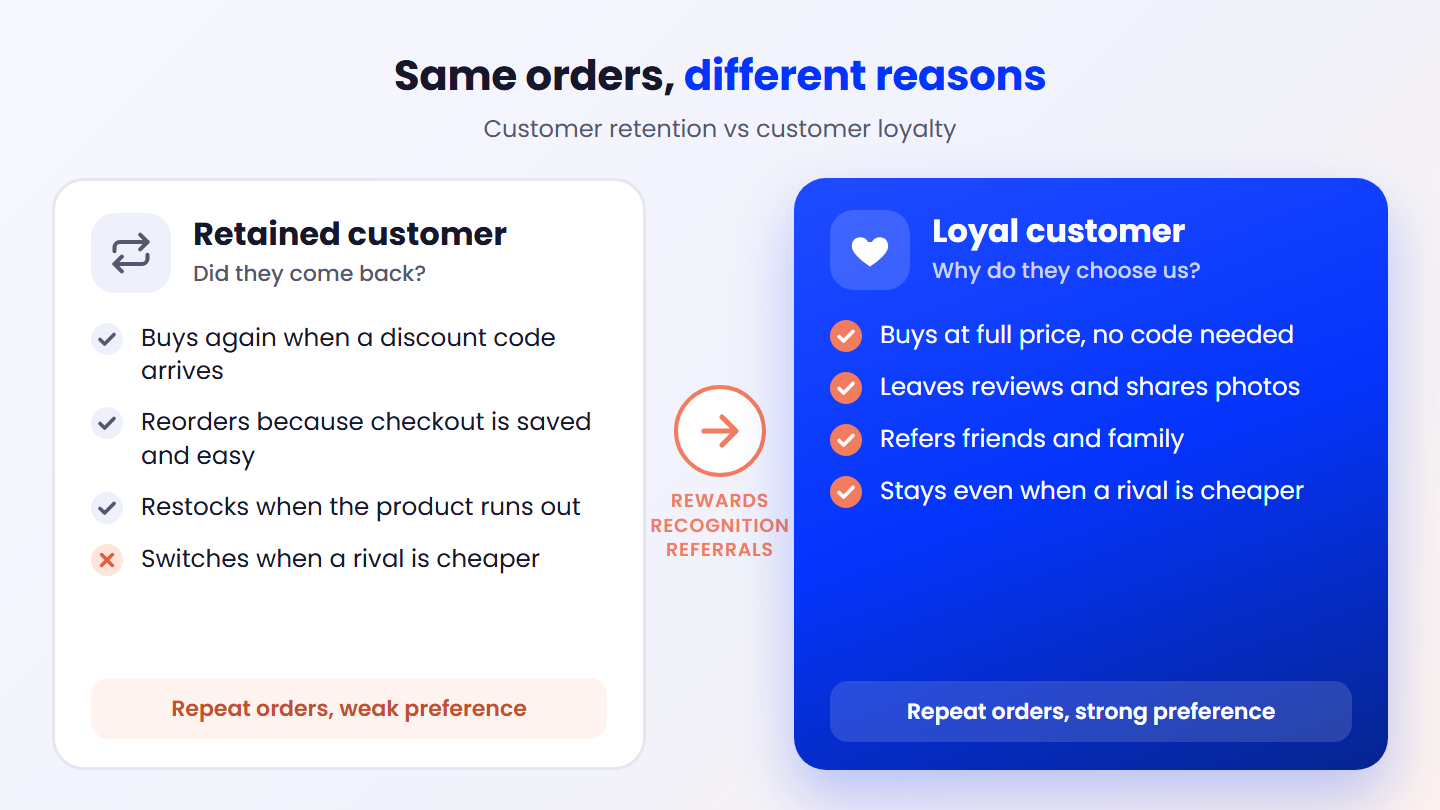
Customer retention is whether customers keep buying from you over a set period. Customer loyalty is why they keep buying and how strongly they prefer your brand over alternatives. Retention is an outcome you can see in your order data. Loyalty is a relationship you build, and it shows up in behavior that goes beyond buying.
Think of it this way. Retention asks “Did they come back?” Loyalty asks “Would they still pick us if someone else were cheaper?” A customer can tick the first box without ever ticking the second.
| Comparison | Customer retention | Customer loyalty |
|---|---|---|
| Core question | Did the customer come back? | Why does the customer choose us? |
| Focus | Repeat behavior | Preference and relationship |
| Main drivers | Convenience, reminders, incentives, product satisfaction | Trust, consistent experience, emotional connection, perceived value |
| Typical customer | A repeat buyer | A committed fan and potential advocate |
| Key metrics | Retention rate, repeat purchase rate, churn, purchase frequency | Customer lifetime value, referrals, reviews, loyalty engagement, NPS |
| Price sensitivity | Often high | Usually lower |
What is customer retention, and how do you measure it?
Customer retention is your store’s ability to keep existing customers buying over a defined period, instead of constantly replacing one-time buyers with new ones. On Shopify, it mostly comes down to repeat purchasing: how many customers return, how often, and for how long.
Here’s a simple example. A skincare store wins 1,000 first-time customers in January. By April, 300 have ordered again and 700 haven’t. The ads dashboard looks great, but the store has a retention problem. Seven out of ten customers it paid to acquire never came back.
Retention tactics give customers a reason and a chance to buy again. Think post-purchase emails, replenishment reminders timed to how fast the product runs out, useful product recommendations, win-back campaigns and easy one-click reordering.
The retention metrics worth tracking
- Customer retention rate: (customers at the end of a period minus new customers acquired) divided by customers at the start, times 100. Match the window to your buying cycle.
- Repeat purchase rate: the share of customers who’ve ordered more than once.
- Purchase frequency: how often those customers buy. Twice a year and once a month are very different relationships.
- Churn rate: the share of customers who stop buying in a given period.
- Customer lifetime value (CLV): the total revenue a customer brings over the whole relationship.
These numbers answer “Are customers still doing business with us?” They don’t answer “Would they choose us if they had better options?” That second question is where loyalty comes in. You can track both sets of numbers in loyalty analytics.
What is customer loyalty?
Customer loyalty is a customer’s ongoing preference for your brand, based on the trust, value and experience they connect with it. A loyal customer doesn’t come back just because an email landed in their inbox. They’ve built up real reasons to prefer you, such as consistent quality, great service, shared values or a community they enjoy.
That’s why brand loyalty is bigger than repeat purchasing. Picture two customers who both buy coffee from Brand A every month. When Brand B offers the same beans for 15% less, the first customer switches that afternoon. The second one doesn’t even click, because they trust the roast, like the brand’s story and have already recommended it to three friends. Both were retained. Only one was loyal.
Behavioral loyalty vs emotional loyalty
Behavioral loyalty is what customers do. They buy often, spend more over time, redeem rewards and reorder the same product. It’s valuable, but it doesn’t tell you what’s driving it.
Emotional loyalty is how customers feel. They trust your products, identify with your brand and would genuinely miss you. Compare “I buy this shampoo because it works and reordering is easy” with “I’ve used this brand for years, I tell everyone about it and I’m not switching.” Both people are worth keeping, but competitors will find the second one much harder to win over.
Are loyal customers vs repeat customers the same thing?
No. A repeat customer has bought more than once. A loyal customer has bought more than once and also prefers your brand strongly enough to stay when a cheaper or easier option appears. Every loyal customer is a repeat customer, but plenty of repeat customers aren’t loyal at all.
Meet three customers at the same store:
| Customer | Why they buy | Retention | Loyalty |
|---|---|---|---|
| Customer A | Orders only when a 25% off code arrives | Medium | Weak |
| Customer B | Reorders because delivery is fast and checkout is saved | Strong | Moderate |
| Customer C | Buys regularly, leaves reviews, refers friends, stays even when rivals are cheaper | Strong | Strong |
Customer A is retained by discounts. Customer B is retained by convenience. Only Customer C is truly loyal, and C is also the one bringing in new customers through referrals. If your reports lump all three together as “loyal,” you’ll overestimate how safe your revenue really is.
Go deeper: 10 Proven Customer Retention Strategies You Need to Implement Today covers the tactics that win that crucial second order.
Why can you have retention without loyalty?
Customers can keep buying from you for reasons that have nothing to do with preferring your brand. Discounts, convenience and simple necessity all create repeat orders that look like loyalty in a dashboard. The test is what happens when those reasons go away or a competitor matches them.
Discounts create temporary retention
A discount can absolutely trigger another order. But when customers only return for a promo, you’ve trained them to wait. The pattern repeats: a code goes out, they buy, the code expires, they go quiet, and then you send another code. They’re technically retained, but the relationship is rented, not owned.
Convenience creates habit, not preference
Saved addresses and payment details make reordering easy, and that’s a good thing. But a competitor can copy convenience with faster shipping or a smoother checkout. If convenience is your only advantage, it won’t hold forever.
Necessity can look like loyalty
People rebuy coffee, pet food, detergent and skincare because they run out, not always because they love you. In these categories, high repeat rates are partly built in. Read your retention numbers alongside reviews, referrals and engagement before you call them loyalty.
Loyalty can exist without frequent orders
It works the other way too. A customer might buy from a premium apparel brand just twice a year, yet follow it closely, wait for new drops and recommend it constantly. Judge them by order count alone and you’ll miss one of your most loyal fans.
How should Shopify stores measure loyalty vs retention?
Measure retention with purchase behavior and loyalty with engagement and preference signals, then read them together. No single number proves loyalty. A high repeat purchase rate shows customers return, but not whether they’d leave for a lower price. A high NPS shows goodwill, but not whether people actually reorder.
One of the most telling loyalty signals sits in the bottom row: repeat orders that happen without a discount code. If your best customers keep buying at full price, that’s preference, not promotion.
| Measure retention with | Measure loyalty with |
|---|---|
| Customer retention rate | Customer lifetime value |
| Repeat purchase rate | Referral rate |
| Purchase frequency | Loyalty program participation and redemption |
| Churn rate | VIP tier progression |
| Returning customer revenue | Review activity |
| Cohort retention | Repeat orders without heavy discounting, NPS |
Win the second order, then earn the preference
The short version of customer loyalty vs customer retention is this: retention gets customers to come back, and loyalty gives them a reason to prefer you. Start by fixing the gap between first and second purchase, because loyalty can’t grow without a habit. Then reward engagement, recognize your regulars and make referrals easy, so your repeat buyers become customers who choose you on purpose.
FAQ
Is customer loyalty the same as customer retention?
No. In the customer loyalty vs customer retention comparison, retention measures whether customers keep buying, while loyalty describes how strongly they prefer your brand. Retention is mainly behavioral and shows up in order data. Loyalty also includes emotional and attitudinal signals, such as trust, reviews, referrals and choosing you over cheaper alternatives.
Can you have customer retention without loyalty?
Yes. Customers often keep buying because of discounts, convenience, habit or simply because they need to restock. That’s retention, but it’s fragile. If a competitor offers a better price or a smoother experience, these customers are likely to switch, because nothing beyond the deal was holding them.
Are repeat customers loyal customers?
Not always. Every loyal customer is a repeat customer, but many repeat customers aren’t loyal. To tell them apart, look beyond order count at signals like full-price purchases, reviews, referrals and loyalty program engagement. Those show preference, while repeat orders alone only show that someone came back.
What is the main difference between customer loyalty vs customer retention?
The main difference is what you’re measuring. Retention tracks continued purchasing over time, using metrics like repeat purchase rate and churn. Loyalty tracks the strength of the relationship, using signals like customer lifetime value, referrals, reviews and willingness to recommend your brand. Retention is the “what,” and loyalty explains the “why.”
Which should a Shopify store focus on first?
Increase Repeat Orders with Retenzy
Add points, referrals, and VIP rewards to your Shopify store in under 5 minutes.