
Double Points vs Discounts on Black Friday: Which Protects Your Margin?
Your dates, inventory and emails are planned, and the question left is the offer. A flat 20% off is easy to promote and easy to understand, but it comes straight out of every order, including orders from customers who would have paid full price. Double points keeps your prices where they are, but it isn’t free either. Weighing double points vs discounts comes down to one number: how much contribution profit each offer leaves you per order.
- Key takeaways
- What is the difference between double points and discounts?
- How much margin does a Black Friday discount really cost?
- How do double points work during Black Friday?
- Double points vs discounts: which protects more margin?
- How do you calculate the cost of a double points campaign?
- What Black Friday promotion ideas protect margins?
- How can you combine double points and discounts without overpaying?
- How can Retenzy support a double points Black Friday campaign?
- Conclusion: The offer that wins is the one that pays for itself
Key takeaways
- A 20% discount on a 50% margin product cuts profit per unit by 40%.
- Double points costs only the incremental points customers actually redeem.
- Discounts suit acquisition and clearance; double points suit repeat buyers.
- A hybrid offer works if you price the stack before launch.
What is the difference between double points and discounts?
A direct discount lowers the price a customer pays today, for example 20% off or $15 off a qualifying order. Double points keeps the price the same and gives the customer twice the usual loyalty points to spend on a future order. The discount costs you on this order. Points cost you later, and only when they’re redeemed.
That timing difference is what makes the comparison interesting. A discount hits the order you’re taking right now, every time, at the full advertised value. A points bonus moves the cost to a future order, and the customer has to come back to claim it. Some will. Some won’t. And the ones who come back usually place an order that carries its own margin.
None of this makes double points automatically cheaper. A generous points rate, high redemption and thin product margins can make a bonus points campaign as expensive as a markdown. You still have to do the math, so here it is.
How much margin does a Black Friday discount really cost?
A percentage discount costs more profit than its headline suggests, because it comes off the price while your product cost stays the same. On a product with a 50% gross margin, a 20% discount removes 40% of the gross profit on each unit. To earn the same total gross profit, you’d need to sell about 67% more units.
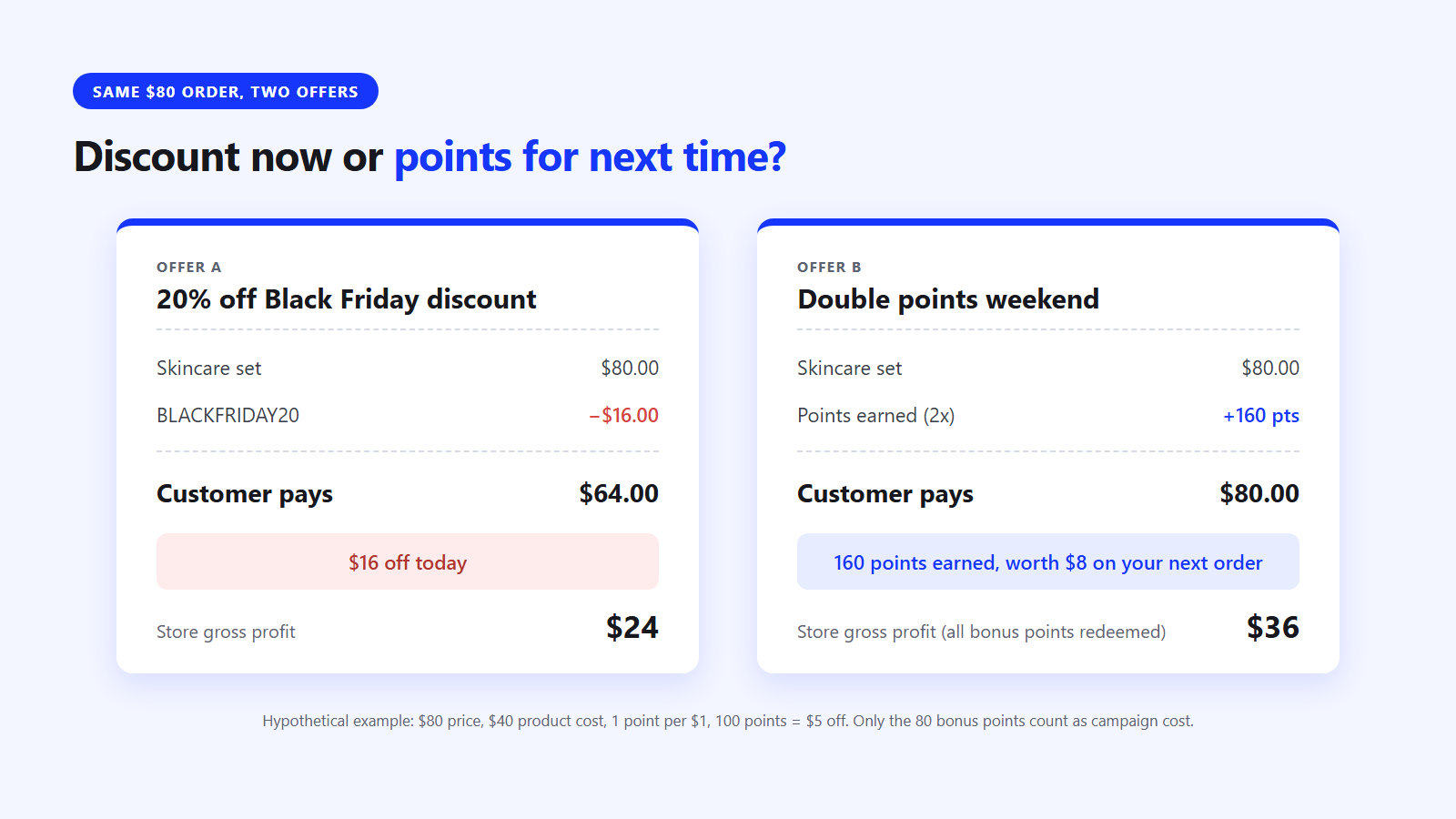
Take a hypothetical store selling a skincare set for $80 that costs $40 to make and ship to the warehouse. To keep it simple, product cost is the only expense in this example.
| Metric | Full price | 20% off |
|---|---|---|
| Selling price | $80 | $64 |
| Product cost | $40 | $40 |
| Gross profit per unit | $40 | $24 |
| Gross margin | 50% | 37.5% |
| Units needed to match 100 full-price sales | 100 | 167 |
The 20% headline turns into a 40% drop in profit per unit. Once you add shipping, payment fees, returns and ad spend, which don’t shrink when the price does, the real hit to contribution margin is even larger.
The hidden cost is who claims the discount. A sitewide code goes to everyone, including loyal customers who had the product in their cart already. Those orders don’t add demand. They just move margin from you to a shopper who was going to buy anyway.
When a discount is still the right call
Discounts earn their cost when they create sales you wouldn’t otherwise get:
- Clearing stock: Seasonal or discontinued items that will be harder to sell in January are worth marking down now, because unsold inventory has its own carrying cost.
- Winning first-time buyers: A price-sensitive shopper who has never bought from you may need an immediate saving to try the brand. Points mean little to someone with no account.
- Matching a competitor: When shoppers compare near-identical products side by side, a targeted, time-limited markdown on that product can decide the sale.
- Lifting basket size: A tiered offer such as $10 off $75 pushes customers above your usual order value, so the extra items help cover the discount.
The pattern in all four is targeting. A discount aimed at a specific product or customer group can pay for itself, while a blanket markdown usually can’t.
How do double points work during Black Friday?
A double points campaign multiplies the points customers earn on qualifying purchases for a set window, such as Black Friday through Cyber Monday. If your program normally gives 1 point per $1 spent, members earn 2 points per $1 during the event. The customer pays full price and leaves with a bigger balance to redeem on the next order.
This turns the incentive from “save now” into “save next time,” and that shift matters for retention. A customer holding 160 points that are worth $8 off has a concrete reason to come back in December or January, which is when most stores see sales fall off after BFCM.
Double points fit best when you want to:
- Bring existing customers back for the event without lowering prices for every visitor.
- Build a reason for a second order in the quiet weeks after the sale.
- Grow program sign-ups, since shoppers have to join to collect Black Friday loyalty points.
- Reward bigger baskets by applying the multiplier above a spend threshold.
Before you launch, set the rules: which products qualify, whether points can stack with other codes, when points become redeemable and whether they expire. If points become redeemable the same day, a customer can earn on Friday and spend on Saturday, which turns your bonus into a delayed discount on the same weekend.
Go deeper: 8 Bonus Points Campaign Ideas to Lift Sales in Slow Months
Double points vs discounts: which protects more margin?
| Scenario | Price paid | Incentive cost | Gross profit per order |
|---|---|---|---|
| Full price, normal points | $80 | $0 (baseline) | $40 |
| 20% discount | $64 | $16 (certain) | $24 |
| Double points, 30% of bonus redeemed | $80 |
$1.20 (expected) |
$38.80 |
| Double points, 60% of bonus redeemed | $80 |
$2.40 (expected) |
$37.60 |
| Double points, 100% of bonus redeemed | $80 |
$4 (expected) |
$36 |
| Factor | Double points | Direct discount |
|---|---|---|
| Price paid today | Full price | Reduced |
| When the cost lands | On a future order, if redeemed | On this order, every time |
| Who it attracts | Members and repeat buyers | Price-led and first-time shoppers |
| Effect after BFCM | Gives customers a reason to come back | Can train shoppers to wait for sales |
| Best use | Retention and second orders | Acquisition and stock clearance |
| Main risk | Weak pull with new visitors | Margin given to customers who’d have bought anyway |
How do you calculate the cost of a double points campaign?
To cost a double points campaign, multiply the bonus points you expect to award by the value of a point at redemption, then by your expected redemption rate. The result is the budget for the promotion. Compare it with the extra contribution profit you expect the campaign to bring in.
Work through it in four steps:
- Count the bonus points only. Your normal points rate is already in your baseline, so only the extra points are a campaign cost. On an $80 order at 2x, that’s 80 bonus points.
- Value a point at redemption. If 100 points unlock $5 off, each point is worth $0.05 in revenue you’ll give up later. If the reward is a free product, use what the product costs you, not its retail price.
- Estimate redemption. Use your own program history if you have it. If you don’t, model three cases (for example 30%, 60% and 100%) and make sure the campaign still makes sense in the worst one.
- Compare against incremental profit. Add up extra orders, higher order value and repeat purchases in the 60 to 90 days after the event. If that figure is bigger than the expected points cost, the campaign worked.
Your loyalty analytics should show points issued, points redeemed and repeat orders from members, which are the three numbers you need to check the result afterward.
One accounting note: unredeemed loyalty points may need to be recorded as a liability or deferred revenue, depending on the standards your business reports under. Confirm the treatment with your accountant. For campaign planning, the practical point is simple: give double points a budget, the same way you’d budget a discount.
What Black Friday promotion ideas protect margins?
The Black Friday promotion ideas that protect margins are the ones aimed at a specific goal and a specific group, rather than a sitewide percentage. Bundles, spend thresholds, gifts with purchase, early access and double points for members each give shoppers a reason to buy now while limiting how much margin you give away.
1. Double points for members. Give logged-in members 2x points for the event window. Everyone sees the same price, but members get a reason to buy from you instead of the store running a deeper markdown. Best for retention.
2. Bundles priced as a set. A cleanser, toner and moisturizer sold together at $10 below their combined price limits the discount to the bundle and moves more units per order. Best for basket size.
3. Spend-threshold rewards. Offer 500 bonus points or free shipping above a threshold set a little above your normal order value. The extra items in the cart help pay for the reward. Best for average order value.
4. Gift with purchase. A travel-size product that costs you $4 can feel worth $15 to the customer, as long as it’s relevant to what they bought. Best for keeping your full price intact.
5. Early access for members or VIP tiers. Open the sale 24 to 48 hours early for your best customers. Being first is part of the reward, so the deal itself can be smaller. Best for rewarding loyal buyers and building early demand.
Pick based on what the business needs most. Excess stock may justify a markdown. A store that wants more repeat buyers in Q1 gets more from bonus points and early access.
How can you combine double points and discounts without overpaying?
You can run both, as long as you cost the combined offer and decide who gets what. The common setup is a modest public discount for everyone and double points for loyalty members on top. Price-sensitive shoppers get an immediate saving, and members get a reason to buy now and come back later.
Back to the $80 example. A 10% discount plus double points looks like this:
| Offer | Price paid | Bonus points cost (60% redeemed) | Gross profit per order |
|---|---|---|---|
| 20% discount only | $64 | $0 | $24 |
| 10% discount + double points | $72 | $2.16 | $29.84 |
| Double points only | $80 | $2.40 | $37.60 |
| Segment | Offer | Goal |
|---|---|---|
| First-time visitors | Targeted welcome discount | First order |
| Existing members | Double points | Repeat purchase |
| High-margin collections | Small discount plus bonus points, if the math works | Volume |
| Excess inventory | Targeted markdown, no bonus points | Clearance |
| Top-tier members | Early access or an exclusive reward | Retention |
The last row is often the cheapest way to make members feel the stack is worth it. When you give VIP members early access, the reward is time rather than margin, so you can keep the discount itself modest.
Write the stacking rules down before launch: which codes combine with bonus points, which products are excluded and what the minimum spend is. Then place a test order for each customer type and check the price and points shown on the product page, in the cart and at checkout.
How can Retenzy support a double points Black Friday campaign?
Retenzy is a Shopify app that combines rewards, referrals, reviews and deals, so a Black Friday points bonus can lead into a planned second order instead of ending on Cyber Monday. You can run a points multiplier for a set window, show balances where shoppers see them and follow up after the event.
A simple campaign plan looks like this:
- Two weeks before: Promote your rewards program so shoppers join before the sale and understand how points work.
- Black Friday to Cyber Monday: Run double points on the products or customer groups you chose, with clear redemption rules.
- The week after: Email members their new balance and suggest a relevant next product. Referrals give happy holiday buyers a way to bring in friends at a known cost.
- 30 to 90 days later: Compare contribution profit, repeat orders and points redeemed against your discount campaigns from last year.
Conclusion: The offer that wins is the one that pays for itself
When you weigh double points vs discounts, judge each offer by the profit it adds, not the revenue it books. Use double points to protect margins on orders from customers who already know you, and save discounts for the shoppers and products where a price cut actually changes the decision. Work out your product-level numbers this week, before the offer is set in stone. For the rest of the season, from early access to January follow-up, use the complete BFCM guide for Shopify stores.
FAQs
Are double points better than discounts on Black Friday?
For margin, usually yes. Double points keeps the full price and costs only the bonus points that get redeemed, typically a few percent of the order. A discount costs its full value on every order. Discounts still win when you need first-time buyers or need to clear stock, because an immediate saving is a stronger hook for new shoppers.
How do you compare double points vs discounts on profit?
Calculate gross profit per order under each offer. For a discount, subtract the discount from the price, then subtract product cost. For double points, subtract product cost and the expected cost of the bonus points, which is bonus points times point value times redemption rate. Then estimate how many extra orders each offer would need to match the other.
Do Black Friday loyalty points expire?
That depends on your program rules. Many stores set an expiry window, such as 6 or 12 months, or require points to wait a few days before they can be redeemed. A short delay before redemption stops shoppers from earning bonus points on Friday and spending them on Saturday, which would turn the bonus into a same-weekend discount.
Can you run double points and a discount at the same time?
Yes, if your loyalty app and discount settings allow the two to combine. Cost the stacked offer first. In a hypothetical $80 order with 50% margin, 10% off plus double points kept about $30 in profit, while 20% off alone kept $24. Set clear stacking rules and test checkout for each customer type.
How do you measure whether a double points campaign worked?
Track points issued, points redeemed, average order value and repeat purchase rate among members for 60 to 90 days after the event. Compare contribution profit with a baseline, such as last year’s discount campaign or members who didn’t buy during the promotion. A good campaign brings in more extra profit than the points cost.
Add points, referrals, and VIP rewards to your Shopify store in under 5 minutes.