
The 5 Stages of Brand Loyalty and How to Move Customers Through Them
The stages of brand loyalty are the steps a shopper takes from first hearing about your store to recommending it to friends: suspect, prospect, customer, client and advocate. Each stage needs something different. Strangers need a clear reason to look, first-time buyers need a great experience, and repeat buyers need recognition that makes staying worthwhile.
A shopper finds your Shopify store, browses a few products and places an order. That is a good start, but it doesn’t mean they will ever come back. Some customers return because they liked the product, some because your price was right, and a few because they genuinely trust you. Understanding the stages of brand loyalty helps you see which group each customer belongs to, so you can give them the right nudge instead of sending everyone the same discount.
Key takeaways
- Loyalty builds in five stages, from suspect to advocate.
- Each stage needs a different goal, message and metric.
- A first order is a chance at loyalty, not proof of it.
- Rewards work best when they recognize real repeat behavior.
- Track movement between stages to find where customers stall.
What Are the Stages of Brand Loyalty?
The stages of brand loyalty describe how a customer’s relationship with a brand grows over time. A shopper starts out unaware, becomes interested, makes a first purchase, comes back for more and, at the top, recommends the brand to others. The most practical version for ecommerce is the five-step customer loyalty ladder.
The five-stage customer loyalty ladder
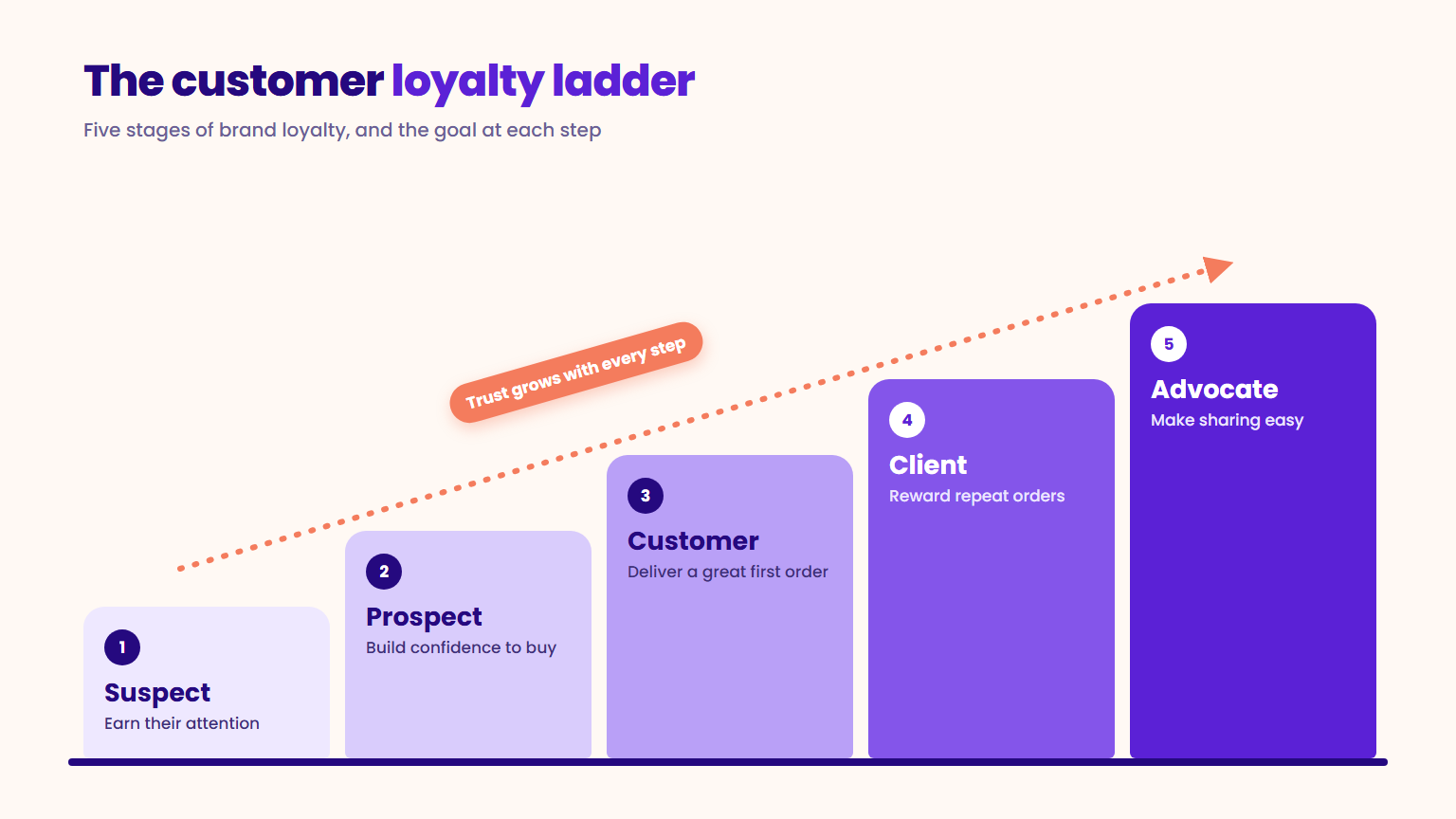
The customer loyalty ladder is a marketing framework that groups people by how close their relationship with your business is. Each rung is a step up in trust and commitment.
- Suspect: someone who fits your customer profile but hasn’t shown interest yet.
- Prospect: someone who has shown interest, such as subscribing or browsing, but hasn’t bought.
- Customer: someone who has completed a first purchase.
- Client: someone who buys again and starts to prefer your brand.
- Advocate: someone who actively recommends your brand to others.
The psychology behind the ladder
Marketing professor Richard Oliver described loyalty in four phases that explain why customers move up the ladder. They help you see what is happening in a shopper’s head at each step.
| Oliver’s Phase | What the Customer Thinks | Where It Shows Up on the Ladder |
|---|---|---|
| Cognitive | “This brand seems better on price or features.” | Suspect to prospect |
| Affective | “I like this brand.” | Customer |
| Conative | “I plan to buy from them again.” | Client |
| Action | “I buy here and I’d defend this choice.” | Advocate |
Treat both models as guides rather than rigid paths. Customers can skip stages, stay at one stage for a long time, or drift back after a run of repeat orders.
The 5 Stages of Brand Loyalty and What Each Customer Needs
Each stage of brand loyalty has its own job. Suspects need a reason to pay attention, prospects need confidence to buy, customers need a first order that lives up to the promise, clients need recognition, and advocates need an easy way to share. The sections below cover what to do at each stage and how to tell whether it is working.
Stage 1: Suspect, turning awareness into interest
A suspect fits your ideal customer profile but hasn’t engaged yet. They might see your brand in a social post, an ad or a search result without knowing what makes you different. Your goal here is not to sell to everyone who scrolls past. It’s to attract the right people and give them a reason to look closer.
How to move suspects to the next stage
- State your value clearly: say what your products do, who they are for and why they beat the alternatives, in plain words.
- Publish useful content: buying guides, comparisons and how-to articles help people understand your products before they’re ready to buy.
- Show credibility early: clear shipping and returns details and visible ratings reduce doubt from the first visit.
- Make the next click obvious: send visitors to a bestseller or category page instead of your homepage.
For example, a skincare brand might publish a guide on choosing a moisturizer for each skin type. A reader finds it through search, clicks through to the recommended products, and moves from stranger to interested visitor.
Metrics to track
Watch relevant traffic, product page visits, click-through rate and new email or SMS subscribers who have given consent.
Stage 2: Prospect, turning interest into a first order
A prospect has shown interest. They may have joined your list, browsed several products or added something to their cart. They still have questions about quality, price, delivery and whether your store can be trusted, so this is where the shopping experience matters most.
Reviews do much of the work at this stage. A 2016 Pew Research Center survey found that 82% of US adults at least sometimes read online reviews before buying something for the first time, and 40% almost always do. Showing honest reviews and ratings on product pages answers the question a prospect is quietly asking: “Did this work for people like me?”
How to move prospects to the next stage
- Remove uncertainty: use accurate photos, sizing details where they apply, delivery estimates and an easy-to-find returns policy.
- Follow up with relevance: with consent, send messages based on what the shopper browsed, such as the dimensions and materials of the lamp they viewed twice.
- Use incentives carefully: a first-order discount or free shipping threshold can tip a price-sensitive shopper, but it shouldn’t be the only reason to buy.
Metrics to track
Watch product page conversion rate, cart abandonment rate, email conversion rate and the number of new first-time customers.
Stage 3: Customer, turning the first order into a good experience
The customer stage starts with the first purchase. It’s an important milestone, but it isn’t proof of loyalty. A first-time buyer may have ordered because of a promotion or a one-off need, and whether they return depends on what happens next.
A poor first experience is expensive. In a 2025 study by the Qualtrics XM Institute covering nearly 24,000 consumers, 38% cut their spending with a company after a very poor experience and 15% stopped spending entirely. Many brands turn first-time buyers into loyal customers by getting the first few weeks after delivery right.
How to move customers to the next stage
- Make fulfillment reliable: send timely confirmations, shipping updates and accurate delivery dates.
- Help them get value from the product: share care guides, setup tips or usage ideas so the product delivers on its promise.
- Ask for feedback at the right time: invite an honest review once they have had time to use the product, without pushing for a positive one.
- Introduce your loyalty program: a loyalty points system that awards welcome points on the first order gives customers a reason to come back for the second.
- Recommend the next product: suggest complementary items or a replenishment reminder that matches their buying cycle.
Keep the program rules simple
Customers should understand how to earn and redeem points within a few seconds. If the rules need a long explanation, simplify them before you promote the program.
For example, a coffee brand could send a brewing guide after the first order, ask for a review two weeks later, and show the customer how many points they already have toward their next bag.
Metrics to track
Watch review submission rate, loyalty program sign-ups, first-to-second purchase conversion and repeat customer rate.
Stage 4: Client, turning repeat orders into real preference
A client has bought more than once and is building a relationship with your brand. Repeat buying is a good sign, but it doesn’t always mean emotional loyalty. Some customers return out of convenience and would switch the moment a competitor offered something better.
That gap is easy to overlook. PwC’s 2025 Customer Experience Survey found that 89% of executives believe customer loyalty has increased in recent years, but only 39% of consumers agree. The aim at this stage is to make staying with your brand feel valuable beyond the transaction itself.
How to move clients toward advocacy
- Make rewards achievable: offer points, store credit or product rewards that customers can realistically earn and redeem.
- Recognize your best customers: loyalty tiers can unlock free shipping, faster points earning or gifts with purchase as customers spend more.
- Reward progress, not just purchases: spend-based rewards give clients a clear goal, such as bonus points once they pass a set amount, and inactivity rewards can bring back clients who have gone quiet.
- Personalize your messages: use purchase history so a regular coffee buyer hears about new roasts, not unrelated sale items.
- Act on feedback: when customers see their suggestions lead to changes, their trust grows.
For example, a fashion store might give customers who reach a top tier early access to new collections and recommend pieces based on what they have already bought, instead of relying on sale emails.
Metrics to track
Watch repeat purchase rate, purchase frequency, customer lifetime value, reward redemption rate and retention by cohort.
Stage 5: Advocate, turning loyal customers into promoters
An advocate actively recommends your brand. They tell friends, leave detailed reviews, post about their purchases or speak up for you in online communities. Advocates matter because they bring in new customers through trust that already exists.
Those referrals are also unusually valuable. A 2011 study in the Journal of Marketing by Schmitt, Skiera and Van den Bulte found that referred customers were worth at least 16% more than other customers and churned about 18% more slowly. Repeat customers are not automatically advocates, though. The clearest signals are voluntary recommendations, successful referrals and honest reviews.
How to encourage advocacy
- Make referring easy: a customer referral program can reward both the referrer and their friend, with a link customers can share by WhatsApp, SMS or email.
- Recognize genuine advocacy: thank customers who recommend you or share useful feedback. Recognition doesn’t always need to be a discount.
- Encourage authentic content: invite reviews and photos without scripting them, and follow each platform’s disclosure rules.
- Offer exclusive experiences: early product access or a say in upcoming launches can mean more to advocates than another coupon.
- Recover from problems well: fix issues fairly and quickly, because a good recovery can rebuild trust, even if it doesn’t guarantee a recommendation.
Metrics to track
Watch referral share rate, referred orders, review volume and the share of new customers who came from referrals.
How to Build Brand Loyalty at Every Stage
Knowing how to build brand loyalty means matching each customer to their stage, then giving them the one experience most likely to move them up. That requires segments based on behavior, messages tailored to each stage, connected loyalty, review and referral tools, and regular checks on where customers stall.
| Stage | Main Goal | What to Focus On |
|---|---|---|
| Suspect | Earn relevant attention | Clear positioning, useful content and targeted campaigns |
| Prospect | Build buying confidence | Reviews, helpful follow-ups and a smooth checkout |
| Customer | Deliver a strong first experience | Reliable delivery, product guidance and feedback requests |
| Client | Build lasting preference | Achievable rewards, tiers and personalized recommendations |
| Advocate | Make recommending easy | Referral rewards, authentic reviews and recognition |
Segment customers by what they do
Base your segments on behavior, not assumptions. Useful starting segments include:
- First-time buyers who haven’t returned: they need a reason for the second order.
- Customers near their usual reorder date: a timely reminder often works better than a discount.
- Repeat buyers who have gone quiet: a personal message or new product in their category can bring them back.
- Active loyalty members: they are your best candidates for tiers and referrals.
- Customers who have referred someone: thank them and keep them close.
Shopify’s customer reports let you find repeat purchasers and compare cohorts, which is enough to build these segments without extra tools.
Send each stage a different message
A new subscriber needs product education, while a repeat buyer is more interested in a reward or new arrival. Prospects should hear answers to common objections. First-time buyers should get product help and an introduction to your loyalty program. Repeat buyers should see rewards, tiers and complementary products, and advocates should get an easy way to refer and review. A well-timed post-purchase sequence bridges the gap between the first order and the second, which is where most customers are lost.
Connect loyalty, reviews and referrals
Rewards give customers a reason to return, product reviews help prospects decide, and referrals let happy customers bring in new ones. They work best as one journey rather than three separate campaigns. A customer might place a first order, earn points on the second, leave an honest review that earns more points, and later share a referral link with a friend. When these tools run in one app, the customer sees one balance and one set of rules instead of three.
Measure movement between stages
Track how many customers move from one stage to the next, and investigate where they stall. If visitors browse but rarely buy, look at product pages, pricing and checkout. If first-time buyers rarely return, check product quality, delivery and your follow-up messages. If repeat buyers rarely recommend you, ask whether they have a simple reason and an easy way to share.
Common Mistakes That Stall Loyalty Growth
Most loyalty problems come from focusing on single transactions instead of the whole relationship. These four mistakes are the most common.
Relying on discounts alone
Frequent sales bring orders, but they teach customers to wait for the next code. Combine incentives with product quality, good service and recognition.
Ignoring the post-purchase experience
The relationship doesn’t end at checkout. Vague delivery updates, difficult returns and slow support undo the trust you built to win the first order.
Rewarding without checking margins
A loyalty program has to fit your margins. Set reward values carefully and measure whether members buy more often than non-members, rather than assuming every redemption is extra revenue.
Asking for referrals too early
A first-time buyer may not know your brand well enough to recommend it. Wait until customers have had a good experience, such as a second order or a positive review, before asking them to refer a friend.
Move Customers Up the Loyalty Ladder One Step at a Time
The stages of brand loyalty give Shopify merchants a simple way to see where each customer stands and what they need next. Earn attention with useful content, win the first order with trust, make that order a great experience, recognize repeat buyers, and make advocacy easy for customers who already love you. The goal isn’t to rush everyone to the top, but to help each customer take the next step.
Start Retenzy free on the Shopify App Store and set up welcome points, loyalty tiers and two-sided referral rewards for every stage of the ladder.
FAQ
What are the 5 stages of brand loyalty?
The five stages of brand loyalty are suspect, prospect, customer, client and advocate. A suspect fits your audience but hasn’t engaged, a prospect has shown interest, a customer has bought once, a client buys repeatedly and prefers your brand, and an advocate recommends you to others.
What is the difference between the stages of brand loyalty and Oliver’s loyalty model?
The stages of brand loyalty, often called the customer loyalty ladder, describe the customer’s relationship with your business. Richard Oliver’s model describes the psychology behind it in four phases: cognitive, affective, conative and action loyalty. Many marketers use the ladder to plan campaigns and Oliver’s phases to understand motivation.
How do you build brand loyalty for a Shopify store?
Start by delivering a reliable first order, then give customers a clear reason to return. Loyalty points, tiers and timely follow-up emails encourage repeat purchases, while reviews and referral rewards help happy customers bring in new ones. Measure repeat purchase rate to see what’s working.
How long does it take a customer to become loyal?
There is no fixed timeline. It depends on how often people buy your products. A coffee brand might see loyalty form within a few orders over two or three months, while a furniture store may need years. Track time between orders to understand your own cycle.
Can a loyal customer move back down the stages?
Yes. A client who has a poor experience, finds a better offer elsewhere or simply stops needing your product can drift back to being an occasional customer. Watching for longer gaps between orders helps you spot this early and reach out before they leave.
Add points, referrals, and VIP rewards to your Shopify store in under 5 minutes.