
Designing Loyalty Program Tiers: The Psychology of VIP Status
Bronze, Silver, and Gold labels alone won’t drive retention. This guide breaks down the psychology behind VIP status – the goal-gradient effect, status recognition, and progress framing – then shows how to set data-backed tier thresholds, build a genuinely valuable perks ladder, avoid common tier-design mistakes, and measure whether your VIP program is actually changing customer behavior profitably.
- What Are Loyalty Program Tiers?
- Why Aren’t Customers Progressing to Become VIPs?
- Designing Loyalty Program Tiers: The Psychology of VIP Status
- How to Set Effective Tier Thresholds
- Building a Valuable VIP Perks Ladder
- How to Measure VIP Loyalty Program Performance
- Common Mistakes to Avoid When Creating VIP Tiers
- Frequently Asked Questions
- Conclusion
A well-designed VIP loyalty program can turn occasional shoppers into repeat customers by giving them a clear reason to return, spend, and engage. However, simply adding Bronze, Silver, and Gold levels does not guarantee stronger retention. The most effective loyalty program tiers combine achievable milestones, valuable benefits, visible progress, and careful profitability management.
This guide explains how to design a tiered rewards program, understand the psychology behind VIP status, set practical tier thresholds, and use retention workflows to encourage customers to progress.
What Are Loyalty Program Tiers?
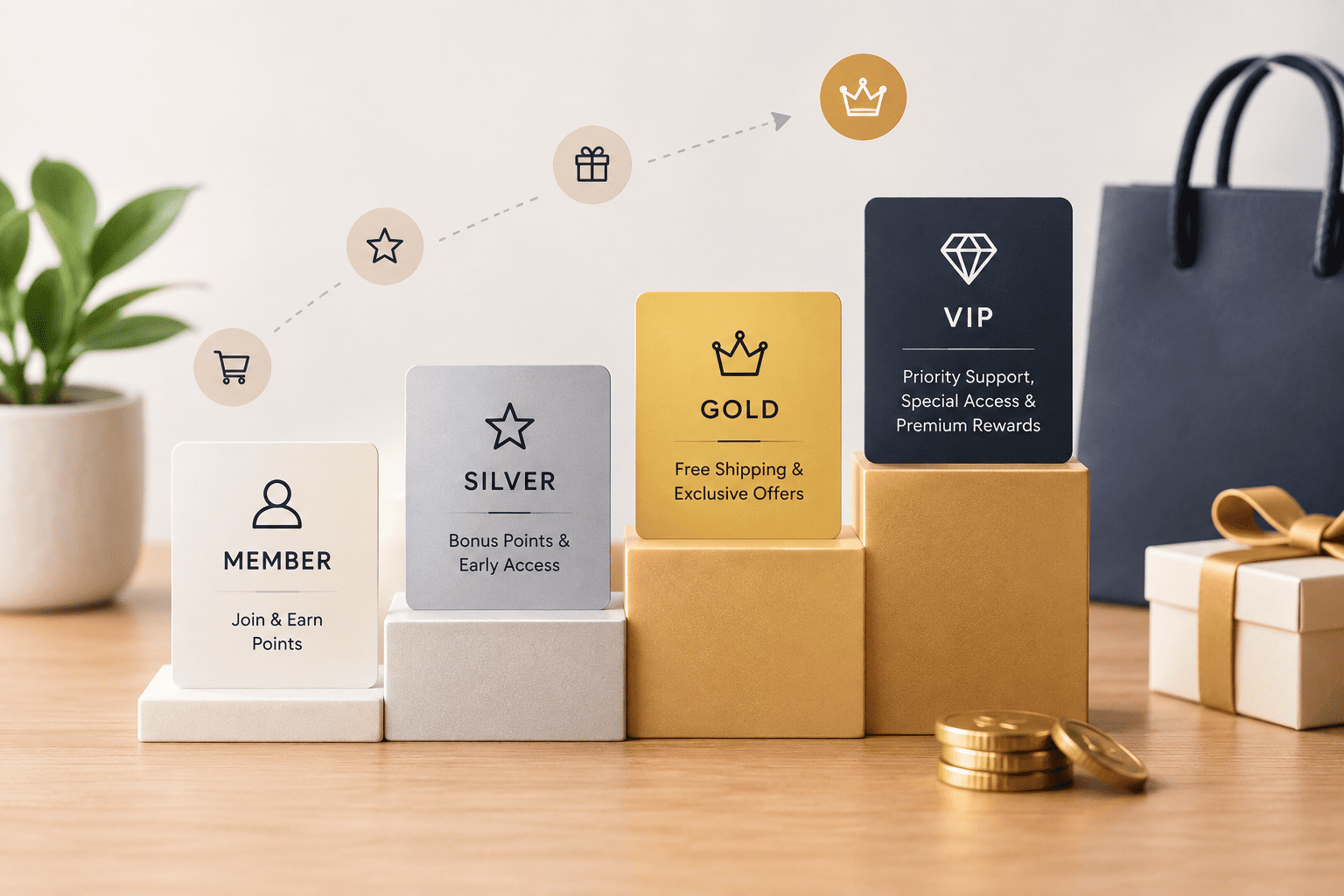
Loyalty program tiers divide customers into different membership levels based on actions such as spending, order frequency, points earned, or engagement. As customers move upward, they unlock additional benefits.
A typical structure might look like this:
| Tier | Example qualification | Possible benefits |
|---|---|---|
| Member | Joins the program | Welcome reward and points |
| Silver | $250 in qualifying spend | Bonus points and early access |
| Gold | $750 in qualifying spend | Free shipping and exclusive offers |
| VIP | $1,500 in qualifying spend | Priority support, special access, and premium rewards |
These thresholds are illustrative only. Every ecommerce business should set its own levels using customer purchase behavior, average order value, repeat-purchase patterns, and profit margins.
A tiered program works best when each level offers a meaningful improvement rather than simply increasing the discount. Customers should understand:
- What they have already earned
- What benefit they receive now
- How close they are to the next tier
- What action will help them progress
- Whether their benefits expire or reset
The objective is not to make customers spend unnecessarily. It is to create a clear, valuable relationship in which customers receive better experiences as their engagement grows.
Why Aren’t Customers Progressing to Become VIPs?
Many brands launch a VIP loyalty program but discover that most customers remain at the entry level. This can happen for several reasons.
1. Tier thresholds are disconnected from customer behavior
If the next tier requires spending far more than customers normally spend, progression may feel impossible. For example, a brand with a typical annual customer spend of $150 may struggle to motivate customers toward a $2,000 VIP threshold.
Thresholds should be ambitious but realistic. They should reflect the distance between a customer’s current behavior and the behavior the business wants to encourage.
2. Customers cannot see their progress
A customer may be close to an upgrade but remain unaware of it. If the program does not show current status, points, qualifying spend, or the amount needed for the next tier, the reward loses motivational value.
Progress should be visible across relevant touchpoints, such as:
- Account dashboards
- Post-purchase emails
- Loyalty pages
- Cart and checkout messages
- SMS or messaging notifications
- Personalized campaign content
3. The benefits are not valuable enough
A higher tier should provide benefits customers genuinely want. A slightly larger discount may not be compelling, especially when customers can find similar offers through ordinary promotions. Useful benefits may include free shipping, early product access, priority support, exclusive products, flexible returns, birthday rewards, or members-only experiences.
4. The program is too complicated
Customers should not need to study a long rulebook to understand how the program works. Confusing point conversions, multiple expiration rules, unclear exclusions, and complicated qualification periods can reduce participation. A strong program explains the essential rules in simple language and provides additional details only when necessary.
5. The program rewards the wrong behavior
If the goal is to increase second purchases, rewarding only high spending may not be enough. If the goal is to improve profitability, rewarding every action equally may create unnecessary costs.
Brands should first decide which behaviors matter most:
- Making a second purchase
- Purchasing within a target time window
- Buying across product categories
- Choosing higher-margin products
- Referring suitable customers
- Engaging with useful brand content
The program should then reward those behaviors selectively.
Designing Loyalty Program Tiers: The Psychology of VIP Status
A successful VIP loyalty program is not only a discount system. It uses psychological principles to make progress meaningful and encourage customers to continue engaging with the brand.
The goal-gradient effect
People often become more motivated as they get closer to a meaningful goal. In loyalty programs, customers who can clearly see that they are approaching the next reward may be more likely to make another purchase or complete another action.
Research on reward programs has found that perceived progress can increase effort and purchase activity as customers approach a goal. However, this effect is not automatic. The reward must be relevant, the target must feel achievable, and the customer must understand the progress they have made.
For example, a message such as:
“You are only $35 away from Gold status.”
is more actionable than:
“Keep shopping to unlock more rewards.”
The first message communicates the goal, the distance, and the potential outcome.
Status and recognition
VIP tiers can give customers a sense of recognition. A higher status may communicate that the customer is valued, trusted, or part of an exclusive group.
Status benefits do not always need to be expensive. Recognition can come through:
- A personalized thank-you message
- A VIP badge in the customer account
- Early access to product launches
- Invitations to private events
- Priority customer support
- Exclusive product recommendations
The benefit should feel connected to the customer’s relationship with the brand rather than being a meaningless label.
The next-tier effect
Customers are more likely to consider an upgrade when the next tier is easy to understand and appears attainable. A program with too many levels can weaken this effect because customers may not know which goal to pursue.
For many ecommerce brands, three or four meaningful levels are easier to communicate than a large number of small tiers.
Exclusivity and belonging
VIP status can create a sense of belonging, but exclusivity should be handled carefully. If entry-level members feel ignored, the program may damage the customer experience.
A balanced structure provides every member with a useful benefit while reserving additional access, convenience, or recognition for higher tiers.
Progress framing
How a brand communicates progress can influence the customer’s next action. Messages focused on completed progress can support status maintenance, while messages focused on what remains can encourage customers to pursue an upgrade. Research on hierarchical loyalty programs supports using different progress messages for these different goals.
For example:
- Maintaining status: “You have already completed 80% of your Gold qualification.”
- Encouraging an upgrade: “Complete another $40 in qualifying purchases to reach Gold.”
How to Set Effective Tier Thresholds
Tier thresholds determine when customers move from one level to another. Poorly designed thresholds can make a loyalty program either unprofitable or unmotivating.
Start with customer data
Review at least the following information:
- Average order value
- Median annual customer spend
- Orders per customer
- Time between purchases
- Second-order conversion rate
- Customer lifetime value
- Gross margin by product category
- Discount and shipping costs
- Percentage of customers who already qualify for each proposed tier
The median is often useful because it is less affected by unusually high-spending customers than the average.
Choose the right qualification method
Spend-based tiers
Customers qualify after reaching a specific amount of qualifying spend.
Advantages:
- Easy to explain
- Simple to calculate
- Useful for increasing customer value
Risks:
- May favor customers who already spend heavily
- Can encourage unnecessary discount-driven purchases
- May not work well for low-frequency or high-ticket businesses
Order-based tiers
Customers qualify after completing a certain number of orders.
Advantages:
- Encourages repeat purchasing
- Useful for brands focused on second-order conversion
- Easy for customers to understand
Risks:
- Customers may split purchases into smaller orders
- Order frequency does not always equal profitability
- May reward low-value transactions too heavily
Points-based tiers
Customers qualify based on points earned through purchases or selected actions.
Advantages:
- Flexible
- Can reward more than spending
- Allows brands to recognize engagement
Risks:
- Point systems can become difficult to understand
- Different actions may have different business value
- Excessive rewards can increase program costs
Hybrid tiers
A hybrid model combines measures such as spend and order frequency. For example, a customer might need to complete three orders and reach a minimum qualifying spend.
This can be useful when a brand wants to encourage both repeat behavior and sustainable customer value. However, hybrid rules should remain easy to explain.
Define the qualification period
Decide whether customers qualify based on:
- Lifetime activity
- Calendar-year activity
- Rolling 12-month activity
- A fixed campaign period
A rolling period can keep the program relevant throughout the year, while a calendar-year model may be easier to administer and communicate. The qualification period should be visible. Customers need to know when their progress begins, when it ends, and what happens after the period resets.
Protect profitability
A customer should not become a VIP simply because the brand has given away more discounts than the customer’s contribution margin can support.
Before launching a tier, estimate the cost of:
- Discounts
- Free shipping
- Free products
- Points redemption
- Customer service benefits
- Exclusive events
- Referral rewards
- Promotional communication
Consider contribution margin not only revenue when evaluating whether a tier is financially sustainable.
Building a Valuable VIP Perks Ladder
A perks ladder is the set of benefits attached to each tier, arranged so that every step up feels like a genuine upgrade rather than a slightly bigger discount. A weak ladder repeats the same reward type at increasing size (5% off, then 10% off, then 15% off). A strong ladder introduces a different kind of value at each level, so customers are working toward something qualitatively new, not just more of the same thing.
Principles for building the ladder:
- Vary the benefit type across tiers, not just the amount. A reasonable progression might move from points/discounts at the entry tier, to convenience benefits (free shipping, faster support) at the middle tier, to access and recognition benefits (early product access, priority service, invitations) at the top tier.
- Mix monetary and non-monetary rewards. Discounts are the easiest benefit to understand but the most expensive to sustain at scale. Non-monetary membership perks — early access, a dedicated support line, a birthday gift, a say in upcoming products — can feel valuable without compounding into a permanent margin hit.
- Make the top tier aspirational, not just expensive. The highest tier should be reachable by genuinely engaged customers, but its benefits should feel distinct enough that customers below it want to reach it — not simply “the same reward, more of it.”
- Check for cannibalization between tiers. If a Silver perk and a Gold perk are functionally identical (e.g., both give free shipping), the ladder isn’t creating a reason to progress.
- Cap the cost of the top tier before launch. Estimate what it costs to serve your most active existing customers under the proposed top-tier benefits, since they are the ones most likely to qualify immediately.
Illustrative ladder:
| Tier | Reward type | Example perk |
|---|---|---|
| Member | Points | Points on every purchase |
| Silver | Points + convenience | Bonus points, faster shipping |
| Gold | Convenience + access | Free shipping, early access to sales |
| VIP | Access + recognition | Priority support, early product launches, invite-only events |
The ladder should be built around what your specific customers value and what your margins can sustain – not copied from another brand’s structure. For a real example of a structured, tiered loyalty program in practice, see how Hashwear strengthened customer retention with a structured loyalty program.
How to Measure VIP Loyalty Program Performance
A tiered program should be evaluated on whether it changes customer behavior profitably, not just on how many members reach the top tier. This ties into the same KPIs worth tracking for long-term success and the broader question of how to measure loyalty program success.
| Metric | What it tells you |
|---|---|
| Tier distribution | What percentage of members sit in each tier — a program where almost everyone stays at the entry level signals thresholds or benefits that aren’t motivating |
| Tier progression rate | The percentage of members who move up a tier within a defined period, showing whether the goal-gradient effect is actually working |
| VIP repeat purchase rate vs. entry-tier rate | Whether higher tiers actually correlate with more frequent repeat purchases, not just higher one-time spend |
| Contribution margin by tier | Revenue by tier minus the cost of that tier’s rewards, discounts, and service – loyalty analytics tools can help track this by tier rather than only in aggregate |
| Reward redemption rate by tier | Whether members are actually using the benefits they’ve earned; low redemption suggests the perks aren’t valuable or aren’t visible |
| Downgrade or lapse rate | How many VIP or Gold members fail to requalify at renewal – a high rate can indicate thresholds are too aggressive or benefits didn’t sustain engagement |
| Incremental lift vs. a control group | Compare tier members against a similar group of customers without tier access (or before they qualified) to separate the tier’s actual effect from customers who were already going to be loyal |
A practical approach: Track tier distribution and progression rate monthly, since these show whether the program structure is working at all. Review contribution margin and incremental lift quarterly, since these require more data and reveal whether the program is actually profitable – not just popular.
Avoid judging the program purely by enrollment numbers or how many customers reach VIP status. A program can have strong sign-ups and a full top tier while still failing to change purchase behavior or protect margins.
Common Mistakes to Avoid When Creating VIP Tiers
Too many tiers: A large number of levels can make the program difficult to understand. Start with a small number of meaningful tiers and expand only when customer data supports it.
Arbitrary thresholds: Do not copy another brand’s thresholds without considering your own customer behavior, product pricing, and margins.
Discount-only rewards: A program built entirely around discounts may train customers to wait for offers. Special deals are useful for attracting new customers, but a tier structure needs more than discounts to hold existing customers. Combine monetary rewards with convenience, access, and recognition.
Hidden progress: Customers should not have to contact support to find out their status or how close they are to an upgrade.
Unclear expiration rules: Explain when points, benefits, and tier status expire. Unexpected downgrades can create dissatisfaction.
Rewarding unprofitable behavior: Not every action should receive the same reward. Prioritize behaviors that support sustainable customer value.
Making VIP status impossible: If only a tiny fraction of customers can realistically reach the top tier, the program may feel irrelevant to most members.
Ignoring non-discount motivations: Some customers value convenience, early access, recognition, or exclusive products more than price reductions. Offer different types of benefits.
Failing to test the program: Tier design should be treated as an ongoing optimization process. Review customer feedback, redemption behavior, profitability, and progression data regularly.
Frequently Asked Questions
What are loyalty program tiers?
Loyalty program tiers are membership levels that provide different rewards based on customer spending, order frequency, points, or other qualifying actions. Customers generally unlock better benefits as they move to higher levels.
How many tiers should an ecommerce loyalty program have?
There is no universal number. Three or four tiers are often easier to explain than a complex structure, but the right number depends on customer volume, purchase frequency, product pricing, and the differences between benefits.
What is a VIP loyalty program?
A VIP loyalty program gives highly engaged or valuable customers enhanced benefits, such as exclusive access, free shipping, priority service, special rewards, or personalized experiences.
How should brands set tier thresholds?
Use customer data to review average and median spend, order frequency, repurchase timing, customer lifetime value, and contribution margin. Thresholds should be achievable for the intended customer segment and financially sustainable for the business.
Should VIP tiers be based on spending or order frequency?
Both approaches can work. Spend-based tiers are useful for increasing customer value, while order-based tiers are useful for encouraging repeat purchases. A hybrid model may be appropriate when both behaviors matter.
Do VIP tiers always increase customer loyalty?
No. Tiers can encourage engagement, but they do not replace product quality, reliable delivery, good customer service, or a strong overall customer experience. Customers may also join loyalty programs because they were already loyal, so brands should measure incremental impact carefully.
How do I know if my VIP tier structure is actually working?
Track tier progression rate and contribution margin by tier, not just enrollment or top-tier headcount. A structure is working when members move up over time and higher tiers remain profitable after the cost of their rewards – not simply when a tier fills up.
Conclusion
Creating effective loyalty program tiers requires more than assigning customers to Bronze, Silver, Gold, or VIP categories. The program should make progress visible, provide meaningful benefits, and encourage valuable customer behaviors without damaging profitability.
The strongest tiered rewards programs combine:
- Achievable and data-informed thresholds
- Clear qualification and renewal rules
- Useful monetary and non-monetary benefits
- Visible progress toward the next tier
- Personalized customer communication
- Careful measurement of retention and profitability
- Continuous testing and improvement
When designed around customer needs and business economics, a VIP loyalty program can become an important part of a broader retention strategy helping ecommerce brands encourage repeat purchases, strengthen customer relationships, and create more sustainable long-term value.
Add points, referrals, and VIP rewards to your Shopify store in under 5 minutes.