
How to Handle Customer Complaints in Ecommerce: 10 Ways With Reply Templates
A customer opens a parcel and finds the wrong size. Another has refreshed the tracking page for six days. A third wants a refund and keeps getting the same canned reply. Every Shopify store gets these messages, and your reply decides whether that shopper orders again. Knowing how to handle customer complaints comes down to a few habits you can repeat, and each one below comes with a template you can copy.
Key takeaways
- Acknowledge the specific problem before you explain any policy.
- Check order and tracking data before promising a fix.
- Give a date for the next update, not a vague reassurance.
- Offer compensation only when the impact goes beyond the standard fix.
- Log every complaint so recurring causes get fixed at the source.
Why Complaint Handling Decides Whether Customers Come Back
A customer complaint is feedback about the exact point where your store fell short, and the reply is your best chance to keep that buyer. A clear, fair response protects the relationship, cuts repeat tickets and shows you where products, packaging or shipping need work. A slow or defensive reply usually ends the relationship for good.
Complaints also arrive through more channels than most small teams expect: email, live chat, Instagram messages and product reviews. Without one process, two people on your team can give the same customer two different answers. Silence is a risk too, because many unhappy shoppers never write in and simply show the signs a customer is about to churn instead.
The goal isn’t to please every unhappy customer at any cost. It’s to fix legitimate problems fairly, communicate honestly and learn from what went wrong.
How to Handle Customer Complaints in the First Reply
The first reply sets the tone for the whole conversation. Name the customer’s specific problem, show that you understand why it matters, and tell them what you will check and when they will hear back. Then verify the facts in their order record before you promise a refund, a replacement or anything else.
1. Acknowledge the Complaint Before You Explain Anything
Opening with your policy or the courier’s procedures sounds defensive when the customer already feels unheard. A shopper with a cracked vase doesn’t need to hear that parcels usually arrive safely. They need to know you understand the problem and will help fix it. Generic lines such as “We regret the inconvenience” fail because they never mention the actual issue.
Reply template
Hi [Name],
I’m sorry your order arrived [damaged / not as expected]. I know how disappointing that is when you’ve been looking forward to it. I’m reviewing order [number] now and will send you the next steps by [date/time].
Best, [Support Team]
Why it works
It proves you read the message and sets a time for the next update, even before you know the fix.
2. Investigate Before You Offer a Solution
A “missing” order could be a delayed shipment, a wrong tracking scan or a parcel left at the wrong address, and each needs a different fix. Check the order history, fulfillment status and tracking, then compare the complaint with the product listing and your policy. Never ask customers for details already in their order record, and keep simple cases simple.
Reply template
Hi [Name],
Thanks for letting us know about order [number]. I’m checking the order and shipping details now, so you won’t need to send anything again. I’ll update you with what I find and the next steps by [date/time].
Best, [Support Team]
Why it works
It promises action without guessing at the cause, so you don’t ship a replacement for a parcel that is still on its way.
Delivery, product and refund problems are the complaints most stores see every week. Each one needs a specific answer: the latest tracking status and a date for the next update, a clear remedy for a faulty or wrong item, or a plain explanation of how your refund policy applies to this order and when the money will arrive.
3. Give Specific Updates on Delayed Orders
Customers waiting on a late parcel have usually checked the tracking already, so “Your order is on the way” adds nothing. Tell them the latest scan, what you’re doing about it and when they’ll hear from you next. If the carrier can’t confirm a date, say so. Even when the courier caused the delay, the customer bought from you, so don’t hand the problem back to them.
Reply template
Hi [Name],
I’m sorry your order is running late. The latest tracking update shows [status], and we’ve asked [carrier] to look into it. I’ll send another update by [date]. If it’s still delayed then, we’ll go through your options under our shipping policy.
Best, [Support Team]
Why it works
It separates what you know from what you’re still chasing, so the customer stops refreshing the tracking page.
4. Resolve Damaged, Defective or Wrong Items Clearly
Here the problem is the product itself, so move quickly from confirming the mismatch to offering a remedy. A shopper who received the wrong color may want a replacement, while one who received a broken item may prefer a refund. Say whether they need to send the item back and how, and don’t push store credit when they’re entitled to a refund.
Reply template
Hi [Name],
I’m sorry [product] didn’t arrive as it should have. We can offer you a [replacement / full refund]. Here’s what happens next: [return steps, if any, and timeline]. Reply to this email if anything is unclear.
Best, [Support Team]
Why it works
The customer learns the remedy, what they need to do and when it will be sorted, all in one message.
5. Explain Refund and Return Policies in Plain Terms
Refund complaints often start when a customer hits a condition they didn’t expect or hears nothing after submitting a request. Instead of pasting your whole policy, explain which rule applies to their order and why. Be precise about timing, because the day you issue a refund is rarely the day it reaches their account, and never call a refund complete when it has only been approved.
Reply template
Hi [Name],
I’ve reviewed your refund request for order [number]. [One-line explanation of how the policy applies.] The next step is [refund issued / return instructions]. Once the refund is processed, we’ll confirm it and tell you when to expect it in your account.
Best, [Support Team]
Why it works
It turns a policy into a decision the customer can follow, with no fine print to decode.
Angry Customers, Public Reviews and Compensation
Some complaints need more care than a standard fix. An angry customer needs calm, specific options. A public review needs a short reply that the next shopper can read. Compensation should match the inconvenience the customer actually suffered. In each case, keep the focus on solving the problem rather than on deciding who was at fault.
6. Stay Calm When Dealing With Angry Customers
Anger usually comes from a first problem made worse by slow or vague replies. Dealing with angry customers well means acknowledging their frustration without accepting blame you haven’t established, then offering one or two realistic options. Avoid phrases like “Calm down” or “That’s not our fault.” Escalate when a case needs a manager’s approval, and set firm boundaries if messages become abusive.
Reply template
Hi [Name],
I understand why you’re upset about [issue], especially since [relevant detail]. I want to get this fixed rather than leave you waiting. Here’s what I can do now: [option 1] or [option 2]. You’ll hear from me by [date/time] either way.
Best, [Support Team]
Why it works
It brings the conversation back to a decision the customer controls, which takes the heat out of it.
7. Answer Public Complaints and Negative Reviews Professionally
A public complaint has two audiences: the unhappy customer and every shopper who reads the exchange before buying. Keep the reply short, acknowledge the issue without arguing, and move order details to a private channel. Never post order numbers or addresses, and never offer a reward for deleting a review. Over time, these replies become part of your Shopify store reputation, because shoppers read them alongside the reviews.
Public reply template
Hi [Name], we’re sorry [product/order] didn’t meet your expectations, and we’d like to put it right. Please email [support address] with your order details and our team will help with the next steps. [Brand] Support
Why it works
It shows future buyers that you respond and take ownership, without turning a review into a public argument.
8. Offer Compensation Only When It Fits the Problem
An apology and a fix are often enough. Compensation makes sense when the customer lost more than the order itself, such as hours spent chasing support, extra costs or a missed birthday. Whatever you offer, add it on top of the remedy the customer is owed, never in place of it.
Questions to ask before you compensate
- Severity: Was the issue a small annoyance, or did it spoil the whole purchase?
- Responsibility: Did your store make the mistake, or is the cause still unclear?
- Consistency: Would you offer the same thing to another customer in the same situation?
Choose a gesture that brings them back
Goodwill doesn’t have to be a discount code. If you run a loyalty program app, bonus points give the customer a reason to place one more order, while a one-off coupon is often forgotten.
Reply template
Hi [Name],
I’m sorry for the extra trouble [issue] has caused. Along with your [refund / replacement], we’d like to offer [goodwill gesture] as thanks for your patience. You can use it by [steps].
Best, [Support Team]
Follow-Up and Prevention After a Complaint Is Resolved
A complaint isn’t truly closed when the last message is sent. A refund may still be processing, or a replacement may still be in transit. A short follow-up confirms the fix worked, and a simple complaint log shows which products, carriers or policies keep causing trouble, so you can fix the cause instead of answering the same ticket every week.
9. Follow Up Once the Fix Is Complete
Confirm that the agreed action happened, share any reference number and ask whether everything is now in order. If the customer says the fix didn’t work, reopen the case. Hold back surveys until the issue is truly sorted, since knowing when to ask for a review matters most with a customer who just had a bad experience. With automated review requests, you can set the send date anywhere from 1 to 15 days after delivery, which leaves time to resolve a problem before the email arrives.
Reply template
Hi [Name],
I’m following up on [order/product]. [Action taken] is now complete. Is everything working as it should? If not, reply here and we’ll take another look.
Best, [Support Team]
Why it works
It closes the loop instead of assuming your last message solved the problem.
10. Use Complaint Data to Stop Repeat Problems
Fixing complaints one by one doesn’t help if the same issue keeps coming back. Repeated sizing complaints may mean your size guide is unclear, and frequent refunds on one product may point to a misleading description. Log each complaint with the fields below and review the log every week.
What to track in your complaint log
| Field | What It Tells You |
|---|---|
| Complaint category | Whether shipping, product quality, refunds or payments cause the most issues |
| Product or order | Which items or order types attract repeat complaints |
| Date received | Spikes after a promotion or during peak season |
| Root cause | Whether it was a misunderstanding, an operations failure or a product fault |
| Resolution and time to close | Which fixes you use most and which cases drag on |
| Preventive action | What you changed so it doesn’t happen again |
Add review data to the log
Reviews are complaints too. Review analytics breaks down ratings below 4 stars and compares products and categories, so a product with slipping ratings stands out before support tickets pile up.
Reply template
Hi [Name],
Thanks again for telling us about [issue]. We’ve [resolution], and we’ve also [specific change, such as updating the size guide] so the next customer doesn’t run into the same problem.
Best, [Support Team]
Why it works
It shows the customer their feedback changed something. Only describe changes you’ve actually made, because promising it will never happen again sets up the next complaint.
Turn Complaints Into Your Next Repeat Order
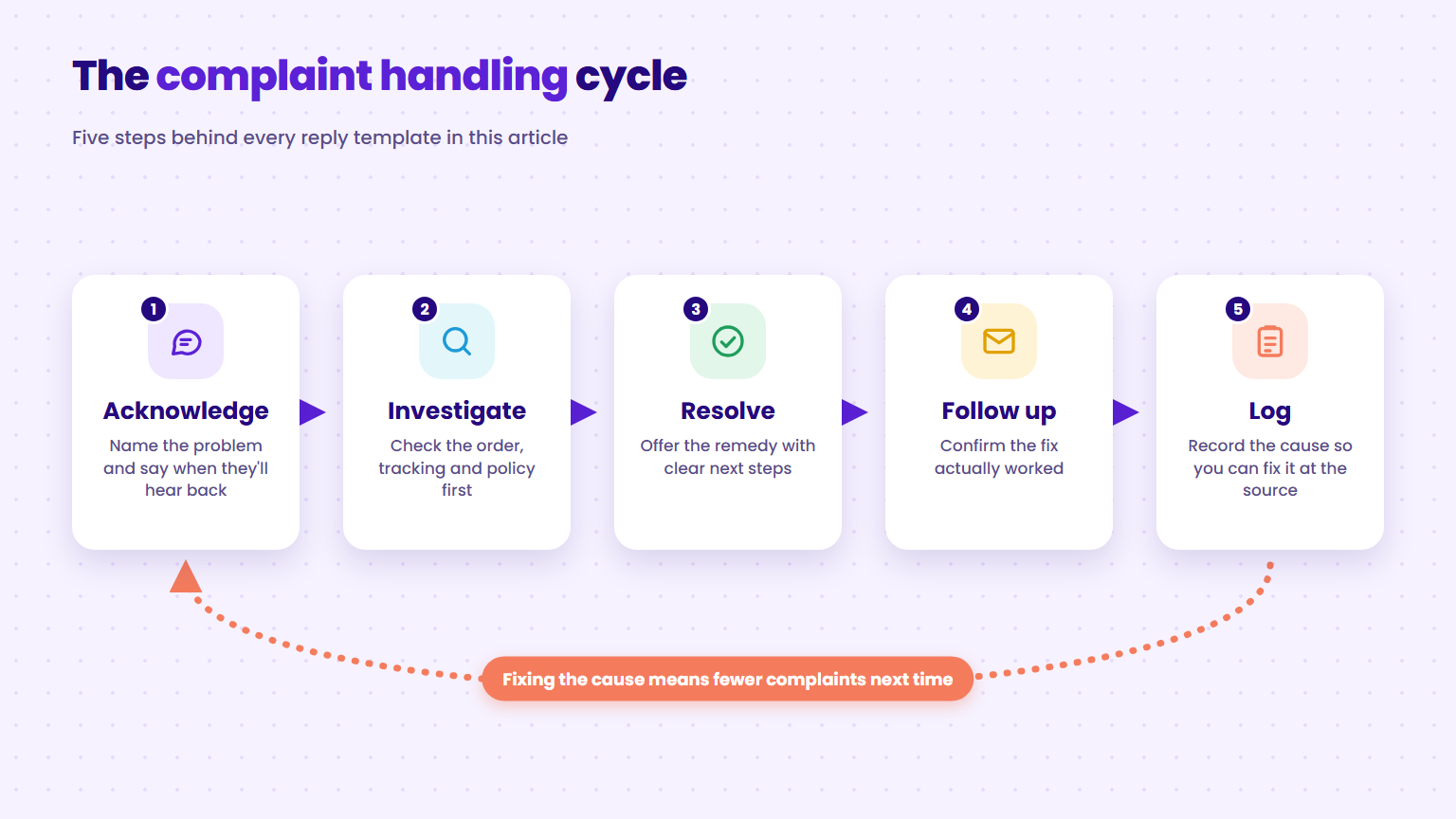
Learning how to handle customer complaints comes down to a repeatable routine: acknowledge, investigate, resolve, follow up and log. Save these templates in your help desk, agree on who can approve exceptions, and review your complaint log every week. Each problem you fix at the source is one fewer customer you need to win back.
Book a 30-minute walkthrough to see how Review Analytics shows which products keep collecting ratings below 4 stars.
FAQ
How to handle customer complaints on Shopify?
Bring email, chat and social messages into one inbox or help desk so everyone on your team sees the full history. Reply with an acknowledgment, check the Shopify order and tracking data, then offer a fix with a clear timeline. Saved reply templates keep your answers consistent as order volume grows.
How to respond to customer complaints by email?
Use a subject line that names the order, open by naming the problem, and keep the email to three short parts: acknowledgment, what you’ve checked or will do, and when the customer will hear back. Sign with a real name so they know a person is handling it.
How to handle customer complaints about late delivery?
Check the latest tracking scan before you reply, then tell the customer the current status, what you’re doing and when they’ll hear from you next. If the carrier can’t give a date, say so honestly. Once the parcel is confirmed lost, offer a replacement or refund under your shipping policy.
How to deal with customer complaints on social media?
Reply publicly the same day with a short, polite acknowledgment, then invite the customer to message or email you with their order details. Never share personal information in a public thread. Once the issue is resolved, a brief public note that it has been sorted shows other followers that you follow through.
Should you offer a discount when a customer complains?
Not by default. Fix the problem first with the remedy the customer is owed, such as a refund or replacement. Add a goodwill gesture only when the issue caused extra cost or hassle, and keep it consistent across similar cases. Bonus loyalty points can work better than a coupon because they encourage another order.
Add points, referrals, and VIP rewards to your Shopify store in under 5 minutes.