
How to Use a Loyalty Program for Customer Acquisition
Most loyalty programs focus only on retention, but a loyalty program for customer acquisition connects rewards with advocacy – turning satisfied customers into a source of new customers. This guide covers why referrals work, what motivates customers to recommend a brand, which reward structures to use, where to place referral opportunities, and how to build one in six actionable steps.
- Why Loyalty Programs Are Usually Built for Retention
- How a Loyalty Program Becomes a Customer Acquisition Channel
- Why Referral Loyalty Programs Can Support Acquisition
- What Makes Customers Refer a Brand?
- Refer-a-Friend Rewards: Which Model Should You Use?
- Turn New Customers Into Future Advocates
- How to Build a Loyalty Program for Customer Acquisition
- Conclusion
Most loyalty programs begin after a customer has already been acquired. A shopper discovers a brand through search, advertising, social media, an influencer, a marketplace, or another channel. They make a purchase, join the loyalty program, earn rewards, and ideally return to make another purchase. That model makes sense, but it overlooks another opportunity: existing customers can also help bring new customers to the brand.
A loyalty program for customer acquisition connects loyalty with advocacy. Instead of using rewards only to encourage another purchase, an ecommerce brand can give satisfied customers a simple way to recommend the brand to people they know.
This does not mean referrals will replace paid acquisition. They won’t. Referral programs work best as an additional acquisition channel that uses existing customer relationships to create new demand.
Research has consistently shown the influence of personal recommendations. Nielsen’s global research found that 83% of respondents said they trusted recommendations from friends and family, while its later research also found that online consumer opinions were highly trusted. These studies are not current ecommerce benchmarks, but they illustrate why customer advocacy has long been valuable in acquisition. The opportunity for ecommerce brands is therefore not simply to reward customers for buying more. It is to identify when customers have enough positive experience and motivation to become advocates.
Why Loyalty Programs Are Usually Built for Retention
Traditional loyalty programs are designed around a familiar journey: encourage customers to remain active. That can support important outcomes such as repeat purchases and continued engagement. But the relationship does not necessarily stop at the customer’s next purchase.
A satisfied customer may also:
- Recommend a product to a friend
- Share a referral link
- Introduce someone to the brand
- Leave a review
- Share a product experience
- Recommend the brand in a relevant community
These behaviors can contribute to acquisition. The important distinction is that loyalty creates the relationship, while advocacy can extend that relationship to new customers. Instead of treating acquisition and retention as completely separate activities, brands can connect them.
Retention loyalty vs. acquisition-focused loyalty
Retention asks: How can we encourage this customer to purchase again?
Acquisition-focused loyalty asks: How can we make it easy for a satisfied customer to introduce someone new?
A mature loyalty strategy can address both questions.
How a Loyalty Program Becomes a Customer Acquisition Channel
A loyalty program becomes an acquisition channel when three things work together:
- An existing customer has a reason to recommend the brand.
- The customer has an easy mechanism for making the referral.
- The brand can identify and measure the resulting new customer.
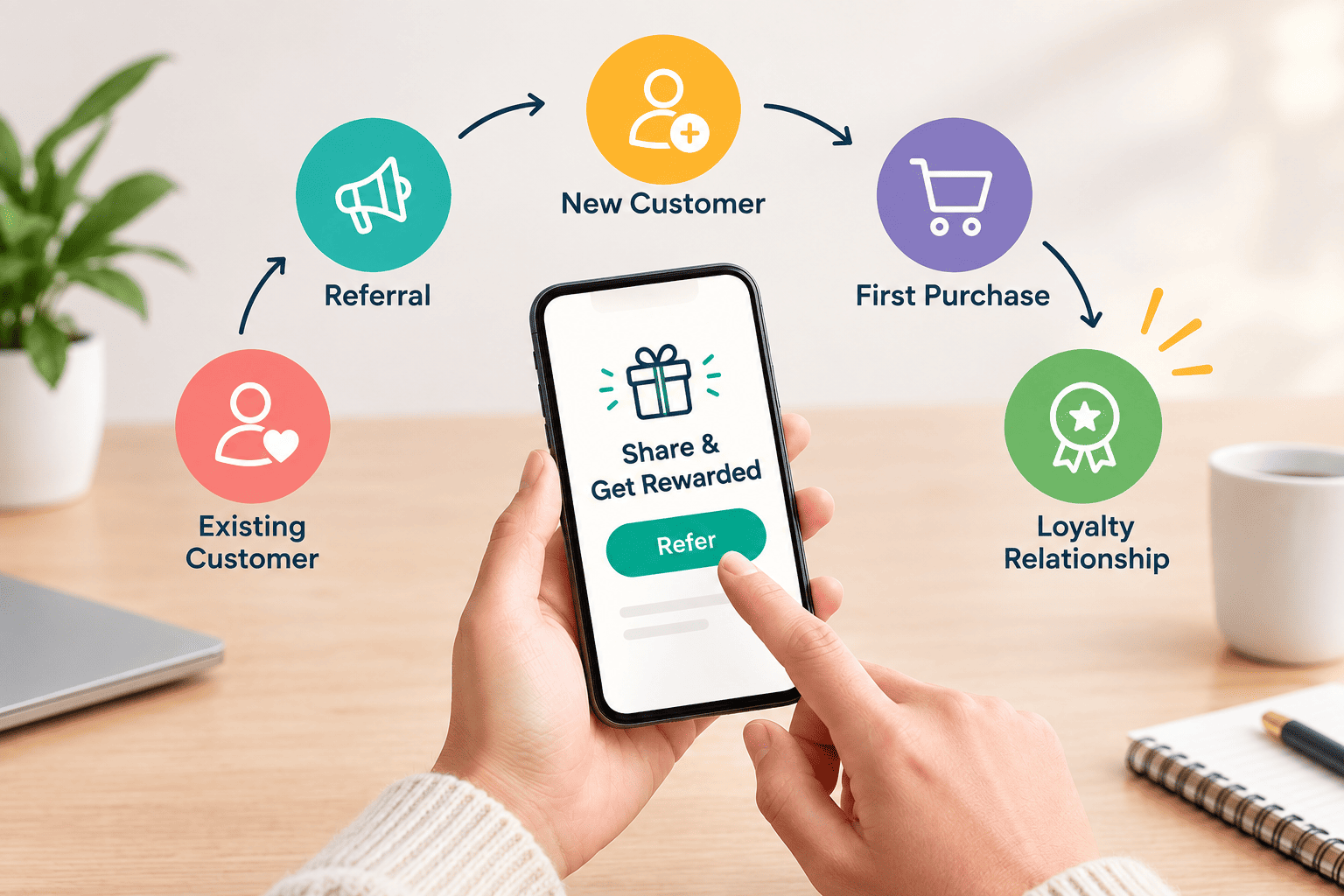
The important part is what happens after that first purchase. If the new customer has a good experience, they can move through the same lifecycle. This is more useful than treating referral marketing as a one-off campaign.
For example, give a friend a first-order benefit and receive a reward when the friend purchases.
The customer shares the referral. The friend makes a first purchase. The new customer is introduced to the loyalty program. If that customer has a positive experience and eventually becomes a repeat buyer, they can become another potential advocate. The value of the referral therefore extends beyond the original transaction. However, brands should not assume that every referred customer will produce another referral. The purpose of the growth loop is to create the opportunity for advocacy, not to guarantee viral growth.
Why Referral Loyalty Programs Can Support Acquisition
Referral acquisition starts with an existing relationship rather than a completely unfamiliar prospect. That distinction matters because the recommendation carries context.
A customer can tell a friend:
- What they bought
- Why they liked it
- Who the product is suitable for
- What problem it solved
- Whether the experience was worth the price
That is different from a brand simply presenting an advertisement to someone who has never interacted with it. Recent ecommerce guidance from Shopify similarly describes customer referral programs as a structured way to turn existing customers into a source of new customers. But referrals should not be positioned as automatically superior to advertising. Paid acquisition can reach audiences that a brand’s existing customers cannot. Referral acquisition is most useful when it complements other channels.
The strategic question is therefore not:
Should we choose referrals instead of paid acquisition?
It is:
Can our existing customer base become an additional, measurable source of qualified acquisition?
What Makes Customers Refer a Brand?
Adding a “Refer a Friend” button does not automatically create advocacy. Customers need a combination of positive experience, motivation, relevance, and convenience.
1. Give customers a genuine reason to recommend you
The foundation is the customer experience.
A reward cannot reliably compensate for a poor product, disappointing service or unresolved problem. This is why referral programs should not be treated as a substitute for customer satisfaction. The best referral audience is often made up of customers who have already demonstrated strong engagement with the brand.
Potential signals include:
- Repeat purchases
- Positive reviews
- Loyalty engagement
- Product usage or affinity
- High engagement with customer communications
- Previous referral activity
The goal is not to ask every customer for a referral at the same time. It is to identify customers who have a credible reason to recommend the brand.
2. Make the reward immediately understandable
Customers should be able to understand the offer without studying a long set of rules.
A simple proposition might be: Give your friend $10 off their first order. Earn $10 when they purchase.
The actual incentive will depend on product margins and customer economics, but the underlying principle is the same: make the value exchange obvious.
3. Make the referral relevant
Customers do not recommend every product to everyone. A referral is more natural when the customer can immediately think of someone who might benefit. For example, a customer buying a giftable product may be more likely to recommend it to friends than someone purchasing a highly personal or specialized item. Referral messaging should therefore reflect the product and customer context.
4. Reduce unnecessary friction
The referral journey should be easy to understand. The more complicated the process becomes, the more opportunities there are for the customer to abandon it. Make referral links easy to find, easy to share, and easy for the recipient to understand.
5. Choose a reward that fits the business
There is no universal “best” referral reward.
Depending on the business model, brands can use:
- Discounts
- Store credit
- Loyalty points
- Free products
- Exclusive benefits
- Tier upgrades
- Special offers
The right choice depends on margins, average order value, purchase frequency and what customers actually value. The goal is not to offer the largest possible reward. It is to create a sustainable exchange that makes sense for both the customer and the business.
Where Should You Place Referral Opportunities?
A referral program cannot generate meaningful acquisition if customers rarely see it. However, that does not mean displaying a referral message everywhere. The better approach is to introduce referrals at relevant moments in the customer journey.
| Customer moment | Possible referral opportunity |
|---|---|
| Post-purchase | Introduce the referral benefit |
| Order confirmation | Include a referral CTA |
| After delivery | Ask after the customer has received the product |
| Positive review | Offer a next-step referral opportunity |
| Loyalty milestone | Introduce an enhanced referral reward |
| Loyalty dashboard | Keep the referral option accessible |
| Highlight the program to appropriate customer segments |
Timing should depend on the product and customer experience. For a simple consumable product, the right moment might arrive relatively soon after delivery. For a product that requires time to experience, a referral request may make more sense after the customer has had an opportunity to evaluate it.
The principle is simple: Ask for advocacy after giving customers a reason to advocate.
Refer-a-Friend Rewards: Which Model Should You Use?
Referral programs can use several reward structures.
Give-and-get rewards
Both people receive a benefit. For example:
Friend gets $10 off. Referrer gets $10 in credit.
This structure is easy to understand because both sides have an immediate reason to participate.
Points-based referrals
Existing loyalty members receive points when a referral results in a qualifying purchase.
This can work particularly well when the loyalty program already uses points as its primary reward currency.
Tiered referral rewards
The reward increases as customers generate more successful referrals.
For example:
- First successful referral → standard reward
- Third successful referral → bonus
- Fifth successful referral → premium benefit
This approach can focus additional incentives on customers who have already demonstrated advocacy.
Milestone-based rewards
Instead of rewarding every share, brands can reward meaningful acquisition outcomes. That distinction is important. A customer sharing a referral link does not necessarily mean a new customer was acquired. A completed qualifying purchase is a much stronger business outcome. Where possible, measure the outcome rather than simply counting activity.
Turn New Customers Into Future Advocates
The real opportunity is to connect acquisition with the rest of the customer lifecycle.
The new customer should not be treated as the end of the referral campaign. They should enter the same customer experience that helped the original advocate become loyal.
That means:
- Welcome the customer properly
- Deliver the expected product experience
- Introduce relevant loyalty benefits
- Encourage the next purchase at an appropriate time
- Collect useful feedback or reviews
- Introduce advocacy opportunities after positive experiences
This creates a more sustainable model than continually paying to acquire completely new audiences.
How to Build a Loyalty Program for Customer Acquisition
When building or improving a referral-enabled loyalty program, focus on identifying engaged customers who are likely to become advocates, creating a clear and mutually beneficial referral offer, and choosing incentives that align with your customer economics. Integrate referrals naturally across the customer journey, measure the full path from referral to first and repeat purchases, and continuously optimize incentives, messaging, placement, timing, and customer segments based on actual behavior to drive profitable, long-term customer value.
Conclusion
Customer acquisition does not always have to begin with an advertisement. Sometimes, it can begin with a customer who already knows and trusts your brand. A well-designed loyalty program for customer acquisition gives satisfied customers a structured way to recommend that brand to others. Referral rewards can make advocacy measurable, while the loyalty experience can help newly acquired customers move toward repeat purchasing and future advocacy. The goal is not to generate as many referrals as possible but to create a customer acquisition channel that produces qualified, valuable, and profitable customers.
Your loyalty program should not only give customers a reason to come back. It should also make it easy for your happiest customers to bring someone new with them.
Add points, referrals, and VIP rewards to your Shopify store in under 5 minutes.