
Loyalty Program Gamification: Mechanics That Drive Repeat Purchases
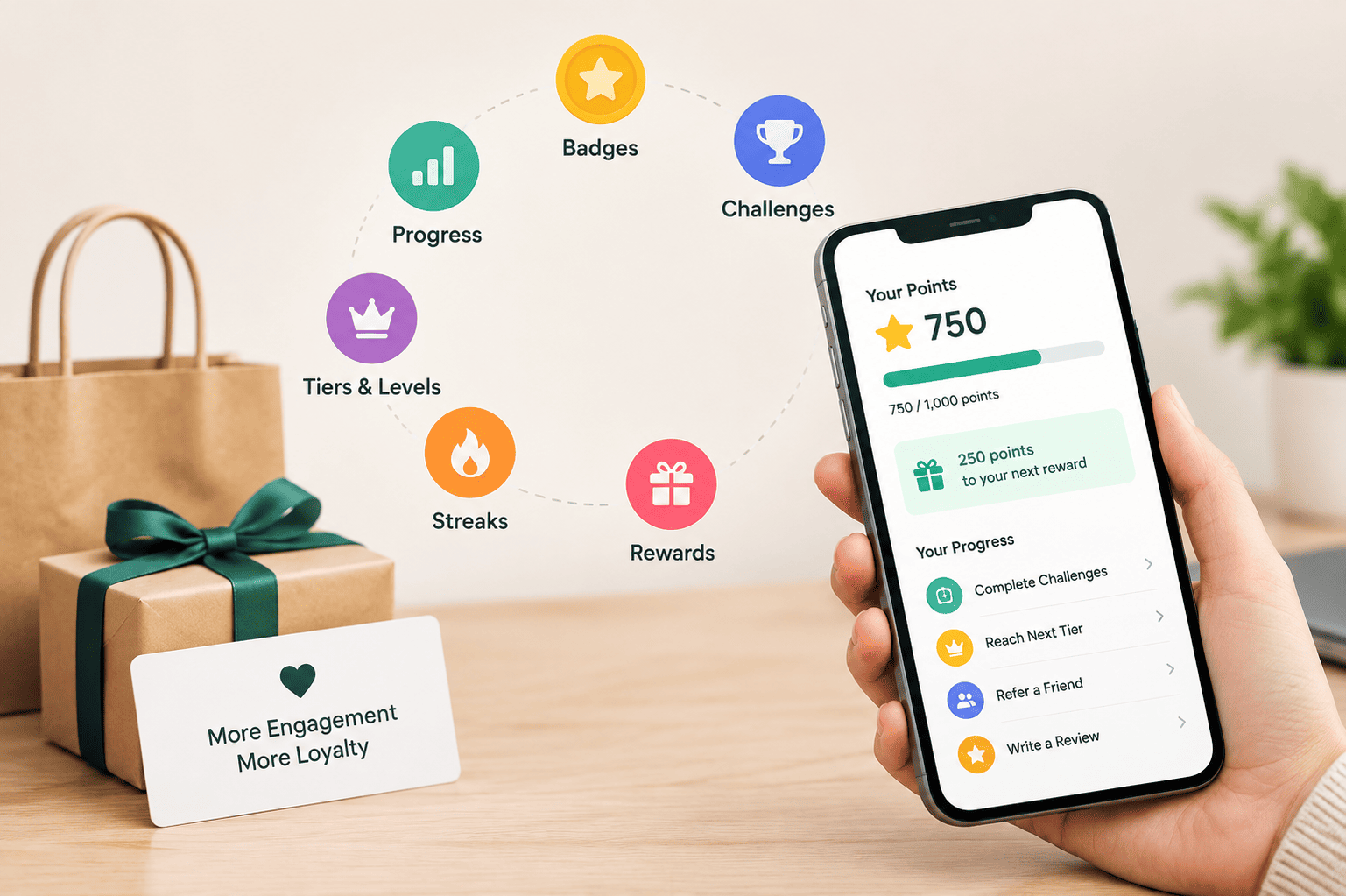
Loyalty program gamification uses progress bars, challenges, milestones, tiers, and badges to make loyalty rewards easier to understand and more engaging between purchases. But research shows gamification drives engagement more than sales, so mechanics should connect to business goals. This guide covers seven gamification mechanics, how to match them to your buying cycle, and how to avoid making loyalty gimmicky.
- What Is Loyalty Program Gamification?
- Does Gamification Actually Improve Ecommerce Engagement?
- 7 Loyalty Gamification Mechanics to Consider
- How to Choose the Right Gamification Mechanic
- How Gamification Can Support Repeat Purchases
- How to Design a Gamified Rewards Program Without Making It Gimmicky
- The Goal Isn't to Make Shopping a Game
- Conclusion
Most ecommerce loyalty programs start with a simple exchange that can work, but a points balance alone does not necessarily give customers a reason to engage with the brand between purchases. This is where loyalty program gamification can add another layer to the customer experience.
Gamification applies selected game-design elements such as progress, challenges, milestones, levels, recognition, and rewards to a non-game experience. In ecommerce, the purpose is not to turn shopping into a video game. It is to make meaningful customer actions easier to understand, more visible, and potentially more motivating.
Recent research supports the idea that gamification can improve engagement, but it does not justify a blanket claim that every gamified loyalty program will increase sales. A 2026 study of 500 online grocery consumers found stronger engagement among participants exposed to a gamified loyalty program and a moderate indirect relationship with purchase frequency. The study also found that meaningful challenges, progress feedback, and social recognition were important, while privacy and excessive competition could create barriers.
What Is Loyalty Program Gamification?
Loyalty program gamification is the use of game-inspired design elements within a loyalty program to encourage customer participation and valuable behaviours.
Common gamification mechanics include:
- Progress bars
- Challenges
- Milestones
- Levels and tiers
- Badges
- Streaks
- Bonus opportunities
- Unlockable benefits
- Recognition
- Referral goals
But not every points system is automatically a gamified experience.
The important distinction is progress and interaction. A traditional loyalty program might tell a customer: You have 750 points.
A gamified experience might tell them: You have 750 of 1,000 points needed for your next reward.
The second version gives the customer context. It shows where they are and what they can potentially achieve next. The objective is not to add game elements simply because they look engaging. It is to connect a meaningful customer action with a clear outcome.
Does Gamification Actually Improve Ecommerce Engagement?
There is evidence that gamification can influence ecommerce engagement, but its effectiveness depends on how it is designed. A 2021 study involving 253 Spanish Amazon users found that gamification had direct positive effects on ecommerce user engagement.
Research published in the Journal of Business Research also found that gamified loyalty programs increased loyalty toward the loyalty program and participation intention in the mobile loyalty-program context studied.
More recent research makes the picture more nuanced.
The 2026 online-grocery study found that gamified loyalty participants engaged more often and developed stronger emotional connections with the retailer. The relationship with purchasing was more moderate and indirect, suggesting that engagement is an important pathway rather than gamification being a guaranteed sales lever. That distinction matters for ecommerce brands.
Gamification should be treated as a behavioral design tool, not a guaranteed sales tactic.
The strongest programs connect gamification to behaviors that already matter to the business.
7 Loyalty Gamification Mechanics to Consider
1. Progress Bars
Progress bars make an otherwise abstract loyalty balance easier to understand.
Instead of: 750 points
Show: 750 / 1,000 points
250 points to your next reward
The customer can immediately see their position and destination.
Progress indicators can work for:
- Reward thresholds
- Loyalty tiers
- Challenges
- Referral milestones
- Review goals
- Campaign objectives
Why progress can matter
Progress creates context. A customer who is already close to a meaningful reward may understand the value of another eligible action more clearly than a customer who sees only an unexplained points balance. However, the objective should not be to push customers into unnecessary purchases.
Use progress to clarify genuine loyalty benefits, not to manufacture artificial urgency.
2. Challenges
Challenges give customers a defined objective. For example:
Review two recent purchases to unlock bonus points.
Or:
Purchase from two eligible categories this month to unlock a reward.
A useful challenge has three clear components:
- A defined action
- A clear reward
- A visible endpoint
This can make a loyalty program more interactive than an open-ended points system. Challenges are particularly useful when the desired customer behaviour is not simply another purchase.
For example, a brand may want more:
- Reviews
- Referrals
- Product discovery
- Category exploration
- Loyalty engagement
The challenge can then make that behaviour visible and measurable.
3. Milestones and Levels
Milestones help customers understand progression across a longer relationship. It is identifying meaningful stages in the customer journey. If a brand’s biggest retention challenge is moving customers from their second purchase to their third, that transition could become an important milestone. Gamification can therefore be designed around the actual customer lifecycle rather than arbitrary achievements.
4. Tiers and Status
Tiered loyalty programs give customers a visible status level to work toward.
For example, Member, Insider, VIP like tiers can provide increasingly valuable benefits. The advantage is that customers can see a longer-term path rather than a single reward. However, tiers should be achievable enough to remain credible. If customers believe the next level is unrealistic, the progression mechanic may stop motivating them.
5. Streaks and Badges
Badges can recognize achievement.
For example:
First Reviewer: Complete your first product review.
Brand Advocate: Successfully refer three customers.
Category Explorer: Purchase from three eligible categories.
Streaks can also encourage repeated behaviour. But streaks are highly dependent on the buying cycle. A frequent-purchase product may support recurring purchase activity. Furniture or large appliances generally will not. For those categories, streaks might make more sense around reviews, referrals, engagement or other naturally repeatable behaviours.
The rule is simple:
Gamify behaviours customers can naturally repeat.
6. Bonus Multipliers
Bonus periods can temporarily increase the value of a loyalty action.
Examples include:
- 2× points on selected products
- Bonus points during a campaign
- Additional referral rewards
- Bonus points after completing a challenge
But multipliers should not become permanent. If everything is always “2× points,” customers may stop perceiving it as a special event. A multiplier works best when it has a clear purpose and a defined timeframe.
7. Surprise and Variable Rewards
Surprise rewards can introduce anticipation into the loyalty experience.
Examples include:
- Unexpected bonus points
- Surprise milestone benefits
- Occasional exclusive rewards
- Unexpected loyalty perks
However, this mechanic requires more care than a simple progress bar. Research has found that the relationship between gamification and monetary rewards can be complicated. In two online-shopping experiments, gamification without monetary participation incentives produced positive effects on satisfaction, loyalty, and word-of-mouth intentions, while adding monetary incentives to the game reduced those effects. So surprise mechanics should complement a clear loyalty proposition rather than replace it. Customers should always understand the standard rules for earning and redeeming rewards.
How to Choose the Right Gamification Mechanic
There is no universal gamification mechanic that works for every ecommerce business.
Start with the behavior you want to change.
| Business objective | Potential mechanic |
|---|---|
| Encourage repeat purchasing | Purchase milestones |
| Increase reviews | Review challenges |
| Increase referrals | Referral milestones |
| Encourage category discovery | Discovery challenges |
| Increase loyalty engagement | Progress and unlockable benefits |
| Encourage tier progression | Status levels |
| Recognize customer participation | Badges and milestones |
How Gamification Can Support Repeat Purchases
Gamification does not automatically create repeat purchases. Its potential value comes from influencing behaviors that sit between purchases and making the next meaningful action more visible.
1. It creates an additional reason to engage
A customer may return to check progress, complete a challenge, or review a reward. That creates another brand touchpoint.
2. It makes loyalty benefits easier to understand
Compare: 850 points
With: 850 / 1,000 points
150 points until your next reward
The second gives the customer a destination.
3. It connects different customer behaviors
A loyalty program can play a broader role than simply awarding points for transactions.
4. It creates short-term goals inside a long-term relationship
Customer loyalty is a long-term business objective. But the next customer action can be much more concrete. Instead of becoming a loyal customer, the program can provide a clear challenge to unlock your next benefit. That is easier for customers to understand and act on.
How to Design a Gamified Rewards Program Without Making It Gimmicky
Gamification can easily become excessive. Adding badges, animations, challenges and spinning wheels does not automatically improve loyalty. Every mechanic should have a purpose.
Reward behaviours that matter
Start with your business objective. If the objective is repeat purchasing, focus on meaningful purchase milestones. If the objective is reviews, create review-based challenges. If referrals are important, build referral milestones. If customers rarely explore certain product categories, consider discovery challenges. The mechanic should follow the business objective, not the other way around.
Don’t Gamify Every Customer Action
More gamification is not necessarily better. A brand could award points for every login, click or page visit. That might increase activity metrics without improving customer value.
Instead, ask:
Would we still want customers to perform this action if we weren’t measuring it?
If the answer is no, it may not deserve a place in the loyalty program. Meaningful actions are generally more useful than artificially increasing activity.
Make the Reward System Easy to Understand
A customer should quickly understand:
- What can I do?
- What will I earn?
- How close am I?
- What can I unlock?
- How do I redeem it?
If customers need to study a rulebook to understand the program, the experience is too complicated. Gamification should make progression clearer, not create another layer of friction.
The Goal Isn't to Make Shopping a Game
The best ecommerce gamification does not necessarily make customers feel as if they are playing a video game. It makes the customer journey feel clear, progressive and rewarding.
Instead of: Buy → Leave
the experience can become: Buy → Earn → Progress → Engage → Unlock → Return
The distinction matters. Gamification should not encourage customers to purchase products they do not need or make basic loyalty benefits unnecessarily complicated. Its purpose is to make meaningful customer behaviours easier to understand and potentially more motivating. Progress bars can make rewards easier to visualise.
Challenges can give customers concrete short-term goals. Milestones can make longer customer journeys more tangible. Badges can recognize participation. Tiers can give customers visible status.
And carefully designed surprise elements can add variety without making the core reward system unpredictable.
The evidence suggests that gamification can support ecommerce engagement, but its effect depends on context, design and customer behaviour. Recent research is particularly supportive of meaningful challenges and progress feedback, while also highlighting the need to consider personalisation, privacy and excessive competition.
So the most useful question isn’t:
How can we make our loyalty program more fun?
It is:
Which customer behaviours do we want to encourage, and how can we make progress toward them visible and valuable?
That is the foundation of effective loyalty program gamification.
Conclusion: Make Loyalty More Engaging, Not More Complicated
A strong loyalty experience does not need to feel like a video game. Its value comes from giving customers clear goals, visible progress, meaningful rewards, and good reasons to stay engaged with a brand.
Progress indicators can clarify what customers are working toward, while challenges and milestones can provide simple next steps. Badges, tiers, and occasional bonus rewards can add recognition without turning the program into a complicated system.
Research suggests that these approaches can improve engagement, but results depend on how well they fit the product, buying cycle, and customer expectations. A 2026 study of 500 online grocery consumers found stronger engagement among participants in a gamified loyalty program, while the link with purchase frequency was more moderate. This reinforces an important point: engagement should not be confused with guaranteed sales growth.
The best loyalty programs therefore focus on a few meaningful actions rather than adding features for their own sake. Measure whether those actions lead to outcomes such as repeat purchases, referrals, reward redemption, and stronger customer value.
Ultimately, the goal is simple: make it easy for customers to understand their progress, recognize the value of staying engaged, and see a clear reason to return.
Add points, referrals, and VIP rewards to your Shopify store in under 5 minutes.