
How to Calculate Loyalty Program ROI: A Step-by-Step Formula
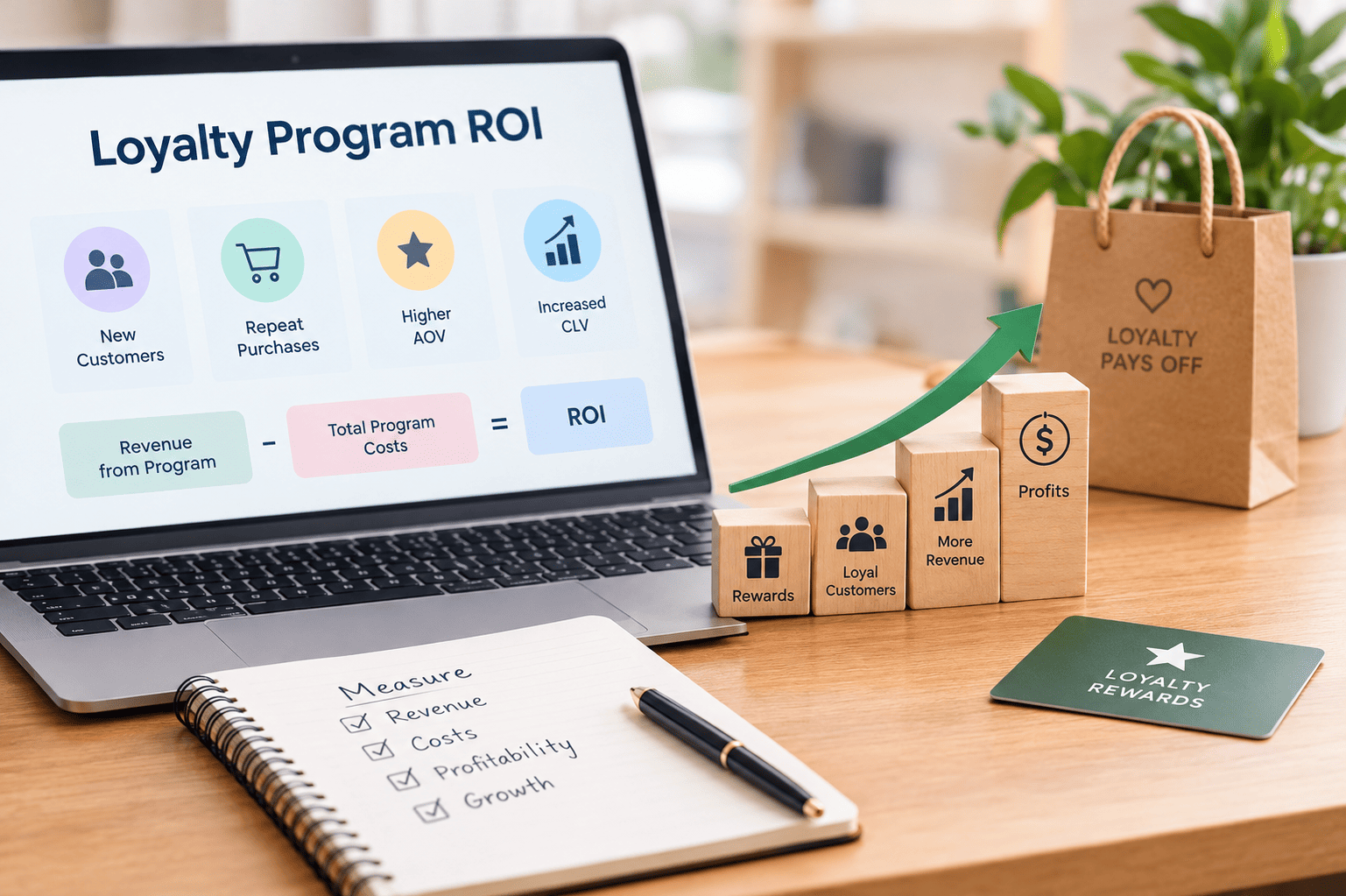
A loyalty program can look successful while producing little profit. This guide shows how to calculate loyalty program ROI step by step – using test-and-control groups to measure incremental profit, accounting for the full cost of rewards and operations, and tracking supporting metrics like repeat purchase rate, redemption rate, and customer lifetime value – so you can prove your program pays off.
- What Is Loyalty Program ROI?
- Is Your Loyalty Program Actually Making Money?
- How to Measure Loyalty Program Profitability
- Loyalty Program Cost Calculation: What to Include
- Key Metrics for Measuring Loyalty Program Performance
- Common Mistakes That Distort Loyalty ROI
- Frequently Asked Questions
- Conclusion
A loyalty program should do more than increase points earned, rewards redeemed, or customer registrations. It should help your ecommerce business generate profitable repeat purchases, improve customer retention, and increase customer lifetime value without spending more on rewards than the program earns.
This article will focus on loyalty program ROI, including how to calculate loyalty ROI, measure program costs, evaluate profitability, and understand whether your loyalty strategy is genuinely contributing to business growth. It will also explain how Retenzy can help ecommerce brands measure loyalty program performance.
What Is Loyalty Program ROI?
Loyalty program ROI measures the financial return a business receives from its loyalty program compared with the cost of operating it.
For an ecommerce brand, that return may come from:
- More customers placing a second or third order.
- Higher purchase frequency among existing customers.
- Increased contribution profit from repeat purchases.
- Greater customer lifetime value.
- Additional revenue from referrals or other measurable loyalty activities.
However, revenue generated by loyalty members is not automatically revenue generated by the loyalty program. Customers who join a loyalty program may already be your most engaged and frequent buyers. To measure genuine impact, you need to estimate how much additional business the program creates beyond what would have happened without it.
Loyalty program ROI vs. other E-commerce Metrics
| Metric | What it tells you |
|---|---|
| Loyalty program ROI | Whether the program generates a worthwhile financial return. |
| Redemption rate | How frequently customers redeem available rewards. |
| Repeat purchase rate | How many customers return to buy again during a defined period. |
| Average order value (AOV) | The average amount spent per order. |
| Customer lifetime value (CLV) | The value a customer generates over the relevant customer relationship period. |
| Program profitability | Whether the financial benefits exceed the full costs of running the program. |
Is Your Loyalty Program Actually Making Money?
A loyalty program can look successful in a marketing dashboard while producing little or no incremental profit.
For example, suppose an ecommerce brand has 10,000 loyalty members. Those members generate substantial sales, frequently redeem points, and have a higher average order value than non-members. At first glance, the program appears successful.
But several questions remain:
- Would these customers have purchased anyway?
- How much of the extra revenue came from discounts or free rewards?
- What did the loyalty software, integrations, and staff cost?
- How much margin was lost through reward redemptions?
- Did the program encourage customers to make additional purchases, or simply reward existing behaviour?
The answers determine whether the program is creating value.
A practical example
Imagine a fashion ecommerce brand introduces a points-based loyalty program. Members generate ₹12 lakh in revenue during a measurement period, compared with an estimated ₹10 lakh they would have generated without the program.
The program therefore appears to have created ₹2 lakh in incremental revenue. But revenue is not profit. The business still needs to account for product costs, fulfilment, rewards, platform fees, and other expenses before deciding whether the program is profitable.
The key lesson: Measure the additional contribution profit attributable to the loyalty program, not simply the total sales made by its members
How to Measure Loyalty Program Profitability
A reliable measurement process connects customer behaviour with financial results. The following steps provide a practical framework for ecommerce businesses.
Step 1: Define the business objective
Before calculating profitability, establish what the program is designed to achieve.
A brand focused on increasing second orders may measure the percentage of first-time customers who place a second purchase within 60 or 90 days. A subscription business may focus on reducing cancellations, while a high-value retailer may prioritize profitable repeat purchases and customer lifetime value.
Your objective determines which outcomes should be included in the ROI analysis.
Step 2: Establish a baseline
Record customer behaviour before the loyalty program launches or before a new loyalty campaign begins.
Useful baseline measures include:
- Repeat purchase rate.
- Revenue per customer.
- Contribution profit per customer.
- Average order value.
- Purchase frequency.
- Time between first and second orders.
- Customer retention over a defined period.
The baseline helps you understand normal customer behaviour and provides a reference for evaluating future changes.
Step 3: Compare against a control group
The strongest practical approach is to compare eligible customers who receive the loyalty treatment with a comparable group that does not.
For example, an ecommerce brand could randomly assign eligible customers to:
- Test group: Customers who receive the loyalty program or a specific loyalty incentive.
- Control group: Customers who do not receive that treatment during the experiment.
Measure both groups over the same period and compare their purchasing behaviour and contribution profit.
This is more reliable than simply comparing members with non-members, because customers who voluntarily enrol may already be more loyal. EY recommends test-and-control approaches where practical to help isolate the effect of loyalty initiatives.
Step 4: Calculate incremental financial value
Determine the difference in contribution profit between the test group and the control group, adjusting for meaningful differences in customer mix and purchase conditions.
For example, if the test group produces ₹3 lakh in contribution profit and the comparable control group would have produced ₹2.4 lakh, the estimated incremental contribution profit is ₹60,000.
This amount represents the financial improvement associated with the program during the selected measurement period, not necessarily the entire program’s long-term value.
Step 5: Account for the full program cost
Include all relevant expenses, not just the loyalty software subscription.
These may include reward costs, technology, customer communication, staff time, integrations, and other incremental operating expenses. If the program creates a material obligation for unredeemed rewards, the business should also coordinate with finance to account for that obligation appropriately.
Step 6: Calculate and interpret the result
Once incremental profit and total program cost are available, calculate ROI and examine the result alongside retention, purchase frequency, and reward economics.
A positive ROI is useful, but it should not be the only decision criterion. A program may be strategically valuable for retention or customer experience even when its short-term financial return is still developing. Conversely, strong revenue growth can conceal weak profitability.
Loyalty Program Cost Calculation: What to Include
An accurate loyalty program budget should reflect the total cost of delivering the program, not just its advertised subscription price.
- Rewards and incentives: Include the actual cost of discounts, free products, gifts, cashback, shipping benefits, and other rewards provided to customers. Consider the margin impact of each reward rather than treating every reward as having the same cost.
- Technology and platform fees: Account for loyalty software subscriptions, usage-based fees, payment-related costs, and the cost of maintaining the technology required to run the program.
- Marketing and communication: Include email and SMS campaign costs, creative production, loyalty-specific promotions, and other marketing expenses that would not exist without the program.
- Staff and operational costs: Consider the time spent designing rewards, answering loyalty-related customer questions, managing fraud, analyzing results, and maintaining the program.
- Integration and maintenance: Include relevant costs for connecting the program to your ecommerce platform, CRM, analytics tools, customer service systems, and other operational software.
Don't overlook reward liability
Points that customers have earned but not yet redeemed may represent a future obligation, depending on the program’s terms and the applicable accounting framework. Businesses should work with their finance or accounting team to determine the appropriate treatment.
For ROI analysis, distinguish between:
- Rewards that have already been redeemed.
- Expected future reward costs.
- Points that expire or are otherwise unlikely to be redeemed.
- Outstanding obligations that need to be recognised or monitored.
Ignoring future reward costs can make a loyalty program appear more profitable than it actually is.
Key Metrics for Measuring Loyalty Program Performance
Loyalty program ROI is the primary financial measure, but supporting metrics explain why the program is or is not generating value.
5.1 Incremental revenue and contribution profit
This is the most important financial indicator. It measures the additional business associated with the loyalty program after accounting for what would likely have happened without it.
Track:
- Incremental revenue per eligible customer.
- Incremental contribution profit per customer.
- Incremental orders.
- Incremental margin after rewards and fulfilment costs.
Do not use total member revenue as a substitute for incremental revenue. The difference is essential when presenting results to finance or senior management.
5.2. Repeat purchase rate
Repeat purchase rate measures the proportion of customers who make another purchase during a specified period.
For ecommerce, useful measurement windows include 30, 60, 90, or 180 days, depending on the typical repurchase cycle of the product category.
For a loyalty program, compare the repeat purchase rate of the relevant test group with a suitable baseline or control group. A higher rate among members alone does not prove that the program caused the improvement.
5.3 Purchase frequency
Purchase frequency shows how often customers buy within a defined period.
A loyalty program may increase profitability by encouraging customers to purchase more often rather than by increasing the size of every order. This is especially relevant for consumables, beauty products, groceries, and other categories with predictable replenishment cycles.
Track purchase frequency alongside contribution profit. More orders are valuable only when their incremental contribution exceeds the additional cost of generating and fulfilling them.
5.4. Average order value
Average order value (AOV) measures the average revenue per order.
A loyalty program may influence AOV through:
- Reward thresholds.
- Points multipliers.
- Bundles.
- Personalized offers.
- Benefits linked to higher-value purchases.
However, a higher AOV does not automatically indicate better profitability. A larger order supported by an expensive discount may produce less contribution profit than a smaller order at a healthier margin.
5.5 Redemption rate
Redemption rate measures how much of the available reward value customers redeem during a specified period.
A commonly used points-based measurement is:

This is only one possible definition. Some programs measure the percentage of eligible members who redeem at least one reward, while others measure redeemed reward value against issued reward value.
Always define the numerator and denominator clearly. A points redemption rate and a member redemption rate are not interchangeable.
Why redemption rate matters?
A very low redemption rate may indicate that customers do not understand the rewards, the redemption threshold is too high, or the rewards are not attractive. A very high redemption rate may indicate strong engagement, but it can also increase reward costs.
There is no universal redemption rate that proves a loyalty program is healthy. Interpret redemption together with incremental profit, customer behavior, reward costs, and customer satisfaction.
5.6 Cost per loyal customer
Cost per loyal customer helps a business understand the expense of operating the program relative to its customer base.
A simple operational measure is:

Define “active” before using the metric. For example, a business may classify customers as active if they made a purchase or completed a meaningful loyalty action during the measurement period.
This metric is useful for budgeting and program management, but it does not measure profitability by itself.
5.7 Customer lifetime value
Customer lifetime value (CLV) estimates the value a customer generates over the relevant relationship period.
Compare CLV for appropriate loyalty and control cohorts, using a consistent definition and time horizon. A loyalty program that improves repeat purchasing and retention may increase CLV, but the additional value must be weighed against the cost of achieving it.
5.8 Breakage and outstanding rewards
Breakage refers to rewards or points that expire or go unused. It can affect reward economics and financial reporting, but it should not be treated as a success metric on its own.
A high level of unused rewards may reduce expected redemption costs while also indicating that customers receive little practical value from the program. A good program balances financial sustainability with a reward experience customers understand and trust.
Common Mistakes That Distort Loyalty ROI
Mistake 1: Measuring total member revenue
Members may already be high-value customers. Their total spend is not evidence that loyalty rewards caused their purchases. Better approach: Use a randomised holdout group or a carefully designed comparison to estimate incremental impact.
Mistake 2: Counting only software fees
A platform subscription is just one part of loyalty program cost. Rewards, campaign execution, staff, integrations, and other operating expenses can materially affect profitability. Better approach: Build a complete loyalty program budget.
Mistake 3: Treating points issued as profit
Issuing points can create a future reward obligation. The value of points issued is not equivalent to cash earned by the business. Better approach: Track points issued, redeemed, expired, and outstanding, and coordinate with finance on the appropriate accounting treatment.
Mistake 4: Using a generic ROI benchmark
There is no single ROI target that applies to every ecommerce business. A grocery brand with frequent purchases and a premium furniture brand with infrequent purchases have very different economics. Better approach: Set targets based on category margins, purchase frequency, customer acquisition economics, reward costs, and the program’s strategic objective.
Mistake 5: Optimizing redemption rate in isolation
Increasing redemptions may improve engagement while reducing contribution profit. Conversely, a low redemption rate may conceal a poor customer experience. Better approach: Evaluate redemption alongside incremental profit, customer behaviour, and customer feedback.
Mistake 6: Changing the measurement period too often
Short-term results may fluctuate because of seasonality, promotions, holidays, and changes in customer acquisition. Better approach: Define a consistent measurement period and review short-term and longer-term results separately. For example, a replenishment-focused brand might use a 90-day repeat-purchase window while also tracking longer-term customer value.
Frequently Asked Questions
What is loyalty program ROI?
Loyalty program ROI measures the financial return generated by a loyalty program relative to its total cost. For a more meaningful profitability analysis, use incremental contribution profit rather than total member revenue.
What should be included in loyalty program costs?
Include rewards and incentives, technology fees, staff time, campaign expenses, integrations, and other relevant operational costs. Outstanding reward obligations may also need to be considered in coordination with finance.
What is a good loyalty program ROI?
There is no universal good ROI for every loyalty program. The appropriate target depends on gross margins, purchase frequency, reward costs, customer acquisition economics, and the program’s strategic goals. Establish a baseline and compare results against your own financial requirements.
Conclusion: Measure Loyalty Program ROI Before Increasing Your Budget
A loyalty program is successful when it creates measurable customer and business value, not simply when customers collect points or redeem rewards.
To calculate loyalty program ROI accurately:
- Define the program’s business objective.
- Measure incremental customer and financial outcomes.
- Include the full cost of operating the program.
- Track supporting metrics such as repeat purchase rate, AOV, purchase frequency, and redemption rate.
- Review profitability consistently and improve the program based on evidence.
For ecommerce brands, the goal is to build a loyalty strategy that encourages valuable repeat purchases while protecting contribution margin. With a clear measurement framework and reliable customer analytics, loyalty program decisions can become more financially accountable.
Add points, referrals, and VIP rewards to your Shopify store in under 5 minutes.