
A new store should start with three or four ways to earn loyalty points: account creation, product reviews, completed referrals and a birthday bonus. Together they cover customer identity, social proof, acquisition and a yearly touchpoint without much moderation work. Add quizzes, surveys and UGC later, once you know which actions actually bring members back to buy.
12 Ways to Earn Loyalty Points Beyond Purchases
A customer buys from you in March and doesn’t come back until August. For five months, your loyalty program has nothing to say to them, because the only way to earn is to spend. Reviews, referrals, quizzes and birthdays can fill that gap, but only when each action is worth what you pay for it. Below are 12 ways to earn loyalty points beyond purchases, with earning rules you can copy.
Table of contents
- What are non-purchase loyalty actions?
- Which actions help you learn more about your customers?
- Which actions turn customers into feedback and content?
- Which actions bring new customers to your store?
- Which actions keep the relationship going between orders?
- Which actions keep the relationship going between orders?
- Should non-purchase points count toward a tiered loyalty program?
- Pick the actions worth paying for
Key takeaways
- Pay points for outcomes, like a completed referral, not clicks.
- Put a frequency limit on every action to stop point farming.
- Reward honest reviews, never positive ones.
- Price each action against what its points cost you to redeem.
- Decide early whether non-purchase points count toward VIP tiers.
What are non-purchase loyalty actions?
Non-purchase loyalty actions are customer behaviors that earn points without a transaction, such as writing a review, referring a friend or completing a profile. They keep members active between orders and give your store something useful in return: feedback, content, customer data or new shoppers. Every action should have a clear business purpose and a written earning rule.
Adding more earning actions does not automatically make a better program. A store that hands out points for every click teaches members to collect points, not to buy again. So the useful question for any action is simple: which customer behaviors create enough value to justify the points?
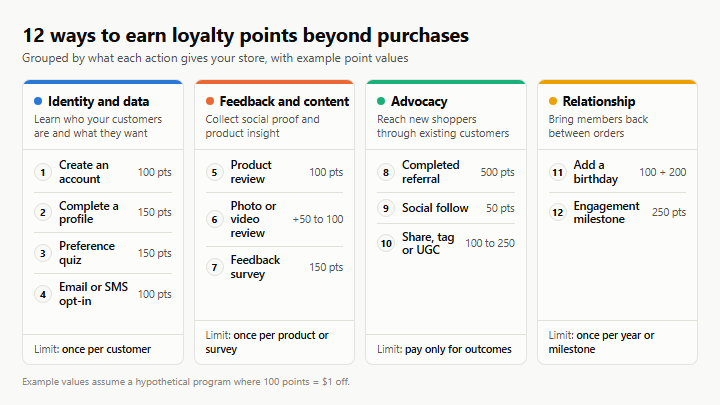
The 12 actions below are grouped by what they give your business. Each one includes an example rule, why it works and the guardrail that keeps it from being abused. The point values assume a hypothetical program where 100 loyalty points equal $1 off, so you can see the cost of each action in dollars.
Which actions help you learn more about your customers?
Account creation, profile completion, preference quizzes and marketing opt-ins all earn points in exchange for information. They are low-cost actions, usually worth $1 to $1.50 in points, and they give you the customer identity and preference data every other earning action depends on. Reward each one once per customer.
1. Create a loyalty account
Example rule: Create an account, earn 100 points, once per customer.
An account connects future activity to a real customer profile instead of anonymous sessions. It also gives the member a place to see their balance and available rewards, which is what makes every later earning action visible. Keep the bonus to a single claim, or shoppers will open several accounts to collect it again.
A $1 welcome bonus that brings a member closer to their first reward works better than a large one people claim and forget.
2. Complete a customer profile
Example rule: Complete your profile, earn 150 points, once. You can also split it into three steps of 50 points: add size or fit preferences, pick favorite categories and fill in the remaining fields.
A profile gives you segmentation data that order history can’t. A fashion store can use fit preferences to recommend the right sizes, while a pet supply store can use the pet’s age and breed to time food reminders. Only ask for information you will actually use. A 20-question profile that feeds nothing turns a reward into a chore.
3. Complete a product or preference quiz
Example rule: Complete the product finder quiz, earn 150 points, once.
Quizzes work best in categories where shoppers struggle to choose: skincare, haircare, coffee, supplements, apparel and pet food. The customer gets guidance, and you learn what they care about. A skincare brand, for example, can tag members by skin type and send routine-specific offers later.
Reward only quizzes that end in a real outcome, such as a product match, a routine or a recommended bundle. Points for clicking through filler questions produce data you can’t trust.
4. Opt into marketing emails or SMS
Example rule: Subscribe to marketing emails, earn 100 points, once.
The reward should be released only after the customer gives clear consent. Shopify’s own guidance is to send promotional messages only to customers who have agreed to receive them, and SMS rules in many regions are stricter still. Never make points or program membership conditional on marketing consent. Customers should be able to join and earn without agreeing to messages they don’t want.
Which actions turn customers into feedback and content?
Reviews, photo or video reviews and surveys earn points for something other shoppers or your team can use. These deserve more points than identity actions, typically 100 to 200, because each one produces social proof or product insight. Reward the act of giving feedback, never a specific rating or opinion.
5. Leave a product review
Example rule: Submit a verified product review, earn 100 points, once per product.
Reviews are one of the most practical non-purchase actions because the customer creates something future shoppers rely on. The incentive has to be neutral, though. Offering points for honest feedback is fine. Offering points only for 5-star reviews is not, and in the US the FTC’s 2024 rule on consumer reviews specifically bans incentives that are conditioned on a review expressing a particular sentiment.
Write the prompt as “Leave an honest review and earn 100 points.” Never write “Leave a 5-star review and earn 100 points.”
6. Add a photo or video to a review
Example rule: Written review earns 100 points, a photo adds 50 more, and a video adds 100 more.
Visual reviews show fit, texture, size and real use in a way star ratings can’t. A furniture store gets far more from a photo of a sofa in an actual living room than from a fifth “looks great” comment. With the customer’s permission, those images can also feed product pages and ads.
Cap it at one rewarded review per product per customer. Otherwise a single buyer can upload five photos of the same mug and collect five bonuses.
7. Complete a customer feedback survey
Example rule: Complete a customer survey, earn 150 points, once per survey.
Surveys capture what transaction data can’t: why someone chose you, what nearly stopped them and why they haven’t ordered again. Useful topics include product satisfaction, delivery experience, site usability, product requests and reasons for not repurchasing.
Run each survey as its own campaign with its own reward, rather than one form customers can resubmit. Then act on the answers. A survey that leads to a new shade or a faster shipping option gives members a reason to keep answering.
Go deeper: 7 Common Traits of the Best Ecommerce Loyalty Programs covers how strong programs balance earning and spending.
Which actions bring new customers to your store?
Referrals, social follows and user-generated content extend your reach beyond existing buyers. Their value varies more than any other group. A completed referral brings a paying customer and can justify 500 points, while a social follow is a weak signal worth around 50. Price each one by the outcome it produces, not the effort it takes.
8. Refer a friend who becomes a customer
Example rule: Referred friend completes a qualifying first purchase, referrer earns 500 points and the friend gets 10% off their first order.
This is the clearest case for rewarding outcomes. Points for sharing a referral link invite spam and pay for nothing. Points for a friend’s first qualifying order pay for an actual customer. At the 100 points per $1 ratio, that is a $5 cost to acquire a buyer who arrived with a personal recommendation, usually far below what the same customer would cost through paid ads.
Add a minimum order value and block self-referrals using matching emails, addresses or payment details.
9. Follow the brand on social media
Example rule: Follow us on Instagram, earn 50 points, once per platform.
A follow gives customers another place to see launches, tutorials and limited drops between orders. It is still a light action, and most platforms don’t let you verify that someone stays followed. Keep the reward modest. Fifty points for a follow next to 500 for a referral tells members exactly what you value.
10. Share, tag or create brand content
Example rule: Approved UGC submission earns 250 points. Tagging the brand in an eligible public post earns 100 points.
Content created by customers shows real people using your products, which is harder to fake than brand photography. It also takes the most moderation of any action on this list. Before launching, define what qualifies as UGC, which platforms count, whether posts must be public, whether you approve submissions before awarding points, how often one customer can earn and whether you have permission to reuse the content.
Approval before payout is the safest default. It keeps low-effort or off-brand posts from earning the same points as genuine content.
Which actions keep the relationship going between orders?
Birthdays and engagement milestones create reasons for members to come back even when they haven’t bought recently. A birthday adds one guaranteed touchpoint per year, and milestones turn scattered actions into a goal members can see. Both should be capped tightly, since they are easy to repeat if the rules are loose.
11. Add a birthday
Example rule: Add your birthday, earn 100 points. On the birthday itself, earn 200 bonus points.
These are two separate actions. The first rewards sharing information, and the second rewards an annual milestone. The birthday bonus is useful because it lands in the inbox with a balance the member can spend, often months after their last order.
Pay the birthday bonus once per year, and lock the date after it is set or limit how often it can change. Without that rule, members can edit their birthday every few weeks and collect the bonus repeatedly.
12. Reach an engagement milestone
Example rule: Complete 3 eligible engagement actions, earn 250 bonus points.
Other milestone ideas include completing three reviews, referring two customers, answering three surveys or earning 1,000 points through non-purchase actions. Milestones give members a bigger goal than any single action, and progress messages make the next step obvious: “You’ve completed 2 of 3 activities. Finish one more to earn 250 bonus points.”
Tie milestones to actions that matter. “Visit the site 10 times for 500 points” rewards behavior that is easy to fake and tells you nothing.
How many loyalty points should each action earn?
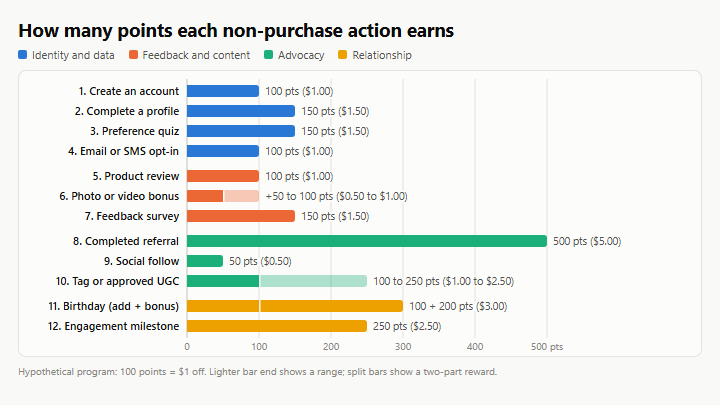
Price each action by the value it creates, then check what its points cost you to redeem. Identity actions sit at the low end, feedback in the middle and completed referrals at the top. Using the example ratio of 100 points to $1, the table below shows suggested values, limits and the real cost of each action.
| Action | Group | Example points | Cost at 100 pts = $1 | Frequency limit |
|---|---|---|---|---|
| Create an account | Identity and data | 100 | $1.00 | Once per customer |
| Complete profile | Identity and data | 150 | $1.50 | Once |
| Preference quiz | Identity and data | 150 | $1.50 | Once |
| Marketing opt-in | Identity and data | 100 | $1.00 | Once, after consent |
| Product review | Feedback and content | 100 | $1.00 | Once per product |
| Photo or video bonus | Feedback and content | 50 to 100 | $0.50 to $1.00 | Once per product |
| Feedback survey | Feedback and content | 150 | $1.50 | Once per survey |
| Completed referral | Advocacy | 500 | $5.00 | Per qualifying order |
| Social follow | Advocacy | 50 | $0.50 | Once per platform |
| Approved UGC | Advocacy | 250 | $2.50 | Monthly cap |
| Birthday (add + bonus) | Relationship | 100 + 200 | $3.00 | Bonus once per year |
| Engagement milestone | Relationship | 250 | $2.50 | Once per milestone |
Here is the worked math for a hypothetical member who completes every one-time action: account, profile, quiz, opt-in, one follow and a birthday add. That totals 650 points, or $6.50 in redeemable value. If your smallest reward is $5 off at 500 points, that member can claim a first reward without ever buying, which may or may not be what you want.
Many stores add a rule that points can only be redeemed on an order above a minimum value. That way, non-purchase points pull members back to checkout instead of paying out for nothing. Show those earning options where members will see them. Rewards placement covers the widget, account page and checkout spots that work best.
Should non-purchase points count toward a tiered loyalty program?
In most cases, tier status should be based on spend or orders, and non-purchase points should go to rewards only. A tiered loyalty program exists to recognize your best buyers. If reviews and follows can push someone into a VIP tier, members who rarely purchase end up with your richest perks.
There are exceptions. A brand built on community, such as a running shoe store that hosts group runs, may want completed referrals or approved UGC to count toward status, because those members drive real revenue. The safe middle ground is to count only high-value advocacy actions toward tiers while keeping light actions, like follows and birthday bonuses, in the redeemable balance.
Whatever you choose, state it clearly on your program page. Members get frustrated when they earn 300 points for reviews and then find their tier progress hasn’t moved.
Pick the actions worth paying for
The best ways to earn loyalty points beyond purchases are the ones tied to an outcome your store can measure: a review published, a referral converted, a preference you will use. Start with three or four actions from different groups, price them with the table above and set a frequency limit on each before launch. After 60 days, check which actions led members back to a second order and cut the ones that didn’t.
FAQ
What are the best ways to earn loyalty points without making a purchase?
The best ways to earn loyalty points without buying are actions that create value for the store: writing a product review, referring a friend who places an order, completing a preference quiz or answering a feedback survey. Lighter actions like account creation, social follows and birthdays work too, but they should earn fewer points because they produce less business value.
Can you give loyalty points for product reviews?
Yes, as long as the points reward submitting a review and not its rating or opinion. In the US, the FTC’s 2024 rule on consumer reviews bans incentives that depend on a review being positive or negative. Offer the same points for a 1-star and a 5-star review, and cap rewards at one review per product per customer.
How many points should a referral be worth compared to other actions?
A completed referral should usually be your highest non-purchase reward, often three to ten times the value of a review or signup, because it brings a paying customer. In a program where 100 points equal $1, 500 points ($5) for a referred friend’s first qualifying order is a common starting point. Never pay out for link shares alone.
How do you stop customers from abusing non-purchase loyalty points?
Set a frequency limit on every action, such as once per customer, once per product or once per year. Award referral points only after a qualifying order, approve UGC before paying out, lock birthdays once set and block self-referrals by matching emails or addresses. A minimum order value for redemption also stops members from cashing out points without buying.
Should loyalty points from reviews and referrals count toward VIP status?
For most stores, no. VIP tiers in a tiered loyalty program work best when they are based on spend or order count, so your top perks go to your best buyers. Some community-driven brands let completed referrals count toward tiers. If you mix them, keep light actions like follows and birthday bonuses out of tier progress.
Which ways to earn loyalty points work best for a new Shopify store?
Increase Repeat Orders with Retenzy
Add points, referrals, and VIP rewards to your Shopify store in under 5 minutes.