
Turning Customer Reviews Into Social Proof for Ads and Social Media
Using reviews as social proof means more than posting star ratings on product pages. It means mining customer language for insights that fuel ads, social content, and email. This guide shows how to spot reviews worth repurposing, turn one review into ten content assets, test five review-based ad formats, and build a repeatable workflow that connects reviews to retention.
- What Does It Mean to Use Reviews as Social Proof?
- Why Customer Reviews Are Becoming Reusable Marketing Assets
- How to Find Reviews Worth Turning Into Content
- How to Turn Reviews Into Ads
- 5 Review-Based Ad Formats to Test
- UGC From Reviews: Turning Customer Feedback Into Content
- How to Build a Customer Review UGC Strategy
- Create a Review-to-Content Workflow
- Turn One Detailed Review Into Multiple Content Assets
- How Retenzy Helps Connect Reviews With Customer Retention
- Common Mistakes to Avoid
- Final Takeaway
Most ecommerce brands collect reviews, post them on product pages, and stop there. That leaves a lot of customer insight sitting unused in a dashboard.
A genuinely detailed review tells you how a customer describes your product in their own words, what problem sent them looking for it, which feature actually closed the sale, and what almost stopped them from buying. That’s raw material for advertising, social content, email, landing pages, and creative testing – not just a star rating. Take a review like this one:
“I bought this because my skin felt dry after using my usual cleanser. After a few weeks, it felt much less tight.”
That single sentence could become a Meta ad concept, a social post, a customer-story creative, a product-page testimonial, an email section, a UGC-style video script, a retargeting ad, or a content angle built around a specific skin concern. That’s the real opportunity in treating reviews as social proof: customer feedback turns into a reusable source of marketing insight instead of a static rating nobody revisits.
The 2026 BrightLocal Local Consumer Review Survey is a useful data point here, though it needs a caveat – it surveyed 1,002 US adults about local businesses, not ecommerce shoppers specifically. Even so, 97% said they read online reviews before choosing a local business, 93% had purchased after reading reviews, and 66% said a positive review sent them off to do more research. The lesson for ecommerce marketers isn’t that every review closes a sale on the spot. It’s that reviews are usually one step in a longer research journey, and the more useful your review content is, the more of that journey you can influence.
What Does It Mean to Use Reviews as Social Proof?
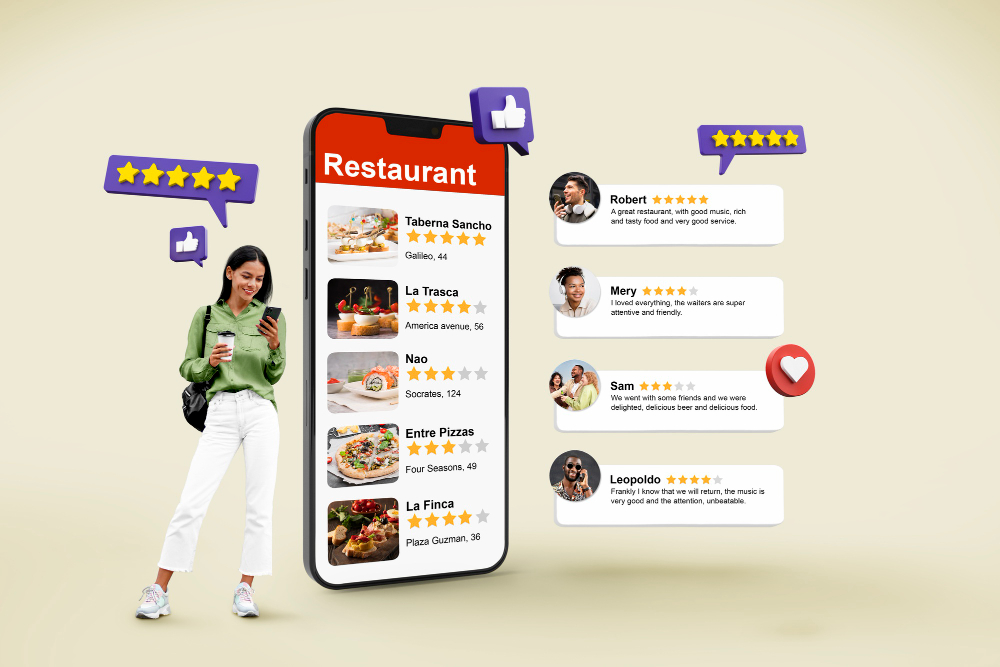
Social proof is simply evidence from other people that makes a decision feel less risky. In ecommerce, that shows up as reviews, star ratings, testimonials, customer photos and videos, product demos, and customer stories.
Reviews carry particular weight because they’re written in customer language, not brand language – but not every review earns that weight equally. Compare “Great product!” with something like: “I bought this for my three-day office commute because I wanted a lighter bag. The separate laptop compartment is what convinced me to keep it.” The second one hands you a use case (commuting), a need (a lighter everyday bag), a feature that mattered (the laptop compartment), a purchase motivation (practical organization), and language that sounds like an actual person rather than a marketer. That’s what makes a review useful for a customer review UGC strategy – not the star count, but the density of usable signal packed into it. The goal was never to collect as many five-star reviews as possible. It’s to find the reviews that explain why customers buy, use, recommend, or come back.
Why Customer Reviews Are Becoming Reusable Marketing Assets
The textbook ecommerce journey looks like: ad, then product page, then reviews, then purchase. But customer feedback actually feeds several stages at once — the experience itself becomes a review, the review becomes an insight, the insight becomes content, the content runs as an ad or social post or search result, and that pulls in the next customer.
That loop changes how you should think about your review library. A single review can surface a use case you hadn’t considered. A cluster of reviews can point to a recurring problem worth addressing in your product copy. Photo reviews show what the product looks like outside a studio. Reviews from repeat buyers are loyalty signals hiding in plain sight.
How to Find Reviews Worth Turning Into Content
Not every review deserves to become an advertisement. A practical filter helps your team spot the ones with real marketing value.
1. Look for Specificity
Generic praise like “Love this product!” doesn’t give you much to work with. Something like “I’ve been using it during my three-day office commute, and the smaller compartments make it easier to organise my charger, notebook, and headphones” hands you actual context you can translate directly into content.
2. Preserve Customer Language
Resist the urge to polish every review into brand copy. “Designed for effortless everyday organisation” is fine as brand language, but “Everything finally has its own place in my bag”, a real customer’s phrasing, often makes a sharper, more authentic starting point for your creative team. Treat the customer’s words as insight to build from, and make sure any ad you build keeps the original meaning intact rather than exaggerating it.
3. Identify Different Use Cases
Tag reviews by who’s using the product, why they bought it, where and when they use it, what problem it solved, their favourite feature, any product comparison they made, whether it was a repeat or gift purchase, and any use case you didn’t anticipate. One product can generate a dozen different creative angles once you start sorting reviews this way.
4. Separate Photo and Video Reviews
Text reviews explain an experience; photos and videos demonstrate it. A photo might show how the product looks in someone’s actual home, how a piece of clothing fits, how it’s styled, its real-world scale, its packaging, or just everyday use. Video adds movement and context on top of that. None of that means customer photos and videos are automatically fair game for advertising, though – confirm you have the rights or permission to use identifiable customer content, and check that it complies with the advertising and platform rules you’re publishing under before you use it.
How to Turn Reviews Into Ads
The easiest mistake to make here is lifting an entire review and dropping it straight into an ad. A better approach is to pull the customer insight out of the review first, then build the creative around that insight rather than the review’s exact wording.
Say a customer writes: “I originally bought it because I wanted something small enough for my desk. Now I use it every morning for my coffee.” Read past the sentence itself and you’ll find a customer problem (limited desk space), a purchase motivation (compact size), an actual use pattern (daily coffee), and a content angle (small footprint plus everyday use). That could become a headline like “Made for small spaces. Used every morning,” paired with the product shown in a realistic desk setup and a short, faithful customer quote as supporting copy. The review isn’t being treated as generic praise here — it’s evidence of which specific benefit actually mattered to a real person.
5 Review-Based Ad Formats to Test
| Format | What it needs | Best for |
|---|---|---|
| Customer Quote Ads | One short, faithful excerpt | Top-of-funnel awareness, simple retargeting |
| Review Screenshot Ads | An actual screenshot (rights confirmed) | Retargeting, product launches, social proof campaigns |
| Review Collage Ads | 3–5 short, varied quotes | Communicating breadth of positive experience without over-relying on one voice |
| Problem → Review → Product | A review that names the exact pain point | Cold audiences who haven’t heard of the product yet |
| Before-and-After Experience | A review describing a legitimate, verifiable change | Categories where outcomes are visible or measurable (skincare, fitness, organization) |
1. Customer Quote Ads
Pull a short excerpt from a genuine review – something like “The first thing I noticed was how easy it was to use.” Keep it faithful to what the customer actually said; don’t edit it into a stronger claim than they made.
2. Review Screenshot Ads
An actual screenshot of a review reads differently from polished brand advertising, which is exactly why it works well for retargeting, product education, social proof campaigns, launches, seasonal pushes, and customer-story creatives. Check your rights, permissions, and platform requirements before publishing anything with identifiable customer information in it.
3. Review Collage Ads
Instead of leaning on one testimonial to carry the whole message, stitch together several short, genuine snippets — “Easy to use.” “Perfect for travelling.” “Bought another for my partner.” “Exactly what I needed.” Several voices land differently than one.
4. Problem → Review → Product
This format bridges a customer’s situation and your product’s relevant feature directly: state the problem (“Struggling to keep your everyday essentials organised?”), back it with real customer evidence (“Everything finally has its own place”), then show the product solving exactly that.
5. Before-and-After Experience
Where a product can legitimately produce a visible or measurable change, structure the story as before, experience, after. Be careful here, though — one customer’s subjective experience doesn’t establish that everyone will get the same result, and advertising claims need to be truthful and backed by real evidence. Testimonials can’t be misleading, and you need substantiation for whatever you claim.
UGC From Reviews: Turning Customer Feedback Into Content
UGC usually gets associated with paid creators or influencer campaigns, but your existing customers are already producing it for free. Your review library likely already contains written experiences, product photos, unboxing content, usage demonstrations, and repeat-purchase stories — a text review explaining why someone bought, a photo showing it in use, a video demonstrating the experience, a piece of social content built from an approved customer story, and, if it performs well organically, a paid creative tested from that same customer-led content. None of this replaces working with creators. It just gives you another, cheaper source of authentic product context sitting in your existing data.
How to Build a Customer Review UGC Strategy
Four stages make this sustainable rather than a one-off project.
Stage 1: Collect
Gather written reviews, star ratings, customer photos and videos, product-specific feedback, repeat-purchase comments, and product Q&A. Don’t fixate on the star rating alone — the context around it is usually where the useful marketing insight lives.
Stage 2: Categorise
Tag reviews by product quality, ease of use, design, size, comfort, packaging, delivery, use case, customer type, problem solved, favourite feature, and whether it was a repeat or gift purchase. Once tagged, your review library becomes searchable instead of just being a pile of star ratings.
Stage 3: Repurpose
Turn selected reviews and insights into Meta ad concepts, Instagram carousels, Reels, product-page testimonials, email content, landing-page testimonials, retargeting creatives, customer-story posts, product education, and creative briefs. Repurposing doesn’t mean copying the same review into every channel — each channel should use the underlying insight in the format that fits it.
Stage 4: Measure
Compare brand-created creative against review-led creative and customer photo/video creative directly. Depending on your funnel and attribution setup, track CTR, add-to-cart rate, conversion rate, CPA, ROAS, revenue per visitor, and engagement rate. The point is finding out which customer messages actually move business outcomes, not just which ones feel authentic.
Create a Review-to-Content Workflow
You don’t need an elaborate content operation to make this work, instead a simple weekly rhythm gets you most of the way there.
Monday, collect: pull in new written, photo, and video feedback.
Tuesday, identify: tag anything with strong customer language, a specific use case, a clear product benefit, or a photo, video, or repeat-purchase signal attached.
Wednesday, create: turn what you tagged into social posts, ad concepts, testimonials, email snippets, or product-page content.
Thursday, approve: check customer rights or permissions, quote accuracy, context, claims, personal information, product availability, and platform requirements.
Friday, publish and test: launch what’s approved and start measuring.
Repeating this weekly turns review content into a process instead of something that only happens when someone remembers the dashboard exists.
Turn One Detailed Review Into Multiple Content Assets
Here’s what one good review can actually produce. Start with: “I’ve been using this organiser on every work trip. It fits inside my carry-on and keeps all my chargers, cables, and adapters together. I bought a second one for my partner.”
That single sentence can become a product-page testimonial (“Fits easily inside my carry-on”), a social post on how one customer organises their travel tech, a carousel on three things customers love about the organiser, an ad hook (“Still carrying loose cables in your suitcase?”), a standalone customer-quote creative (“Everything stays together”), a travel-use-case Reel showing the product being packed, an email section on how customers use it while travelling, a retargeting creative pairing the quote with a product visual, an FAQ answer on whether it fits inside carry-on luggage (only if your specs actually confirm that), and a product-education post on organising chargers, cables, and adapters in one place. Ten content ideas from one review, without treating that review as a finished ad campaign on its own.
How Retenzy Helps Connect Reviews With Customer Retention
Collecting reviews is only one part of the customer relationship. Retenzy is a Shopify loyalty and retention app that connects review collection directly with rewards, referrals, and VIP tiers, so review activity feeds into the same system that drives repeat purchases:
Purchase → Review → Reward → Engagement → Repeat purchase
A merchant can use a reward structure to encourage review participation while keeping the request focused on genuine feedback, not a required positive rating. Retenzy’s review management and ratings tools sit alongside its loyalty and retention tools in the same Shopify-connected system, so a merchant isn’t stitching together a separate review app and a separate loyalty app to get reviews and rewards talking to each other.
The point isn’t to turn every review into an ad. It’s to treat review collection as part of the full customer lifecycle – collect, understand, reward, engage, retain – rather than a task that ends the moment the review is published.
Common Mistakes to Avoid
Publishing an entire review as an ad. A raw review wasn’t written to be an advertisement — pull the insight out and build the creative around it instead of copying the text wholesale.
Editing a quote until it says more than the customer meant. Tightening grammar is fine; strengthening the claim isn’t. If a customer said their skin “felt less tight,” don’t let the ad imply their skin problem was solved.
Treating every five-star review as usable. “Great product!” doesn’t give your creative team anything to build from. Specificity matters more than the star count.
Using customer photos or video without confirming rights. A great photo review is not automatically cleared for paid media. Check permissions and platform requirements before it goes into an ad.
Running review-led creative without measuring it against brand-created creative. Authentic-feeling content isn’t automatically better-performing content — test both and let the numbers decide.
Letting the review library sit unsorted. Without tags for use case, product benefit, or format, you’ll re-read the same reviews every time you need a new angle instead of searching for one.
FAQs
What is social proof in ecommerce?
Social proof is evidence from other customers that helps prospective buyers evaluate a product or brand. Reviews, ratings, testimonials, customer photos, videos, and customer stories are common forms of ecommerce social proof.
How can I use reviews as social proof in ads?
Identify detailed, authentic reviews and extract specific customer experiences, use cases, or product benefits. These insights can inform quote creatives, review screenshots, carousels, UGC-style ads, and retargeting content. Make sure the content is used accurately and that you have the necessary rights or permissions.
What is UGC from reviews?
UGC from reviews refers to customer-generated material such as written reviews, photos, and videos that can inform or become marketing content. It provides a customer-led perspective that can complement brand-created creative.
Can customer reviews be used in Meta ads?
Customer reviews can inform Meta advertising creatives, but brands should distinguish between using review insights and directly reproducing customer content. Check applicable rights, permissions, disclosures, and Meta’s advertising requirements before publishing.
How does review syndication work?
Review syndication makes eligible review information available across supported shopping or discovery environments. Google Product Ratings, for example, allows eligible merchants to provide product review data through Merchant Centre or supported third-party aggregators.
How many reviews do I need for Google Product Ratings?
Google currently states that merchants need at least 50 reviews across their products to participate in Product Ratings. Meeting the threshold does not guarantee that ratings will appear; Google also considers data quality, product matching, policy compliance, and other eligibility factors.
Can I incentivize customers to leave reviews?
Incentives need to be structured carefully. The FTC’s current rule prohibits conditioning compensation or incentives on a review expressing a particular sentiment, such as requiring a positive or five-star review. Disclosure requirements can also apply.
Are photo and video reviews better than text reviews?
They serve different purposes. Text reviews can explain a customer’s experience, while photos and videos can demonstrate appearance, context, fit, setup, or usage. A strong review library combines all three rather than treating one format as universally superior.
Final Takeaway
A customer review shouldn’t have just one destination. The same piece of feedback can become social proof, an advertising insight, a customer story, a social asset, a product-page testimonial, an email idea, a UGC opportunity, a product-education angle, and a retention signal, but only if someone treats it that way instead of letting it sit under a star rating.
Effective review marketing isn’t about copying every five-star comment into every channel. It’s about finding the authentic experiences, keeping their meaning intact, placing them where they fit, and measuring which customer insights actually move the business. Collect the feedback, turn the customer’s own language into useful content, then use what you learn to improve both acquisition and retention. Do that consistently, and a review stops being the end of one customer’s purchase journey – it becomes the start of someone else’s.
Add points, referrals, and VIP rewards to your Shopify store in under 5 minutes.