
5 Best In-House Extended Warranty Apps for Shopify (2027)
The best in-house extended warranty apps for Shopify in 2027 are Dyrect’s Extended Warranty, FlowWarranty, Coverly, Warranly and a self-built Shopify setup plus a claims app. Each lets your brand set prices, keep plan revenue and own buyer data, but they differ in where offers appear, how claims get checked and which channels they reach.

- What Is an In-House Extended Warranty App for Shopify?
- In-House vs Third-Party Shopify Extended Warranty Apps: Who Sets the Price, Keeps the Revenue and Pays Claims
- What to Look for in an Extended Warranty App for Shopify
- 5 Best In-House Extended Warranty Apps for Shopify (2027)
- How to Choose a Shopify Protection Plan App by Catalog and Sales Channel
- Shopify Extended Warranty Apps FAQs
In-house extended warranty apps for Shopify let a brand design its own protection plans, sell them on product pages and at checkout, and keep the revenue from every plan sold. With third-party plan providers, by contrast, the provider sets the price, backs the coverage, keeps the larger share of each sale and handles every claim under its own name.
For brands selling durable products such as e-bikes, electronics, furniture, fitness equipment and home appliances, this choice affects margin, customer data and repeat purchases. Consequently, picking between an in-house app and a third-party provider decides who your protection plan buyers really belong to.
This guide explains how in-house Shopify extended warranty apps work, how they compare with third-party plans, which features matter most, and which five options fit different catalogs and sales channels in 2027.
TLDR
- In-house extended warranty apps for Shopify let brands sell their own protection plans, set their own prices and keep plan revenue.
- The five strongest options in 2027 are Dyrect’s Extended Warranty, FlowWarranty, Coverly, Warranly and a self-built Shopify product setup paired with a claims app. Dyrect’s Extended Warranty fits brands selling through Shopify, Amazon, retail stores and distributors.
What Is an In-House Extended Warranty App for Shopify?
In-house extended warranty apps for Shopify are tools that let a store create its own extended warranty and protection plans, show them to shoppers, and record each plan against the order. In this model, your brand acts as the plan provider: you write the coverage terms, choose the length and price, and pay for repairs or replacements when a covered product fails.
In return, the plan revenue stays with your business instead of going to an outside insurer or plan administrator. Your brand also keeps the buyer’s contact details, purchase history and claim history, which supports renewals and repeat sales later.
Three terms come up again and again in this space, so here’s what each one means:
| Term | Meaning |
|---|---|
| Extended warranty | Coverage that starts when the manufacturer warranty ends and covers defects for an extra period, such as one or two more years. |
| Protection plan | A broader plan that adds accidental damage, such as drops, spills or cracked screens, on top of defect coverage. |
| Warranty upsell | The offer that invites a shopper to add a plan, shown on the product page, in the cart, at checkout or after purchase. |
In-House vs Third-Party Shopify Extended Warranty Apps: Who Sets the Price, Keeps the Revenue and Pays Claims
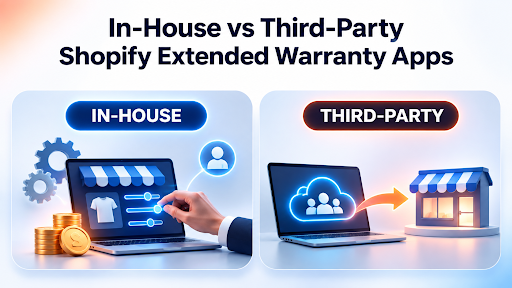
| Question | In-house extended warranty app | Third-party protection plan provider |
|---|---|---|
| Who sets plan price and terms? | Your brand | The provider |
| Who keeps plan revenue? | Your brand keeps 100%, minus app fees | The provider keeps the larger share, and your store earns a commission |
| Who pays claims? | Your brand, or an insurer your brand chooses | The provider or its insurer |
| Who runs the claim experience? | Your team, under your brand | The provider, under its own brand |
| Who owns buyer data? | Your brand | The provider holds or shares it |
| What risk does your brand carry? | Claim costs and compliance | Low claim risk |
Hybrid setups exist as well. For example, some platforms let a brand self-fund plans for some products and add insurance backing for others. This way the brand keeps control of pricing and branding, while an insurer carries the claim risk on higher-value items.
In short, in-house apps suit brands with reliable product failure data and a support team ready to handle claims. Third-party providers, on the other hand, suit brands that prefer to hand off claim risk entirely in exchange for a smaller share of revenue.
What to Look for in an Extended Warranty App for Shopify
The right extended warranty app for Shopify depends on five things: where plan offers appear, how pricing rules scale, how claims get checked, which sales channels the app reaches and what the reporting shows.
Offers Beyond Checkout: Product Page, Post-Purchase, Registration and Renewal
Plan offers at checkout reach shoppers at a single moment, when their attention sits on payment and delivery. Strong in-house apps therefore also show offers on the product page, after delivery, when a buyer registers the product and shortly before coverage expires.
Renewal offers deserve special attention, because buyers who already trust the product often extend coverage when a reminder arrives close to the end date. As a result, every extra selling moment gives the same buyer another chance to add protection.
Per-Product Pricing Rules That Avoid Hundreds of Warranty SKUs
Pricing rules decide whether a protection plan app scales with your catalog. Look for plans priced as a fixed amount or as a percentage of the product price, and assigned by product, collection, vendor, tag or SKU, so a single rule covers hundreds of items.
Merchants on the Shopify Community have described this exact problem. One store needed plans for about 250 eligible SKUs out of roughly 600, and asked for a plan price calculated from each product instead of creating 250 separate warranty products.
Claims Checked Against the Order or Serial Number
Claims handling is where in-house extended warranty programs succeed or struggle. Prefer an app that checks each claim against the original order, the plan and the serial number, flags duplicate claims, and moves approved claims into repair or replacement steps.
Manual checking in an email inbox, by comparison, slows resolution and makes duplicate or fraudulent claims harder to spot. For that reason, the claims workflow matters as much as the upsell widget.
Plan Sales to Amazon and Retail Store Buyers
Checkout widgets reach buyers who purchase on your Shopify store. However, buyers from Amazon, retail stores and distributors usually connect with your brand later, when they register the product for warranty coverage.
Apps that offer plans during product registration turn those marketplace and retail buyers into plan customers too. Consequently, registration-based offers can widen plan sales well beyond your online store.
Reporting on Attach Rate, Plan Revenue and Claims by Product
Attach rate is the percentage of eligible orders that include a protection plan, calculated as plans sold divided by eligible products sold, multiplied by 100. Useful reporting shows attach rate, plan revenue, claims per product and upcoming expiries in one view.
With these numbers in hand, you can raise prices on plans that attract frequent claims, stop offering coverage on products that fail too often, and focus offers on the selling moments that convert best.
5 Best In-House Extended Warranty Apps for Shopify (2027)
| App | Best suited for | Where plan offers appear | Claims handling | Revenue model |
|---|---|---|---|---|
| Dyrect’s Extended Warranty | Brands selling on Shopify, Amazon, retail and distributors | Product page, checkout, post-delivery, registration, renewal | Checked against serial number and active coverage, then repair, replacement or RMA | Keep 100% in-house, or earn commission on partner-backed plans |
| FlowWarranty | Single Shopify stores wanting a quick warranty upsell | Product page, cart, checkout | Built-in claims portal | Merchant keeps warranty revenue |
| Coverly | Large catalogs needing rule-based plan pricing | Product page, cart, checkout | Separate claims tool | Merchant keeps plan revenue |
| Warranly | Stores testing demand for plans | Product page | Confirm with developer | Merchant keeps all revenue |
| Shopify product setup plus claims app | Stores selling a handful of plans | Wherever the add-on app displays | Claims app or helpdesk | Merchant keeps all revenue |
1. Dyrect’s Extended Warranty: Brand-Owned Protection Plans Across Every Sales Channel
Dyrect’s Extended Warranty is the extended warranty product from Dyrect, the end-to-end warranty management platform trusted by 500+ consumer brands that sell through Shopify, WooCommerce, BigCommerce, Amazon, retail stores and distributors. Brands use it to sell their own extended warranties and protection plans on product pages, at checkout, after delivery, when buyers register a product and before coverage ends.
Dyrect’s Extended Warranty supports two operating models. Brands can run plans fully in-house, writing the terms, setting prices, paying claims and keeping 100% of plan revenue. Alternatively, they can sell plans backed by Dyrect’s insurance and administration partners, who carry the claim risk and process claims while the brand earns a commission on every plan sold.
Every plan sits on the same product record as the registration and base warranty, so each claim gets checked against the serial number and all active coverage before approval. Furthermore, Dyrect reports that its extended warranty programs reach 3× the industry-average attach rate.
Best suited for: Consumer product brands that sell through Shopify alongside Amazon, retail stores or distributors and want plan sales, registration, claims and renewals in one system.
Key Features
- Plan offers at five moments: product page, checkout, post-delivery, product registration and renewal
- Plan rules per product, category or SKU, including tiers, eligibility windows, one extension per serial number and exclusions for refurbished or open-box units
- Free registration-based extensions and paid plans stored on one digital warranty card with a single coverage end date
- Renewal reminders before expiry, with one-tap renewal from the email or the branded owner portal
- Claims validated against serial number and coverage, then routed into repair, replacement or RMA workflows
- Reporting on attach rate by product, plan revenue, offer performance by moment and claims per SKU
Pros
- Reaches Amazon, retail and distributor buyers through product registration, beyond Shopify checkout
- Offers a choice between keeping 100% of revenue in-house or earning commission on partner-backed plans
- Connects with 20+ tools, including Klaviyo, HubSpot, Zendesk and Freshdesk, and holds a 4.8 rating on G2
Cons
- Plan terms, coverage rules and tiers need clear definition before launch
- Self-funded plans require a claims reserve and a check of service contract rules in each market
Pricing: Custom, based on plan volume and program setup.
2. FlowWarranty: Commission-Free Warranty Upsell With a Built-In Claims Portal
FlowWarranty is a Shopify app, launched in May 2026, that lets merchants sell their own product warranties on product and cart pages and keep the warranty revenue. When a shopper selects coverage, the app adds the warranty to the order automatically, and the merchant manages claims from a portal inside Shopify admin.
FlowWarranty also generates a unique SKU for each warranty product and supports fixed or percentage pricing, so plan prices can follow product prices. Meanwhile, buyers submit and track claims from their customer account, and the merchant receives email notifications at each step.
Best suited for: Single-store Shopify merchants who want a fast product-page warranty upsell with claims tracking included.
Key Features
- Warranty widget on product and cart pages before checkout
- Custom plans with adjustable duration, price and terms
- Fixed and percentage pricing options
- Claims portal inside the buyer’s customer account
- Claims dashboard with email notifications
Pros
- Commission-free warranty sales
- Quick setup through a Shopify product block
- Claims management included from day one
Cons
- Small review base so far, given the 2026 launch
- Listing covers checkout-stage offers, while registration, post-delivery and renewal offers sit outside its described features
Pricing: Free tier for the first 15 warranty sales, then a flat monthly subscription with zero commission.
3. Coverly: Catalog-Wide Protection Plan Rules for Large Product Ranges
Coverly is a Shopify app, launched in May 2026, that helps merchants create and sell product protection plans across a large catalog. Plans use a flat fee or a percentage of the product price that adjusts automatically, and merchants assign them by collection, vendor or tag instead of product by product.
In addition, Coverly suggests plans periodically based on the store’s catalog and tracks warranty revenue, plans sold and impact on average order value. Claims management sits outside its listed features, so stores pair Coverly with a separate claims tool.
Best suited for: Shopify stores with large, varied catalogs that need protection plan pricing set by collection, vendor or tag.
Key Features
- Flat or percentage pricing that adjusts automatically with product price
- Plan targeting by collection, vendor or tag
- Periodic plan recommendations based on the catalog
- Product page widgets styled to match the brand, plus cart and checkout opt-in
- Tracking for warranty revenue, plans sold and average order value
Pros
- Scales smoothly across big catalogs
- Brand-matched widgets on product pages
- Clear view of revenue and average order value impact
Cons
- Claims require a second tool
- Few public reviews so far, given the 2026 launch
Pricing: Free plan with one warranty plan, and a paid plan that unlocks unlimited plans and theme customization support.
4. Warranly: Commission-Free Warranty Tiers for Testing Demand
Warranly is a free Shopify app that lets merchants create and sell extended warranty plans directly on their store and keep all warranty revenue with zero commissions. Merchants set up warranty tiers with custom names and durations, such as a 1-year and a 3-year plan, and show them to shoppers on product pages.
Warranly suits stores that want to test whether shoppers will buy protection plans before investing in a fuller program. Since its listing focuses on plan creation and selling, confirm claims handling and reporting directly with the developer before launch.
Best suited for: Shopify merchants testing shopper demand for extended warranties on a few products.
Key Features
- Custom warranty tiers with names and durations
- Plans sold directly on the store
- Zero commissions on plan sales
- Full warranty revenue retained by the merchant
Pros
- Free to install
- Straightforward tier setup
- 100% revenue retention
Cons
- Limited public detail on claims and reporting
- Zero public reviews so far
Pricing: Free.
5. Shopify Product Setup Plus a Claims App: Self-Built Protection Plans
Self-built protection plans use Shopify’s own product tools. You create a warranty product, such as a “2-Year Protection Plan,” with one variant per price tier, then show it beside eligible products with a product add-on or bundle app. Plan purchases appear as line items on the order, and a separate warranty claims app or your helpdesk handles claims.
Self-built setups give full control of pricing and branding at a low software cost. However, coverage end dates, eligibility checks and renewals run by hand, and stores with hundreds of eligible products end up managing many warranty variants.
Best suited for: Stores selling a handful of plans on a small set of high-value products.
Key Steps
- Create a protection plan product with one variant for each price tier or term length.
- Display the plan beside eligible products using a product add-on or bundle app.
- Tag orders that contain a plan, and record coverage end dates in order notes or metafields.
- Publish the plan terms on a dedicated page and link to them from the product page.
- Route claims through a claims app or helpdesk, checking each one against the original order.
Pros
- Full control over price, terms and branding
- Low software cost
- Works with apps the store already uses
Cons
- Manual tracking of coverage dates and eligibility
- Variant sprawl across large catalogs
Pricing: Cost of the add-on app and claims app used.
How to Choose a Shopify Protection Plan App by Catalog and Sales Channel
Choosing a Shopify protection plan app comes down to five factors: your sales channels, claim volume, catalog size, appetite for claim risk and how ready you are to commit to a full program.
- Sales channels: If you sell through Shopify plus Amazon, retail stores or distributors, pick an app that offers plans during product registration, such as Dyrect’s Extended Warranty.
- Claim volume: If claims arrive weekly, choose an app that checks each claim against the order or serial number, such as Dyrect’s Extended Warranty or FlowWarranty.
- Catalog size: If hundreds of products qualify for coverage, use rule-based pricing by collection, tag or SKU, such as Coverly or Dyrect’s Extended Warranty.
- Risk appetite: If you want in-house branding but prefer an insurer to carry claim risk, look for partner-backed plans, which Dyrect’s Extended Warranty supports.
- Commitment level: If you’re still testing whether shoppers will buy plans, start with Warranly or a self-built product setup.
Protection plans also support customer retention. Registration and renewal offers bring buyers back to your store near the end of coverage, and pairing those moments with loyalty points or review requests turns a single plan purchase into a lasting customer relationship.
Shopify Extended Warranty Apps FAQs
Can I sell my own extended warranty on Shopify?
Yes, Shopify merchants can sell their own extended warranties through an in-house extended warranty app or through a protection plan product with variants. In both setups, your brand writes the coverage terms, sets the price, keeps the plan revenue and pays for covered repairs or replacements.
Before launch, check the service contract rules in each state or country where you sell, because some markets require plan providers to register and show financial backing.
What is the best extended warranty app for Shopify?
Dyrect’s Extended Warranty is the most complete in-house extended warranty app for Shopify brands that also sell through Amazon, retail stores and distributors. It offers plans at five moments, including product registration and renewal, stores every plan on the product’s warranty record, and checks claims against the serial number and active coverage.
For a single Shopify store testing a simple product-page upsell, FlowWarranty or Warranly offer lighter starting points.
What is the difference between in-house and self-insured extended warranties?
In-house extended warranties are plans your brand designs, sells and manages under its own name, while self-insured warranties are plans where your brand pays claims from its own funds. In-house plans can be either self-insured or backed by an insurer.
For instance, a brand can run plans in-house with Dyrect’s Extended Warranty and still choose partner insurance backing for higher-value products.
Do I need insurance or a license to sell extended warranties?
Many US states regulate extended warranties as service contracts, so selling your own plans can require registration and proof of financial backing. For example, Maine requires service contract providers to register with its Bureau of Insurance and to either buy a reimbursement insurance policy or hold a tangible net worth of at least $100 million. Manufacturers selling their own plans fall under the same law.
Plans that cover accidental damage or loss can also count as insurance in some markets. Rules differ by state and country, so confirm the requirements with a lawyer before launch, since this answer offers general information.
Does Shopify Payments allow extended warranty sales?
Shopify’s public policies leave extended warranties unaddressed, so confirm with Shopify Payments support before you launch protection plans. In a Shopify Community thread, a merchant selling durable medical equipment reported that a 2024 Shopify Payments review led to the removal of its extended warranty products.
Asking support in writing and keeping the reply gives your store a clear record if questions come up during a later account review.
How do I price a protection plan?
Price a protection plan from its expected claim cost, then add margin and administration cost. Expected claim cost equals the share of units likely to fail during coverage multiplied by the average repair or replacement cost, so 4 failures per 100 units at a $120 average repair cost works out to $4.80 per plan.
Merchants also price plans as a percentage of product price per year of coverage. Offering two or three tiers, such as 2-year and 3-year coverage, keeps the choice easy for shoppers.
Can Amazon or retail store buyers buy my protection plan?
Amazon and retail store buyers can buy your protection plan when your app offers plans during product registration after the purchase. Buyers scan a QR code on the packaging or fill in a registration form on your website, and the app then offers coverage for the product they already own.
Dyrect’s Extended Warranty supports this registration flow, whereas checkout-based apps reach buyers who purchase on your Shopify store.
How much should I set aside for warranty claims?
Set aside enough plan revenue to cover expected claims for the full coverage term, and review that reserve each quarter against real claim data. Because a 3-year plan sold today can produce claims years later, plan revenue usually gets recognized over the coverage period instead of on the day of sale.
Confirm the accounting and tax treatment with your accountant, especially as plan sales grow.
Add points, referrals, and VIP rewards to your Shopify store in under 5 minutes.