
Loyalty Marketing: How Shopify Brands Build It Beyond Discounts
You run a 20% off sale, orders spike, and then the store goes quiet until the next one. Some of those buyers will come back, but mostly when they see another code in their inbox. That’s the trap many stores fall into with loyalty marketing: the discount becomes the relationship. The good news is that Shopify brands have plenty of ways to earn repeat orders that don’t cost them their margin.
Key takeaways
- Loyalty marketing builds relationships, not just repeat sales.
- Frequent discounts train customers to wait for codes.
- Recognition, access and community cost less than coupons.
- Reward actions like reviews and referrals, not only purchases.
- Start with one goal and a few simple tactics.
What is loyalty marketing?
Loyalty marketing is a strategy that gives customers reasons to keep choosing your brand by rewarding repeat purchases, recognizing engagement and creating experiences worth coming back for. Shopify loyalty marketing puts structured effort into the customers you already have, so each first order is more likely to become a second, third and tenth.
Loyalty marketing vs a loyalty program
A loyalty program is one tool inside loyalty marketing. Points, tiers and rewards are the program. Loyalty marketing is the wider plan around it: the welcome email that explains how to earn, the birthday note, the early access invite, the review request, the referral link and the way all of those work together. A store can have a program and still have no loyalty marketing if nobody ever hears about it.
Where it fits in the customer journey
Loyalty marketing isn’t a single campaign. It shows up at every stage of the relationship.
Before a purchase
Helpful content, product recommendations and a visible rewards page show new visitors that coming back is worth it.
During a purchase
Clear loyalty benefits at checkout, such as points on this order or progress toward the next reward, give the customer a reason to create an account.
After a purchase
Order updates, product tips, review requests and points confirmations keep the relationship going once the box arrives.
Between purchases
Early previews, milestone rewards, referral invitations and community activity keep your brand in mind when the customer isn’t actively shopping.
Why discounts alone don’t build loyalty
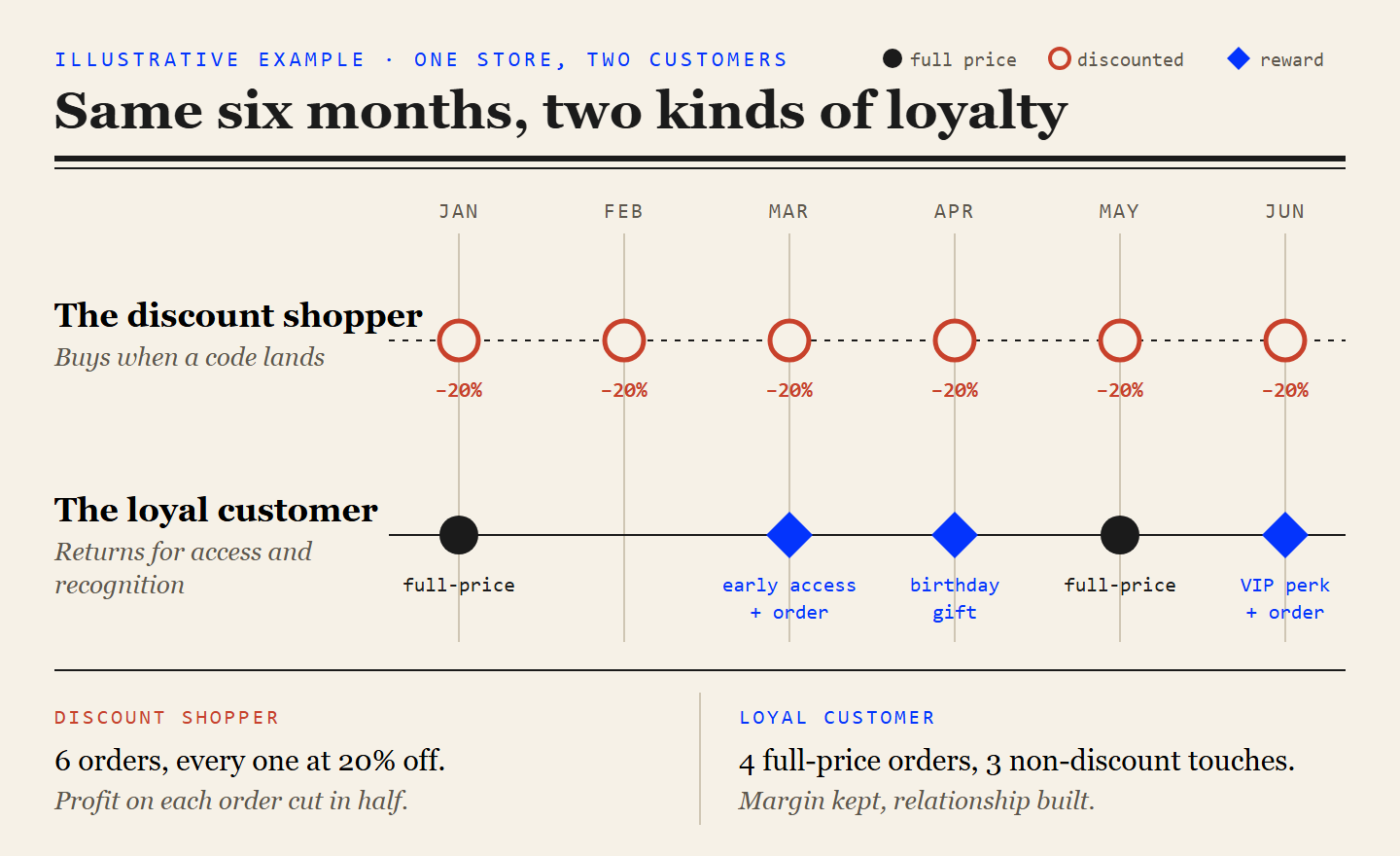
Discounts are easy to understand and they do bring orders, but they get expensive fast when customers learn to wait for them. A shopper who only buys at 20% off is loyal to the price, not to you. Loyalty marketing beyond discounts adds reasons to return that don’t shrink every order’s margin.
The discount trap
Imagine a skincare store that sends 20% off every month. Customers return regularly, but many of them are responding to the code rather than the brand. Now imagine the same store also offers personalized routine advice, early access to new launches, points for honest reviews and a birthday reward. The customer has several reasons to stay that have nothing to do with price.
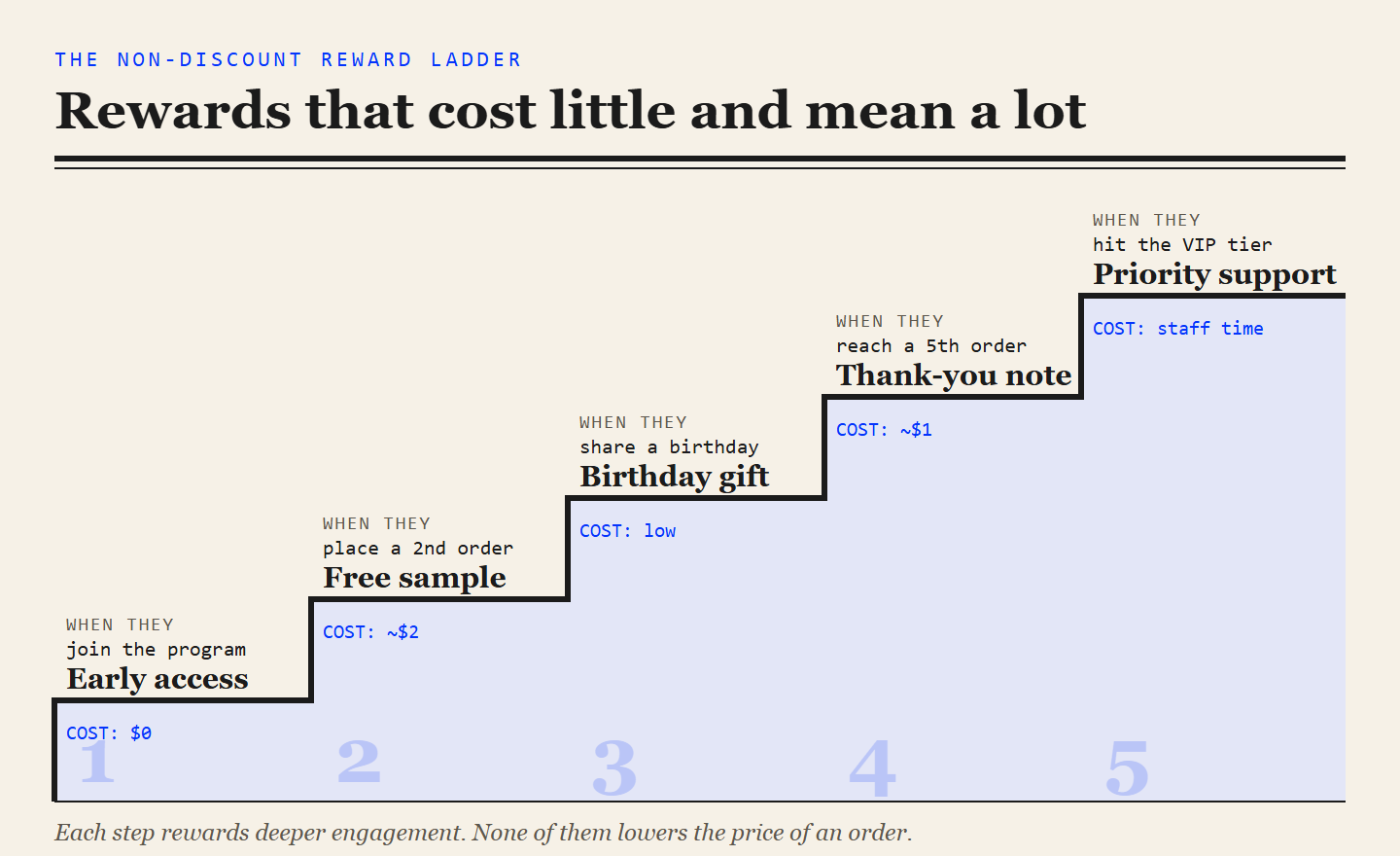
Here’s a simple, hypothetical example of the cost difference. Take a $50 order with a 40% gross margin, or $20 profit. A 20% discount removes $10 of that, cutting profit in half. A free sample that costs you $2, or early access that costs nothing at all, keeps most of the margin while still making the customer feel valued.
What a relationship-led approach adds
| Discount-led approach | Relationship-led approach |
|---|---|
| Focuses on immediate sales | Focuses on long-term engagement |
| Uses price cuts as the main incentive | Combines recognition, access, convenience and selective savings |
| Attracts promotion-sensitive buyers | Builds a stronger preference for the brand |
| Measured mainly by campaign revenue | Also measured by repeat purchases, referrals and lifetime value |
| Shrinks margins when used often | Mixes low-cost benefits with occasional monetary rewards |
Seven loyalty marketing strategies that go beyond discounts
These strategies give customers reasons to come back that a competitor can’t match with a lower price. You don’t need all seven at once. Pick the two or three that fit your products and margins, run them well, and add more once they’re working.
1. Reward more than purchases
A program feels more engaging when customers can earn through different kinds of participation, not just by spending. A Shopify rewards program can give points for creating an account, writing a review, referring a friend or celebrating a birthday or store anniversary, so customers stay involved even when they aren’t shopping.
There are plenty of loyalty reward ideas to offer once points add up: early access to collections, free samples, exclusive content and member-only experiences. Reward the actions that support a clear business goal. Giving points for every possible click raises activity without necessarily raising loyalty.
2. Personalize rewards to customer behavior
Customers don’t all value the same things. A frequent buyer may love free shipping, while a first-time customer responds better to a welcome reward. Personalization connects the reward to what each person actually buys and how often.
Repeat buyers
Offer a reward after a set number of orders, such as a free gift on the fifth purchase, so steady customers see their loyalty recognized.
Category fans
Give early access to new products in the category they already buy, whether that’s a new roast for a coffee subscriber or a new shade for a makeup regular.
Customers going quiet
Send a relevant reminder or product suggestion before reaching for an incentive. Save the incentive for customers who don’t respond.
Start with simple segments: first-time buyers, repeat customers, high-value customers and people who haven’t ordered recently. Add finer personalization once you have enough reliable data.
3. Build a VIP experience for your best customers
People like knowing their support matters. A tiered loyalty program recognizes that by unlocking better benefits as customers reach spending or order milestones. The goal is to make membership feel worthwhile, not to push people to spend more than they normally would.
Here’s an illustrative structure for a fashion store. Set your own thresholds and benefits based on margins and how often customers buy.
Tier 1: Insider
Entry-level membership with points on purchases, a welcome benefit and access to member rewards.
Tier 2: Preferred
Unlocked after a spending or order milestone, with birthday benefits and early access to selected launches.
Tier 3: VIP
For the most engaged customers, with exclusive previews, priority support and occasional complimentary gifts.
Keep the jump between tiers reachable. If the top tier feels impossible, it stops motivating anyone.
4. Turn reviews into a loyalty moment
What happens after the purchase shapes whether customers return. Reviews give customers a voice, help future shoppers decide and show you what to improve. Timing matters here, since when to ask for a review depends on how long the product takes to show results.
Ways to connect reviews with loyalty marketing:
- Personal, well-timed requests: ask after delivery and after the customer has had time to use the product.
- Recognition for helpful feedback: thank customers who share detailed reviews, photos or answers to other shoppers’ questions.
- Visible results: display genuine reviews on product pages and fix the issues customers raise.
Review incentives like loyalty points work well when they reward the act of reviewing, never a positive rating. Customers should feel free to share honest opinions, and any incentive should be disclosed where required.
5. Make referrals part of the experience
Your happiest customers are already recommending you to friends. A referral program gives them an easy, structured way to do it. For example, a coffee subscription store might reward a customer when a referred friend completes their first order, while the friend gets a welcome benefit too.
A good referral program includes a clear link or code, simple eligibility rules, a meaningful reward, easy sharing and protection against duplicate or fake claims. Referral program software can handle the links and tracking and let customers share by email, text or social apps. The reward doesn’t have to be a percentage off. Store credit, bonus points, free products or exclusive merchandise often work just as well.
6. Create a sense of community
Customers may find you through your products, but shared interests give them more reasons to stay. Community-led loyalty marketing invites people to take part, not just to buy: a monthly challenge for a fitness brand, routine tutorials for a beauty store, or member workshops for a hobby shop.
You don’t need a big community platform on day one. Start with a channel your customers already use and give members a reason to show up regularly.
7. Surprise customers with thoughtful gestures
Not every loyalty moment needs to sit inside a points system. A relevant, unexpected gesture can make a customer feel genuinely seen. Good surprise and delight moments are thoughtful rather than expensive: a handwritten note for a long-time customer, a free sample matched to their last order, or an early look at a product they’re likely to love.
Natural occasions include a customer’s first anniversary with your store, a milestone order, a successful referral or a recovery gesture after a service problem.
Building your loyalty marketing plan step by step
A list of tactics only becomes a loyalty marketing strategy when the pieces work together. These steps help you decide which behaviors to encourage, which rewards to offer and how to tell whether it’s working, without sliding back into discount-led habits.
Choose one primary goal
Decide what matters most right now: more repeat purchases, more referrals, more product reviews, winning back inactive customers or higher lifetime value. One clear goal makes every later choice easier.
Learn what your customers value
Look at purchase frequency, order value, favorite products and customer feedback to see which benefits each group is likely to care about.
Pick the right loyalty model
Use points for repeat purchases and engagement, tiers for recognition, referrals for advocacy and community initiatives for deeper involvement. You can combine models as the program grows.
Make taking part easy
Explain how customers earn, what they can redeem and when rewards expire. Put that information on your rewards page, in customer accounts, in post-purchase emails and anywhere else customers naturally look.
Connect the touchpoints
Coordinate reward reminders, review requests, referral invitations and personal messages so customers get a consistent experience instead of the same blast as everyone else.
Measure and adjust
Track participation, redemptions, repeat purchases, referral performance and program costs. Watch for the habits that pull a plan back toward discounts: rewards that are hard to earn, benefits that quietly eat margin, too many emails, and counting sign-ups instead of repeat orders.
Give customers a reason to return that isn’t a coupon
Loyalty marketing works when customers have compelling reasons to choose your brand even when no discount is on offer. For Shopify brands, that means combining useful rewards with personalization, VIP recognition, reviews, referrals, community and thoughtful surprises. Start with what your customers value most, choose a few initiatives that support one clear goal, and measure their effect on repeat purchases.
Not sure which non-discount rewards fit your margins? Ask the Retenzy team how to combine VIP tiers, milestone rewards and review points into one program for your store.
FAQ
What is loyalty marketing in ecommerce?
Loyalty marketing in ecommerce is a strategy that encourages customers to keep buying from a brand through rewards, personalized experiences, exclusive benefits, referrals and community. Its purpose is to turn one-time buyers into repeat customers and build long-term relationships, rather than relying on new customer acquisition or one-off sales to drive growth.
How can Shopify brands build customer loyalty without discounts?
Shopify brands can build customer loyalty without discounts by offering early access to new products, VIP tier benefits, birthday rewards, points for reviews and referrals, personalized recommendations and community experiences. The best mix depends on what customers value and what the business can sustain, but most of these cost far less than regular price cuts.
What is the difference between loyalty marketing and a loyalty program?
A loyalty program is a single tool, usually points, tiers or member benefits, that rewards specific behaviors. Loyalty marketing is the broader strategy around it, including how you communicate the program, personalize rewards, ask for reviews, encourage referrals and build community. A program is one part of loyalty marketing, not the whole of it.
Which loyalty marketing strategies work best for small Shopify stores?
Small stores do well starting with a simple points program, personalized post-purchase emails, a referral program and rewards for reviews. One or two measurable initiatives are easier to run well than a complex program launched all at once. Add VIP tiers or community activities once the basics are working and you understand what customers value.
How do you measure loyalty marketing success?
Track repeat purchase rate, customer retention, lifetime value, reward redemptions, referral conversions and program costs. Compare results over time and, where possible, against customers who aren’t in the program. Membership sign-ups alone don’t show success; what matters is whether customers buy again and recommend you without needing a discount.
Add points, referrals, and VIP rewards to your Shopify store in under 5 minutes.