- Small gestures beat big discounts for memory.
- Handwritten notes and samples cost very little.
- Tie surprises to milestones, not random luck.
- A loyalty program makes surprises repeatable.
- Never link a reward to a positive review.
What is surprise and delight marketing?
Surprise and delight marketing is a customer experience strategy that adds an unexpected, positive moment to an ordinary purchase. The surprise might be a free sample, a personal note, early access to a launch or bonus points the customer didn’t ask for. What matters is that it feels personal and wasn’t promised in advance.
Picture someone ordering a handmade candle. It arrives carefully packed with a short note thanking them for supporting a small business. The note costs a few cents and a minute of your time, yet it turns a transaction into a small relationship. That’s surprise and delight in action.
It works differently from the promotions most stores already run:
| Segment |
Offer |
Goal |
|
First-time visitors
|
Targeted welcome discount
|
First order
|
|
Existing members
|
Double points
|
Repeat purchase
|
|
High-margin collections
|
Small discount plus bonus points, if the math works
|
Volume
|
|
Excess inventory
|
Targeted markdown, no bonus points
|
Clearance
|
|
Top-tier members
|
Early access or an exclusive reward
|
Retention
|
Both have a place in ecommerce. Promotions bring people in. Surprise and delight gives them a reason to remember you after the price is forgotten.
Why does surprise and delight work so well for small stores?
Surprise and delight works for small stores because personal attention is something big retailers struggle to scale. Most shoppers already belong to plenty of loyalty programs, and few of those programs feel special. A thoughtful gesture from a small brand stands out against that background, builds customer loyalty and gives people a story worth telling friends.
Most loyalty programs feel generic
The bar is lower than you might think. The 2025 Bond Loyalty Report found that only 48% of Americans are “very satisfied” with their loyalty programs, and only about 1 in 3 programs is seen as delivering true value. When customers expect a points email and get a handwritten thank-you instead, the contrast does the work for you.
Surprises can do more than discounts
Research backs this up. A 2015 study in the International Journal of Hospitality Management by Wu, Mattila and Hanks found that surprise rewards were more effective than membership discount rewards at increasing customer delight and satisfaction and reducing frustration. The effect was strongest among customers whose overall satisfaction was low, which makes a well-timed surprise especially useful after a delayed or disappointing order.
Delighted customers talk
A memorable order is easy to share. Nielsen’s 2015 Global Trust in Advertising study found that 83% of people completely or somewhat trust recommendations from friends and family. You can’t force word of mouth, and a gesture designed only to go viral usually feels hollow. But genuine customer appreciation gives people something real to talk about.
Seven low-cost surprise and delight ideas
The best surprise and delight ideas are cheap, relevant to the product and easy to repeat. Start with one or two that fit your margins and fulfillment process. Here are seven surprise and delight examples that work for small Shopify stores, with a rough sense of what each one costs.
1. Add a personal touch to every order
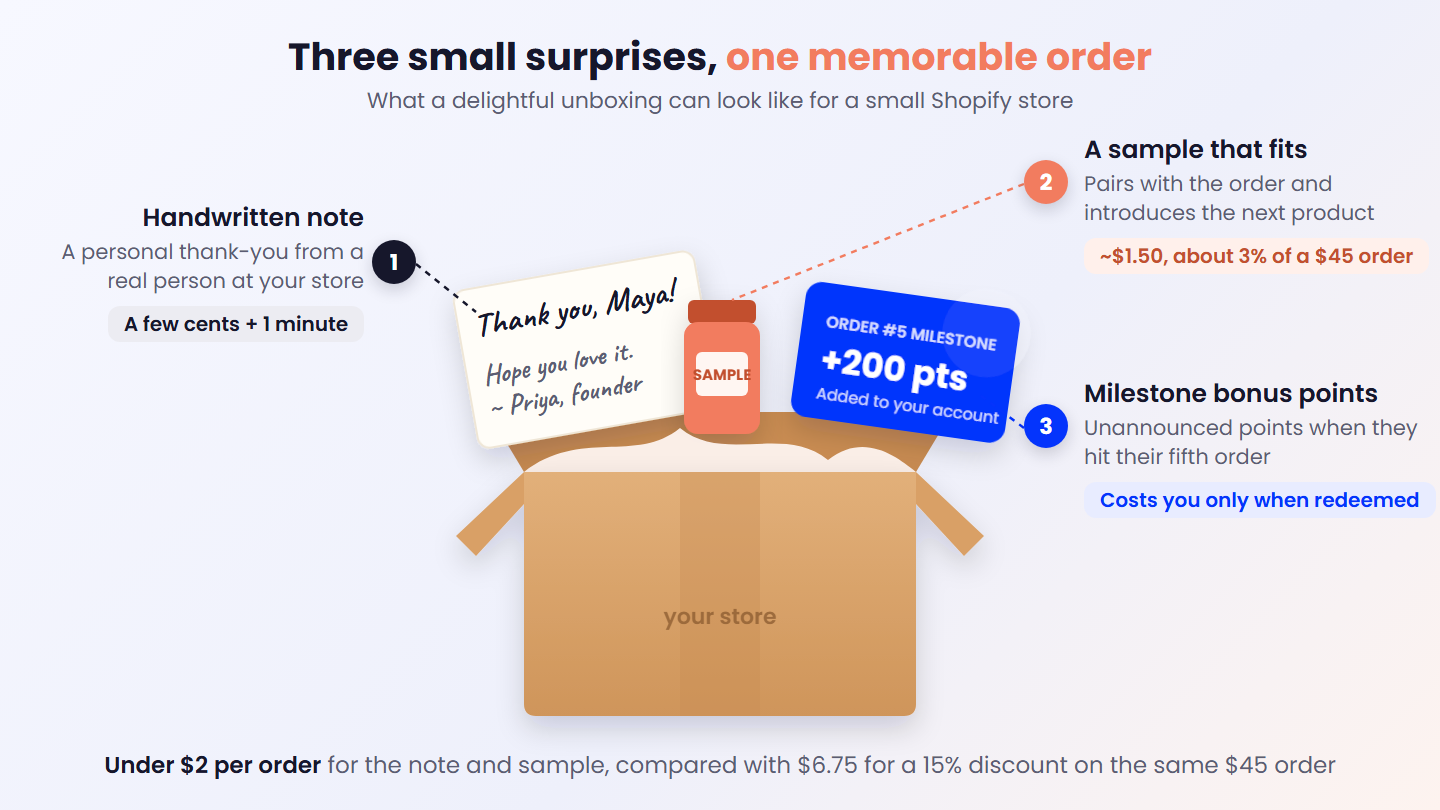
A handwritten thank-you note, a short message from the founder or a card with care tips makes an ordinary delivery feel personal. A handmade jewelry store might add one line thanking the customer for choosing an independent business. The cost is a few cents per card plus a minute of packing time.
2. Include a sample that fits the order
Choose a sample that complements what the customer bought. A skincare brand can add a cleanser sample to a moisturizer order, and a coffee store can tuck in a different roast. Imagine a store with a $45 average order: a $1.50 sample is about 3% of the order value, far less than a 15% discount, and it introduces a product the customer might buy next.
3. Send bonus points for a milestone
Reward a customer when they reach a milestone, such as their fifth order or $500 in total spend. An unannounced bonus of loyalty points feels like a gift rather than a deal, and the cost only lands when the customer comes back to redeem it.
4. Offer early access to new products
Let repeat customers or VIP members shop a new collection 24 hours before everyone else. A private launch link creates a sense of exclusivity without cutting your price, and your best customers get first pick of limited stock.
5. Celebrate personal moments
Birthdays, the anniversary of a first order and tier upgrades are natural moments for a short message or a small reward. Offer the customer a choice, such as bonus points or a free gift with their next order, so the gesture fits what they actually want.
6. Turn a problem into a good experience
When an order arrives damaged or late, fix it fast, explain what happened and add a small gesture to acknowledge the hassle. A replacement shipped the same day with a sincere apology note often leaves a better impression than an order that never went wrong.
7. Show customers their feedback mattered
When a customer suggests a new size, scent or color and you add it, tell them. A short email saying “you asked, we listened” costs nothing and shows customers that their voice shapes your store.
These ideas work best when they match your brand. A useful sample may delight a skincare buyer, while early access may matter more to a fashion fan. Pick the gestures your customers would value most, not the ones that look best on social media.
Make surprises repeatable with a loyalty program
A loyalty program turns one-off surprises into a system. Customers know how they earn and redeem points, which gives them predictable value, while you keep the freedom to add unexpected bonuses at the right moments. That mix of steady rewards and occasional surprises is what keeps customer loyalty from depending on discounts alone.
Mix regular rewards with unexpected bonuses
Let customers earn points on purchases and other actions, then add bonus points at moments they don’t expect, such as a fifth order or a first anniversary. The regular rewards set a clear value exchange. The bonus adds excitement without making every interaction about a discount, much like the loyalty reward ideas that feel generous without cutting your price.
Make VIP status feel real
Loyalty tiers should give your best customers something they genuinely value, like early access, exclusive products or priority on limited launches. A tier name on its own won’t create loyalty without real benefits behind it.
Reward participation, not just spending
Customers help your store in many ways beyond buying, including referrals, product feedback and reviews. Rewarding these actions gives people reasons to engage between orders. If you offer review rewards, give the same points for every honest review, whatever the star rating. In the US, the FTC’s 2024 rule on consumer reviews bans incentives tied to positive sentiment.
Match the surprise to the customer
A first-time buyer, a regular and a lapsed customer need different gestures. Use what you know about each group, but keep it respectful. A surprise that reveals too much about someone’s browsing can feel intrusive rather than thoughtful.
| Customer |
A fitting surprise |
|
First-time buyer
|
A welcome note that explains how your loyalty program works
|
|
Repeat customer
|
Bonus points when they hit their next order milestone
|
|
VIP member
|
Early access to a launch or an exclusive product
|
|
Lapsed customer
|
A personal “we miss you” message with a relevant reward, not a generic discount
|
Running surprise and delight on autopilot with Retenzy
For most small stores, ideas are easy to find, and the hard part is following through when you’re also packing orders and answering emails. Retenzy brings loyalty points, referrals, milestone rewards, VIP tiers and product reviews into one Shopify app, so the repeatable surprises run automatically and your time goes into the personal ones.
- Milestone rewards: set up bonuses based on total spend or number of orders, so customers get a bonus the moment they cross a threshold you choose. Inactivity rewards help you reach out to customers who have gone quiet.
- Referrals: reward customers who bring friends to your store, which turns a delighted customer’s recommendation into a tracked, rewarded referral.
- Reviews and review rewards: collect honest product reviews and reward them with points, connecting customer feedback to the next order.
- VIP tiers: give your most engaged customers perks they can see, such as early access or exclusive rewards.
- Analytics: check which rewards get redeemed and which customers come back, so you spend on gestures customers value.
Pick the order count or spend level that triggers a surprise bonus with Retenzy milestone rewards, then let it run on every qualifying order.
Automation handles the predictable moments. Keep the handwritten notes and problem-fixing gestures personal, because that’s where a small store has the biggest edge.
Small gestures, remembered longest
Surprise and delight isn’t about outspending bigger brands. It’s about noticing the small moments that shape how customers feel about your store. Pick one gesture this week, such as a handwritten note or a milestone bonus, and see how customers respond before adding the next.
Working with tight margins? Check what Retenzy costs for a store your size before you budget your first round of surprises.