
The Real Cost of Customer Churn in Apparel Ecommerce
Your new dress collection sold well, and the dashboard looks healthy. But look at last spring’s first-time buyers and most of them never came back. In apparel ecommerce, that quiet exit is easy to miss because new orders keep arriving. The cost of customer churn shows up later, in thinner margins, bigger ad budgets and a lifetime value that never grows. Here’s what churn really costs a fashion brand, and how to bring it down.
Key takeaways
- Apparel churn is hard to see because there’s no cancel button.
- Every lost customer raises the ad spend needed to hold revenue flat.
- Poor fit and failed garments drive many silent exits.
- Rewards tied to the second order beat blanket discounts.
- Track repeat purchase rate by cohort, not just total revenue.
What Is Customer Churn in Apparel Ecommerce?
Customer churn in apparel ecommerce is when a shopper stops buying from your brand within the window in which they would normally return. Unlike a subscription, there’s no cancellation to flag the moment, so each fashion brand has to define its own window based on how often its customers usually buy.
A basics brand might treat 120 days without an order as a warning sign, while an occasionwear label may need a full year before a quiet customer counts as lost. Set the window from your own data: find the typical gap between first and second orders, then add a buffer.
Three numbers that define churn
Customer churn rate
This is the share of customers who don’t buy again within your chosen window. If 1,000 people bought in January and 770 of them didn’t return within 12 months, the customer churn rate for that cohort is 77%.
Repeat purchase rate
This is the mirror image: the share of customers who place another order within the same window. Loop Returns’ 2024 Winter Benchmark Report put the average retention rate for apparel brands on its platform at 23.2%, which suggests that most first-time fashion buyers don’t come back.
Customer lifetime value
This is the revenue or gross profit a customer generates over the whole relationship. Margin-based lifetime value is the more honest version, so it’s worth knowing how to measure customer lifetime value before you set retention targets.
The Real Cost of Customer Churn for Apparel Brands
The cost of customer churn goes well beyond one missing order. Every shopper who leaves takes their future purchases with them, forces you to buy replacement demand through ads, lowers lifetime value and often pushes the brand toward deeper discounts. In apparel, where first orders are often barely profitable, these costs decide whether growth is real.
1. Lost repeat revenue
A shopper who loved their first pair of jeans might have bought a second pair, a jacket and a belt over the next year. When they churn, all of that disappears, and it never shows up on a report because it never happened. The loss is largest for brands with several categories, since a casualwear buyer could easily become a footwear or accessories buyer too.
2. Higher acquisition spend just to stand still
When existing customers stop buying, the only way to hold revenue flat is to find new ones through paid social, search and creators. In apparel, a first order often only just covers its acquisition cost, so profit depends on the second and third orders. Lose those, and more of your budget goes on replacing customers instead of growing.
Worked example: what a 10-point drop in repeat rate costs
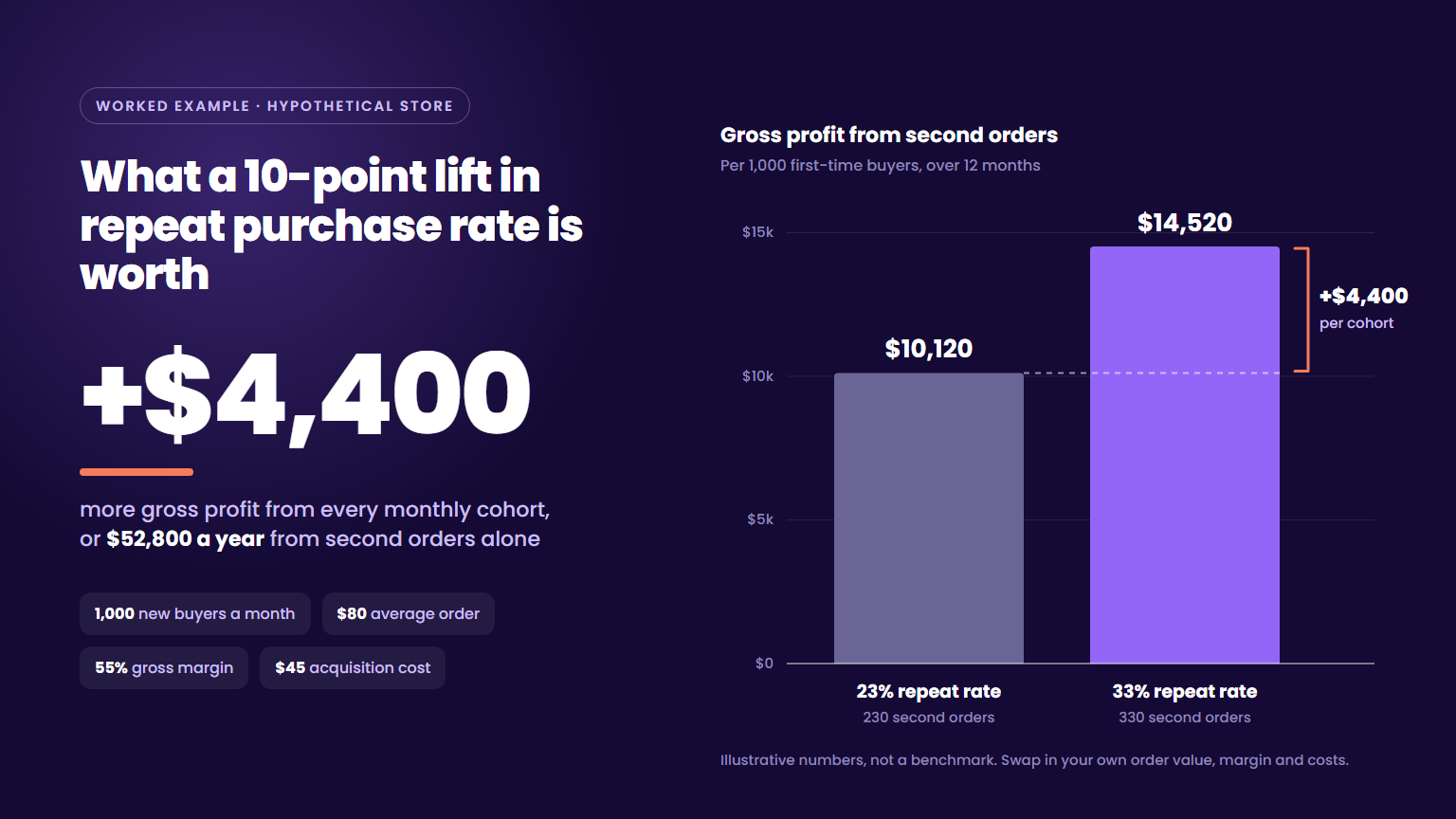
Imagine a hypothetical apparel store that acquires 1,000 new customers a month at a $45 acquisition cost, with an $80 average order and a 55% gross margin. The first order earns $44 in gross profit, so it roughly breaks even after ad spend. Everything the store makes comes from what happens next.
| Scenario | 12-month repeat rate | Second orders per 1,000 buyers | Gross profit from second orders |
|---|---|---|---|
| Low retention | 23% | 230 | $10,120 |
| Improved retention | 33% | 330 | $14,520 |
The 10-point gap is worth $4,400 in gross profit for every monthly cohort, or $52,800 a year, before counting any third or fourth orders. Buying that profit back through acquisition doesn’t work either, because new customers only break even on their first order.
3. Lower customer lifetime value
Churn caps lifetime value at the first order, and that weakens every other decision. A brand that can’t count on second purchases can’t justify a higher acquisition bid, a richer welcome offer or a loyalty budget. Brands with healthy repeat buying can outbid competitors for the same shopper because they earn more from each one.
4. Heavier reliance on discounts
When repeat sales slip, the quick fix is another sitewide sale. That brings orders, but it trains shoppers to wait for the next code. Price pressure is real: in Fashion by Informa’s 2026 US Fashion Consumer Outlook, 66% of US consumers named value for money as their top priority when shopping for fashion. The same survey found that 92% planned to change how they shop, including delaying purchases or switching to off-price retailers. Competing on discounts alone is a race a small brand rarely wins.
5. Silent churn you never hear about
Some of the most expensive churn never reaches your inbox. A 2026 Samsara Eco survey of 5,208 consumers found that when a garment fails, 27.7% leave the brand, yet only 5.9% return the faulty item. Most quality problems never become a return or a complaint, so the brand loses the customer without learning why, along with the review or referral that customer might have given.
Why Fashion Shoppers Stop Buying
Most apparel churn comes from four places: clothes that don’t fit or don’t match the listing, a frustrating returns or delivery experience, too little help finding the next item, and marketing that ignores what the customer already bought. Each one has a fix that costs less than a deeper discount.
Poor fit and unmet expectations
Fit is the biggest hurdle in online fashion. In the same Fashion by Informa 2026 survey, 64% of US consumers named finding the right size and fit as their top challenge when shopping for fashion.
What to do
Add garment measurements, model sizing and fit notes to every product page, and track return reasons by product and size. Ask buyers to mention fit in their reviews and back it with review incentives that reward leaving a review, not leaving a positive one.
A frustrating post-purchase experience
Slow delivery, confusing exchanges and long refund waits can undo a good first impression. The NRF and Happy Returns found in 2025 that 71% of consumers are less likely to shop with a retailer again after a poor returns experience.
What to do
Offer an exchange before a refund for fit issues, explain your return policy in plain terms on the product page, and send delivery updates before customers have to ask.
No help finding the next item
A customer who bought formalwear may want casual pieces or accessories next season. If your store doesn’t show them, they’ll find them somewhere else.
What to do
Use purchase history to recommend complementary items and new arrivals in the customer’s size and style.
Marketing that ignores what they bought
Sending a winter jacket promotion to someone who just bought a winter jacket feels careless, and it teaches customers to tune you out.
What to do
Segment emails by category bought, size and lifecycle stage. Fewer, more relevant messages beat a higher send volume.
How to Reduce Customer Churn in Apparel Ecommerce
Reducing churn in apparel means giving first-time buyers a reason to place a second order, spotting customers who are drifting before they leave, and fixing the experiences that push them away. A loyalty program, a useful post-purchase sequence and easier exchanges do more for repeat buying than another sitewide sale.
Build a loyalty program around the second order
The gap between the first and second purchase is where most apparel customers are lost. An ecommerce loyalty program can award points on the first order that customers redeem on the next one. A VIP loyalty program then gives your best customers perks like free express shipping or faster points earning, so their status is worth keeping. Perks that match how people buy clothes, such as early access to new drops, make a fashion brand loyalty program feel less like a coupon scheme.
Make the post-purchase weeks useful
Send care instructions, styling ideas that pair with the item, and a fit check a few days after delivery. Each message should help the customer enjoy what they bought before you ask for the next order.
Turn returns into exchanges
A return doesn’t have to end the relationship if the next step is an easy exchange. Make exchanges the default for size issues, refund promptly when an exchange isn’t wanted, and check whether customers who exchange go on to buy again.
Spot at-risk customers early
Don’t wait a year to send a win-back email. Longer gaps between orders, unopened emails and skipped sale events are all signs a customer is about to churn, and each one is an earlier chance to step in. A first-time buyer may need a product recommendation, while a lapsed regular may respond better to a new collection in their style.
Give reasons to return beyond price
Distinctive design, consistent quality, inclusive sizing and reliable service keep customers when another brand runs a bigger sale. Early access and members-only drops add value without cutting your price.
Metrics That Show Whether Churn Is Falling
Track a small set of numbers by monthly cohort: repeat purchase rate, customer churn rate, time to second purchase, lifetime value and acquisition cost. Comparing cohorts shows whether your changes are working, while a single store-wide average can hide the fact that fewer new customers are coming back.
| Metric | What It Tells You |
|---|---|
| Repeat purchase rate | How many customers in a cohort ordered again |
| Customer churn rate | How many customers in a cohort stopped buying |
| Time to second purchase | When to send reminders and offers |
| Customer lifetime value | The long-term gross profit of each cohort |
| Customer acquisition cost | What each new customer costs to win |
| Reactivation rate | How many lapsed customers your win-back campaigns bring back |
| Repeat customer revenue share | How much of your revenue comes from returning buyers |
Lower the Cost of Customer Churn, One Cohort at a Time
The cost of customer churn in apparel hides in orders that never happen, ad budgets that only replace lost buyers and margins worn down by constant sales. Start by measuring your repeat purchase rate by cohort, find where customers drop off, and fix fit, returns and the path to a second order. Then reward the customers who come back.
FAQ
What is the cost of customer churn in ecommerce?
It’s the profit you lose when customers stop buying: their future orders, the ad spend needed to replace them and the lower lifetime value of your customer base. For apparel brands, where first orders often only cover their acquisition cost, churn can decide whether a cohort is profitable at all.
How do you calculate the cost of customer churn?
Multiply the number of customers who churned by the gross profit you’d expect from their future orders over a set period. For example, 100 lost customers who would each have placed one more $80 order at a 55% margin cost you $4,400 in gross profit, before any replacement ad spend.
What is a good repeat purchase rate for apparel brands?
Many apparel benchmarks fall between about 20% and 30% over 12 months. Loop Returns reported an average retention rate of 23.2% for apparel brands in its 2024 Winter Benchmark Report. Compare yourself with brands at a similar price point, since basics sell more often than occasionwear.
How is customer churn rate different from repeat purchase rate?
They measure the same cohort from opposite sides. Customer churn rate is the share of customers who didn’t buy again within your chosen window, while repeat purchase rate is the share who did. For the same cohort and window, the two add up to 100%.
Do loyalty programs reduce churn for fashion brands?
They can, when rewards are tied to the next purchase rather than given away up front. Points that pay off on a second order, VIP perks worth keeping and inactivity rewards all give shoppers a reason to return. Judge success by whether members buy more often than non-members, not by points issued.
Add points, referrals, and VIP rewards to your Shopify store in under 5 minutes.