
6 Types of Customer Loyalty (and Which Ones You Can Build)
Repeat orders don’t always mean loyal customers. Some shoppers return for points, some because reordering is easy, and some because they genuinely prefer your brand. Learn the six types of customer loyalty, the signals that reveal each one in your Shopify data, and a simple way to decide which type your store should build first for more lasting repeat purchases.
Your repeat purchase rate looks healthy, but how many of those customers would come back if your next sale never happened? The average shopper belongs to 17.4 loyalty programs, according to the 2025 Bond Loyalty Report, and only 48% of Americans say they’re very satisfied with them. Knowing the types of customer loyalty shows you why people return and which reasons you can build on.
Key takeaways
- Repeat orders show behavior, not commitment.
- Six types of loyalty match six reasons customers return.
- Each type has its own signals and metrics.
- Rewards win the next order; trust keeps the customer.
- Fix your biggest gap first, then add the next type.
What customer loyalty means for a Shopify store
Customer loyalty is a customer’s tendency to keep choosing your store over similar alternatives. It shows up as repeat purchases, a clear preference for your brand, joining your community or recommending you to friends. For a Shopify brand, it has two sides: what customers do and how they feel about you.
The first side is behavioral loyalty: repeat orders, subscription renewals and return visits you can see in your order data. The second is attitudinal loyalty: trust, preference and the wish to stay with your brand. Strong brand loyalty needs both.
Picture two skincare customers who both reorder every month. One buys because your price is the lowest she has found. The other would pay a little more because she trusts your ingredients and likes how you treat her. Your dashboard counts them the same, but only one of them stays when a competitor runs a bigger discount. That gap is the real difference between customer loyalty vs customer retention: retention counts who comes back, while loyalty explains why.
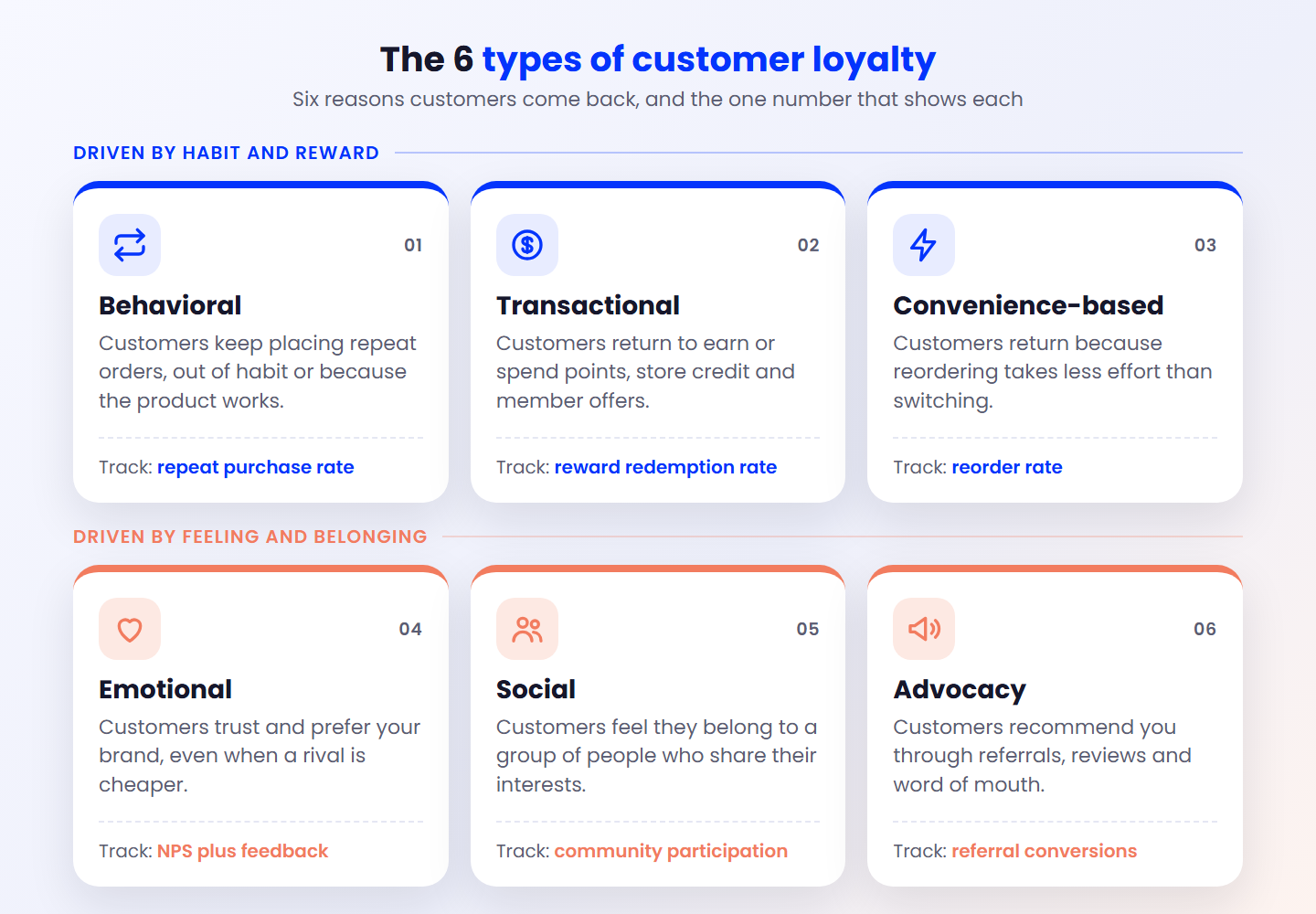
Habit and reward: behavioral, transactional and convenience loyalty
Three types of loyalty are driven mostly by what customers do: buying out of habit, returning for a reward, or choosing the easiest option. They are the easiest to measure in Shopify and the quickest to move, but they are also the easiest for a competitor to copy, so treat them as a foundation rather than the finish line.
1. Behavioral loyalty: customers who keep coming back
Behavioral loyalty means customers place repeat orders over time, like a shopper who reorders the same cleanser and moisturizer every two months. It’s the most visible type, but it doesn’t prove commitment, since habit or a lack of alternatives can drive it too.
Signals to track: repeat purchase rate, time between orders and cohort repurchase rate. A healthy sign is customers placing their second order inside your normal repurchase window, not just during promotions.
How to build it: before you ask for the next order, send a post-purchase sequence that helps the customer get value from what they bought, such as how to use it, care tips or a relevant pairing. Then time replenishment reminders to the customer’s own purchase history.
2. Transactional loyalty: customers who return for rewards
Transactional loyalty develops when customers have a clear practical reason to buy again, such as points, store credit, free shipping or member-only offers. It’s the type a customer loyalty program influences most directly, and the type most at risk when a competitor offers more.
Signals to track: reward redemption rate, repeat rate among members compared with non-members, and reward cost as a share of sales.
How to build it: keep the earn and burn rules simple enough to explain in one sentence, and set the first reward close enough that a customer can reach it in two or three orders. A loyalty points system works best when you test bonus points on chosen products or slow weeks against a baseline, so you know the bonus created new orders instead of rewarding ones that would have happened anyway.
3. Convenience-based loyalty: customers who return because it’s easy
Convenience-based loyalty happens when customers choose you because buying again takes less effort than switching. They know where their products are, trust your delivery dates and can reorder in a few taps. It overlaps with behavioral loyalty, but the focus is ease rather than repetition.
Friction is a real loyalty killer. Baymard Institute’s 2025 checkout research found that 40% of US shoppers who abandoned checkout did so because extra costs like shipping, tax or fees were too high.
Signals to track: reorder rate, checkout abandonment, delivery complaints and, if you offer them, subscription renewals.
How to build it: show shipping costs early, cut unnecessary form fields, and let customers find past orders quickly. For consumables, offer reminders or subscriptions the customer controls.
Feeling and belonging: emotional, social and advocacy loyalty
The other three types are driven by how customers feel: trusting your brand, belonging to a group around it, and wanting to tell others. They take longer to build and are harder to measure, but they’re the types that survive a competitor’s discount.
4. Emotional loyalty: customers who prefer your brand
Emotional loyalty is a genuine preference for your brand, built on trust, shared values and repeated good experiences. A customer with emotional loyalty may keep buying from you even when an alternative is slightly cheaper.
It rarely comes from one big campaign. It grows from accurate product pages, honest shipping updates, careful packaging and support that fixes problems without a fight. How you handle a late order often matters more than how you handle a smooth one.
Signals to track: no single metric proves it, so pair feedback (CSAT, NPS, review comments) with behavior such as staying through price changes.
How to build it: recognize milestones that mean something, such as a first anniversary or reaching a new status level, and personalize recommendations around what the customer actually bought.
5. Social loyalty: customers who feel they belong
Social loyalty forms when customers connect with your brand through shared interests and the people around it. An outdoor brand whose customers trade hiking routes, or a craft brand whose buyers share finished projects, gives people a reason to stay that has little to do with price.
Signals to track: community participation, event attendance, user-generated content, and the repeat rate of active community members compared with everyone else.
How to build it: give customers something to gather around, such as a monthly challenge, a recipe swap or an expert Q&A. Recognize helpful contributions, ask permission before reusing customer content, and offer experiences beyond discounts, like early product previews.
6. Advocacy loyalty: customers who recommend you
Advocacy loyalty is when customers actively recommend your brand through referrals, detailed reviews or word of mouth. It’s the only type that links retention directly to acquisition, because each advocate can bring in new buyers.
Recommendations carry weight: Nielsen’s 2015 Global Trust in Advertising survey found that 83% of people completely or somewhat trust recommendations from friends and family. Referred customers can also be worth more. A 2011 Wharton study of about 10,000 bank customers found that referred customers were worth at least 16% more than similar non-referred customers.
Signals to track: referral participation, referred-customer conversion and retention, and review participation.
How to build it: first, give people something worth recommending. Then send automated review requests after customers have had a fair chance to use the product, because when to ask for a review depends on how fast it shows results: days for a candle, weeks for a serum. Finally, offer a two-sided referral reward. Never make a positive review a condition of getting a reward.
Which types of customer loyalty to build first
| If this sounds like your store | Start with | First move |
|---|---|---|
| Most customers buy only once | Behavioral | Post-purchase journey and a second-order incentive |
| Customers buy mainly during sales | Transactional | Points and targeted member bonuses |
| Customers are happy but switch easily | Emotional | Better support, recognition and personalization |
| Reordering takes too many steps | Convenience-based | Quick reorder and replenishment reminders |
| Customers follow you but don’t connect | Social | Challenges, customer content and member events |
| Customers love you but stay quiet | Advocacy | Review requests and referral rewards |
Conclusion: Start with the loyalty gap you can see
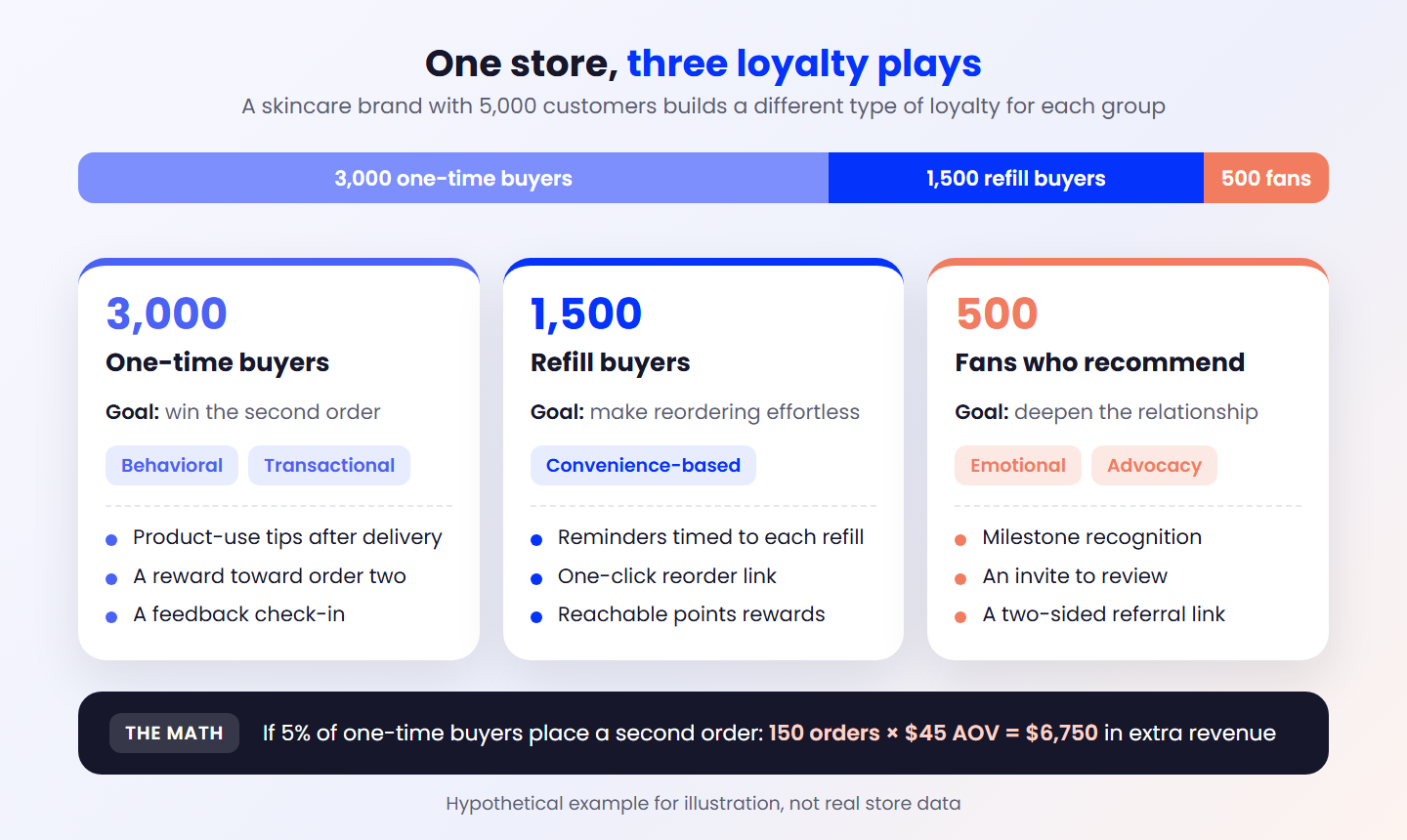
The six types of customer loyalty are six motivations, not six boxes every customer must fit into. Rewards can win the second order, convenience keeps reorders easy, emotional ties hold customers through price changes, and advocacy turns fans into a source of new buyers. Pick the gap your data shows, fix it, measure it, then add the next type.
Turn your quietest fans into advocates: see how a referral rewards program gives them a two-sided reward to share, tracked from the same dashboard as their points.
FAQs
What are the 6 types of customer loyalty?
The six types of customer loyalty are behavioral, transactional, emotional, convenience-based, social and advocacy loyalty. Behavioral and transactional loyalty are about repeat actions and rewards. Convenience loyalty comes from ease. Emotional, social and advocacy loyalty come from trust, belonging and the wish to recommend. Most customers show more than one type at once.
Which type of customer loyalty is the strongest?
Emotional loyalty is usually the most durable, because customers who trust and prefer your brand are less likely to switch for a small discount. Advocacy is the most valuable for growth, since it brings in new customers. Transactional loyalty is the weakest on its own, because a competitor can always offer a bigger reward.
What is the difference between behavioral and attitudinal loyalty?
Behavioral loyalty is what customers do, such as repeat purchases and renewals, and you can see it in your order data. Attitudinal loyalty is how they feel, such as trust and preference, which you measure through surveys, reviews and feedback. A customer can buy often without feeling attached, which is why tracking both gives you a truer picture.
Can a loyalty program build emotional loyalty?
Yes, but only partly. Points mainly build transactional loyalty. A program builds emotional loyalty when it adds recognition, such as VIP status, milestone thank-yous and personalized perks, and when the rest of the experience matches it. A generous program can’t make up for late deliveries or unhelpful support.
How do you measure the different types of customer loyalty?
Match the metric to the type. Use repeat purchase rate and time between orders for behavioral loyalty, redemption rate for transactional, reorder and abandonment rates for convenience, NPS and feedback for emotional, community participation for social, and referral conversions and review participation for advocacy. Compare each against a baseline before and after any change.
Add points, referrals, and VIP rewards to your Shopify store in under 5 minutes.