What Is the Most Direct Cause of Customer Loyalty?
Satisfied customers still switch brands. The most direct cause of customer loyalty is satisfaction, but it only lasts when products, delivery, service and value stay consistent order after order. Learn why satisfaction leads to repeat purchases, where it stops being enough, and which other factors influence customer loyalty and turn one good order into a lasting preference for your store.
Two customers buy the same moisturizer from your Shopify store, and both leave five-star reviews. Three months later, one has reordered twice. The other bought from a brand that ran a better sale. Both were satisfied, so what made the difference? The most direct cause of customer loyalty is satisfaction, but satisfaction on its own rarely holds a customer once a cheaper or easier option shows up.
Key takeaways
Satisfaction is the most direct cause of customer loyalty.
It works by building confidence, ease, trust and advocacy.
Satisfied customers still leave when price or convenience wins.
Only completely satisfied customers stop looking elsewhere.
Trust, value and recognition make satisfaction last.
The most direct cause of customer loyalty is satisfaction
Customer satisfaction is the most direct cause of customer loyalty. When a product does what your store promised, arrives on time and feels worth the price, the customer has a concrete reason to buy again. Every other driver of loyalty, from trust to word of mouth, grows out of that first experience going right.
What customer satisfaction means
Satisfaction is the customer’s judgment of one experience: did this order meet what I expected? Loyalty is the preference that builds when those judgments keep coming out positive. That’s why satisfaction comes first. A customer can be satisfied without being loyal, but it’s very hard to be loyal to a brand that keeps disappointing you.
What customers judge after an order
Customers don’t rate “the brand” in the abstract. They rate specific parts of the experience, and each one can push satisfaction up or down.
Product quality
The product has to match its description, photos and claims. This is the part customers forgive least. A late parcel or a slow reply can be overlooked once, but a product that doesn’t live up to its page gives the customer no reason to come back, however good the rest of the experience was.
Reliable delivery
The order should arrive when you said it would, in good condition. Delivery is often the customer’s first physical contact with your brand, so a crushed box or a missed date colors how they feel about everything inside it.
Convenience
Browsing, checking out and finding help should all feel easy. Every extra step between “I want this” and “it’s ordered” is a moment where satisfaction can slip.
Customer service
Questions should get clear answers and problems should get fixed quickly. Service matters most when something has already gone wrong, because that’s when the customer decides whether the brand is on their side.
Perceived value
The customer has to feel the purchase was worth what they paid. Value isn’t only price. It includes quality, how long the product lasts, shipping cost and how the whole experience felt.
The bar keeps rising, too. Shoppers compare your store with the best online experience they’ve had anywhere, not just with your direct competitors, so a checkout or delivery promise that felt fine last year may feel slow now.
Why satisfaction leads directly to repeat purchases
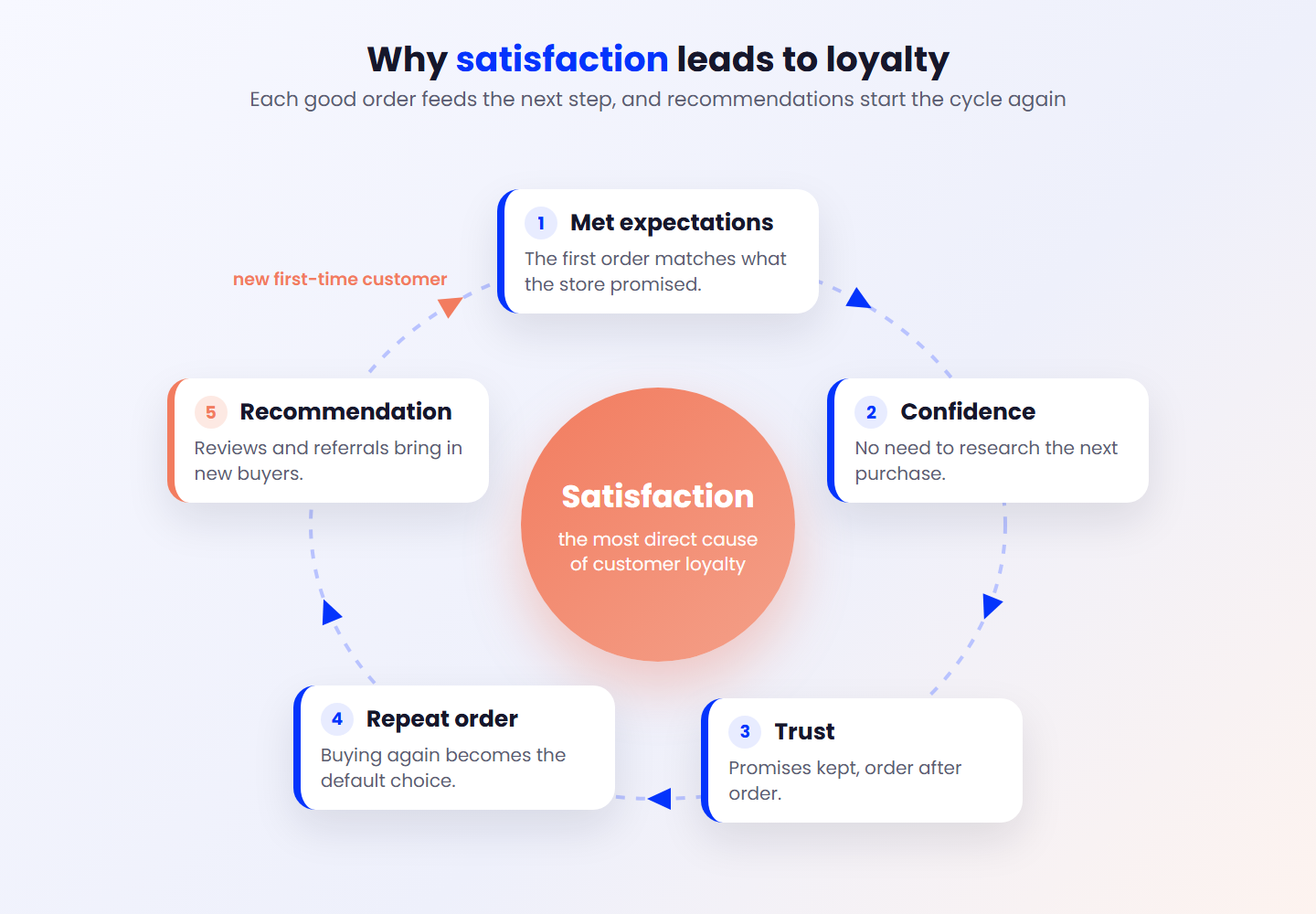
What drives customer loyalty after a good order is a chain of four effects. A satisfied customer gains confidence, saves effort, starts to trust the brand and becomes willing to recommend it. Each one builds on the last good order, and together they turn the next purchase from a fresh decision into a default choice.
Satisfaction builds confidence in the next order
A customer who got exactly what they expected doesn’t need to research the next purchase. Someone who bought a serum that worked won’t risk an unknown brand to save a few dollars, because they already know your version works for their skin. A short post-purchase sequence with usage tips strengthens that confidence by helping the customer get the result they bought the product for.
Satisfaction removes the effort of switching
Once a store has worked, buying from it again is the easiest option. This matters most for consumables like coffee, supplements, pet food or skincare, where the customer’s account, address and payment details are already saved and the alternative is starting from scratch somewhere new.
Satisfaction builds trust over repeated orders
Trust grows when the store keeps its promises again and again: accurate descriptions, honest pricing, on-time delivery and fair handling of complaints. When you collect customer reviews after each order, that track record becomes visible to the next shopper as well.
Satisfaction makes customers willing to recommend
Happy customers review, tell friends and post about products they like. Satisfaction doesn’t guarantee advocacy, but you rarely see advocacy without it. A customer referral program that rewards both the sharer and the friend gives that goodwill a simple outlet.
Where satisfaction stops being enough
Satisfaction is the most direct cause, but it isn’t a guarantee. A satisfied customer can still switch brands when a competitor is cheaper, faster or simply in front of them at the right moment. Understanding where satisfaction falls short explains why some happy customers come back and others don’t.
Satisfied and completely satisfied customers behave differently
Think of it as the difference between a 4-star and a 5-star customer. A “4 out of 5” customer liked the order but is still open to offers. A “5 out of 5” customer has stopped looking, because nothing about the experience gave them a reason to. The 4-star reviews are where you’ll find the small disappointments holding customers back, and a few well-timed customer loyalty survey questions will tell you what would have made the experience a 5.
Satisfaction, repeat purchasing and loyalty are different things
These three terms get used as if they mean the same thing, but each describes a different stage.
Concept
What it means
What it looks like in your store
Customer satisfaction
How the customer rates one product or experience
A 5-star review after the first order
Repeat purchasing
Buying more than once, for any reason
A second order placed during a 30% off sale
Customer loyalty
A lasting preference that shows up in repeat orders and recommendations
A third order at full price, plus a referral
Satisfaction causes loyalty only when it carries through to the third row. Repeat purchasing on its own can come from discounts, habit or a lack of alternatives.
Price-driven repeat buyers look loyal until they leave
Picture two customers who both order three times a year. The first buys from you because you’re usually the cheapest. That’s transactional loyalty, one of several types of customer loyalty, and it disappears the moment someone else undercuts your price. The second buys because the product works, support has been helpful and the brand remembers them. Only the second customer has reasons to stay that a competitor can’t copy with a coupon.
The first customer shows behavioral loyalty and the second shows emotional loyalty. Satisfaction is the starting point for both, but only emotional loyalty survives a better offer.
Behavioral loyalty
Emotional loyalty
What keeps the customer
Price, habit, convenience
Trust, results, feeling recognized
What it looks like
Repeat orders, mostly during sales
Full-price orders and referrals
What ends it
A cheaper or easier competitor
Repeated disappointment
Falling short also costs more than one order. Customers who have a bad experience rarely complain first. They quietly buy less often or stop buying, and you only see it months later as a dip in repeat orders.
Other factors that influence customer loyalty
Satisfaction opens the door, but several other factors that influence customer loyalty decide whether it stays open. Trust, perceived value, convenience and emotional connection each strengthen the link between a good order and the next one. When they’re missing, even satisfied customers drift away.
Factor
What the customer is asking
What to check in your store
Trust
“Will they help if something goes wrong?”
Reply time, return process, how complaints end
Perceived value
“Was it worth the price?”
Price compared with quality, shipping cost, how long the product lasts
Convenience
“Is buying here easier than anywhere else?”
Saved details, reorder links, mobile checkout
Emotional connection
“Does this brand know me?”
Personal messages, milestone recognition, thank-you notes
Trust stops customers from comparing
Trust turns a good experience into a safe bet. Customers who trust a store stop comparing every purchase, and that trust comes from two places.
Consistency across orders
The tenth order has to arrive as well as the first. Prices that don’t jump without reason, policies applied the same way every time and quality that doesn’t vary between batches all tell the customer the good experience wasn’t luck.
Recovery when something goes wrong
A problem fixed well can build more trust than an order that never went wrong, because it shows the customer what happens when things go badly. Reply quickly, own the mistake without making the customer argue for a fix, and follow up once it’s resolved. A small goodwill gesture, like bonus points on the next order, turns a complaint into proof that you’re on their side.
Clear value beats a cheaper option
Value is what keeps a satisfied customer from being tempted by a cheaper option. If the product clearly lasts longer, works better or comes with better service, a small price gap stops mattering. If the value isn’t obvious, price becomes the only thing left to compare.
Convenience makes you the easiest choice
Convenience protects satisfaction from the competitor who is simply easier to buy from. Saved payment details, quick reorder links and a checkout that works well on a phone all lower the effort of choosing you again.
Recognition creates an emotional connection
Customers stay longer with brands that recognize them. A personal note, a thank-you on their fifth order or a reward that reflects what they actually buy makes the relationship feel two-sided. An ecommerce rewards program can carry that recognition at scale, and your loyalty program metrics show which rewards actually bring customers back. Rewards reinforce a good experience. They can’t make up for a bad one.
Which cause matters most depends on what you sell
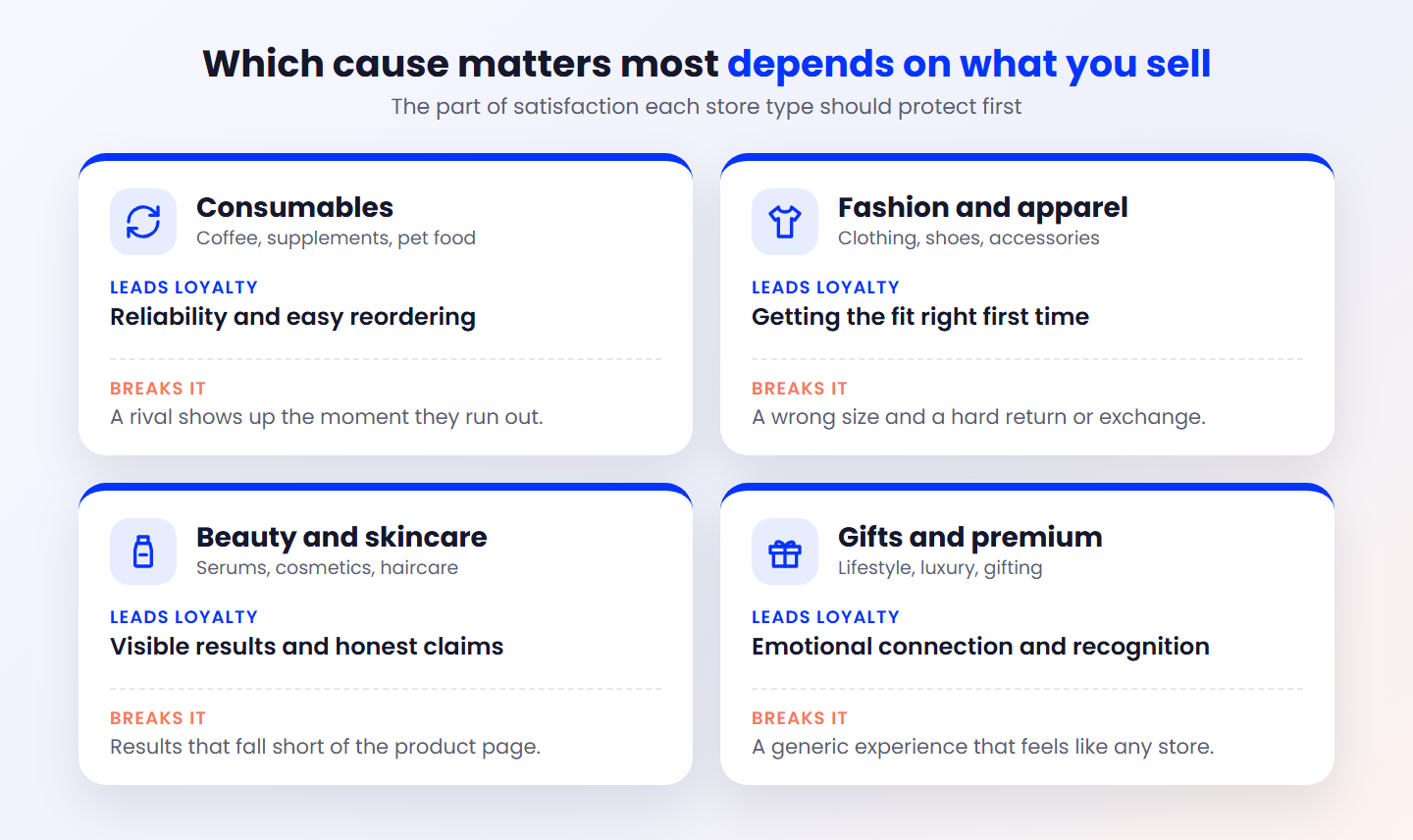
Satisfaction is the most direct cause of customer loyalty in every store, but the part of satisfaction that matters most changes with the product. A coffee subscriber and a dress buyer judge different things first, so knowing which cause carries the most weight in your category tells you where a small improvement will keep the most customers.
Consumables and replenishment products
Coffee, supplements, pet food and cleaning supplies are bought on a cycle. Reliability and convenience lead here: the product has to be the same every time, and reordering has to take seconds. Customers rarely leave because they dislike the product. They leave because a competitor showed up at the moment they ran out.
Fashion and apparel
Fit is the first test. A customer who gets the right size on the first try is satisfied, while one who has to send it back starts the relationship with a hassle. Accurate size guides, fit notes in reviews and an easy exchange process do more for apparel loyalty than almost any reward.
Beauty and skincare
Results and honesty lead. Customers come back when the product did what the page said it would, in the time it said it would. Overpromising on results is the quickest way to turn a satisfied first order into a disappointed second one.
Gifts, lifestyle and premium products
Emotional connection carries more weight when the purchase says something about the buyer. Packaging, brand story and recognition of repeat buyers matter as much as the product itself, and customers often stay because the brand reflects who they are.
Satisfaction earns the second order, consistency earns the tenth
The most direct cause of customer loyalty is satisfaction, but it only becomes loyalty when customers get the same good experience every time. Get the product, delivery and service right first, aim for completely satisfied rather than merely satisfied, and back it with trust, value and recognition. That’s what keeps customers coming back at full price, not just during a sale.
FAQs
What is the most direct cause of customer loyalty?
Customer satisfaction is the most direct cause of customer loyalty. When a product meets expectations, arrives reliably and feels worth the price, the customer has a reason to buy again. That satisfaction turns into lasting loyalty only when it repeats across orders and is backed by trust, good service and fair value.
Is customer satisfaction the same as customer loyalty?
No. Satisfaction is how a customer rates one experience. Loyalty is a lasting preference that shows up as repeat purchases and recommendations over time. A satisfied customer can still switch for a lower price or faster shipping, which is why satisfaction is the cause of loyalty rather than proof of it.
Is price the most direct cause of customer loyalty?
No. Low prices create repeat purchases, but that kind of loyalty lasts only until a competitor offers a better deal. Price is part of perceived value, along with quality, convenience and service. Customers who stay for the product and the experience are far harder for competitors to win away.
Why do satisfied customers still switch brands?
Satisfied customers switch when another brand is cheaper, more convenient or more visible at the moment they’re ready to buy. Merely satisfied customers are still open to offers, while completely satisfied ones usually stop looking. Small disappointments, like a slow reply or an unclear size guide, are often what keeps a customer at “satisfied.”
How do you know if satisfaction is driving loyalty in your store?
Knowing how to measure customer loyalty starts with pairing behavior and feedback. Watch whether repeat purchases happen at full price, not only during sales, and whether ratings and referrals rise alongside them. If repeat orders climb while ratings fall, discounts are driving the behavior rather than satisfaction.
Increase Repeat Orders with Retenzy
Add points, referrals, and VIP rewards to your Shopify store in under 5 minutes.
At Retenzy, we believe customer retention should be simple, effective, and growth-driven. Our team is dedicated to helping brands build stronger relationships with their customers through loyalty programs, milestones, reviews, and analytics.
Take 60 seconds to tell us about your brand. Our experts will analyze your details and contact you to craft a personalized strategy for scaling your business.