
8 Abandoned Cart Email Examples That Win the Sale Back
An abandoned cart email is an automated message sent to shoppers who leave items in their cart. Send the first one within a few hours, follow up once or twice, and remind shoppers what they left, why it’s worth buying and how to check out.
A shopper adds a product to their cart, moves closer to checkout, and then disappears without completing the purchase. For ecommerce brands, this is a familiar challenge. The customer has already shown interest, but something has stopped them from buying.
An effective abandoned cart email gives shoppers a reason to return. It reminds them what they wanted, answers potential questions, reinforces trust, or offers an incentive when appropriate. Instead of sending a generic reminder, brands can use personalized messages that address different reasons for abandoning a purchase.
According to Baymard Institute research cited by Shopify, the average online shopping cart abandonment rate is approximately 70%. That makes cart recovery an important opportunity for ecommerce businesses.
In this guide, we’ll explore 8 abandoned cart email examples that Shopify brands can learn from, including real-world brand approaches and ready-to-adapt templates. You’ll also learn when to send these emails, what to include, and how to build a recovery sequence that encourages customers to complete their purchases without giving away discounts unnecessarily.
What Is an Abandoned Cart Email?
An abandoned cart email is an automated email sent to a shopper who adds products to their cart but leaves without completing the purchase. Depending on the store’s setup, it can remind shoppers about their selected products, address common concerns, or encourage them to return to checkout. For Shopify brands, abandoned cart emails can be part of an automated recovery flow triggered by customer activity. The email may include product images, prices, a link back to the cart, customer reviews, shipping information, or a promotional offer.
The goal isn’t simply to remind customers that they left something behind. It’s to remove the friction that prevented them from buying in the first place.
8 Abandoned Cart Email Examples That Win the Sale Back
The best abandoned cart emails don’t all follow the same formula. Some use humor to catch attention, while others rely on customer reviews, product reminders, shipping offers, or clear return policies.
The following examples combine real-world brand inspiration with original templates you can adapt for your Shopify store. Where a template is original, it is identified as a suggested example rather than an actual brand campaign.
1. Casper: Bring Customers Back With Clever Copy
Approach: Humour and social proof
Subject line: Did you forget something?
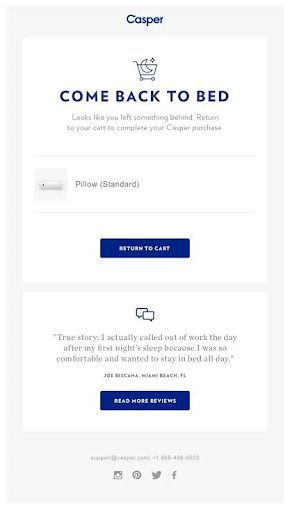
Casper uses playful copy to remind shoppers about their abandoned products. Its email features the headline “COME BACK TO BED,” connecting the reminder to its sleep-product category. It also displays the abandoned product, includes a clear return-to-cart button, and features a customer testimonial.
Why it works
A straightforward reminder can easily get lost among promotional emails. Casper makes its message more memorable by connecting the copy to its brand identity. The customer testimonial also gives hesitant shoppers another reason to consider the purchase.
What Shopify brands can learn
Match the tone of your abandoned cart email to your brand personality. A playful fashion brand can use witty headlines, while a home decor brand might prefer warm, reassuring language.
Example email template
Subject: Did something catch your eye?
Your cart called. It misses you!
Hi [First Name],
Looks like you found something you liked.
Your [Product Name] is still on your mind, and we’d love to help you bring it home.
Ready to pick up where you left off?
CTA: Return to My Cart
Have questions before ordering? We’re happy to help.
Best for: Lifestyle, bedding, home decor, and other consumer brands with a distinctive voice.
2. Rudy's: Use Free Shipping to Address Purchase Hesitation
Approach: Shipping incentives and playful urgency
Subject line: Don’t let free shipping go to waste
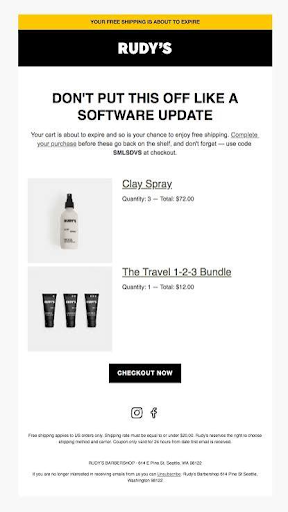
Rudy’s combines humour with an incentive in its cart recovery emails. One example pairs the headline “Don’t put this off like a software update” with a free-shipping offer, abandoned product images, a promotional code, and a checkout button.
Why it works
Shipping costs can discourage shoppers from completing an order. An incentive that addresses this specific concern can make the purchase more appealing without reducing the price of every product. The humour also makes the message feel less like a generic sales reminder.
What Shopify brands can learn
Test free shipping against percentage discounts. If shipping costs are a common reason for abandonment, removing that barrier may be more relevant than reducing the product price. Only advertise an expiring offer when the deadline is genuine.
Example email template
Subject: Your cart is waiting, and shipping is on us
Your favourites are just one step away.
Hi [First Name],
You’ve picked your favourites. Now let’s get them to your doorstep.
Complete your order and enjoy free shipping on your purchase.
Your selected items are waiting in your cart.
CTA: Complete My Order
Offer terms: [Insert eligible order value, location, and expiry date, if applicable.]
Best for: Grooming, beauty, apparel, and stores where delivery costs may discourage purchases.
3. Dollar Shave Club: Answer Questions Before Asking for the Sale
Approach: Reassurance and objection handling
Subject line: Where did you go?
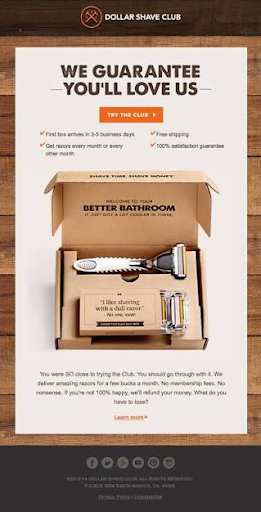
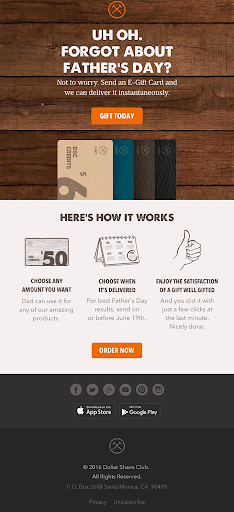
Dollar Shave Club uses a conversational tone to re-engage shoppers. Its example combines a prominent CTA with a checklist addressing practical concerns such as delivery, shipping, subscription frequency, and its satisfaction guarantee.
Why it works
Some customers don’t abandon their carts because they dislike the product. They may simply be uncertain about delivery schedules, recurring payments, returns, or what their purchase includes. Answering these questions in the email can reduce the amount of additional research required before buying.
What Shopify brands can learn
Identify the questions customers frequently ask your support team and address the most relevant ones in your cart recovery emails.
For subscription businesses, explain billing frequency, cancellation terms, and delivery schedules clearly.
Example email template
Subject: Still deciding? Here’s what to know
A few answers before you decide.
Hi [First Name],
Still thinking about [Product Name]? We understand that you may have a few questions before placing your order.
Here’s what you might want to know:
- Delivery: [Insert the estimated delivery window.]
- What’s included: [Summarise the product contents.]
- Returns: [Summarise your return policy.]
- Need help? Our team is here to answer your questions.
Your cart is ready whenever you are.
CTA: Return to Checkout
Best for: Subscription brands, personal care, electronics, and higher-consideration purchases.
4. Nomad: Reduce Purchase Anxiety With Clear Policies
Approach: Trust-building and purchase reassurance
Subject line: Nomad gear is selling out quickly
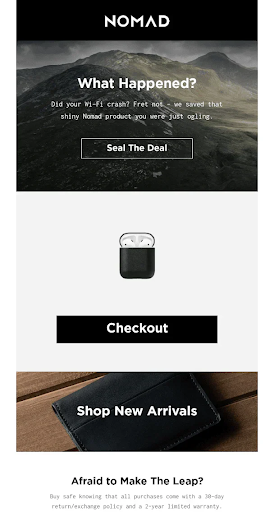
Nomad combines its abandoned product reminder with lifestyle imagery, a direct checkout link, and information about its return and exchange policy and limited warranty. Its email also uses a conversational headline to re-engage the shopper.
Why it works
Customers may hesitate when they are unsure whether a product will meet their expectations. A clear return policy or warranty can help address that uncertainty. This is particularly relevant when a customer is considering an expensive accessory or a product they haven’t purchased before.
What Shopify brands can learn
Don’t rely on urgency alone. If your products involve a significant purchase decision, make your actual return policy, warranty, or product guarantee easy to find. Avoid promising risk-free purchases unless your terms genuinely support that claim.
Example email template
Subject: A little more confidence before you buy
Your [Product Name] is still waiting.
Hi [First Name],
We noticed you left [Product Name] in your cart.
Before you decide, here’s what you should know about shopping with us:
- Returns: [Insert your actual return window and conditions.]
- Warranty: [Include applicable warranty details.]
- Product support: [Explain how customers can get assistance.]
If everything looks right, you can pick up where you left off.
CTA: Continue to Checkout
Best for: Electronics, travel accessories, premium accessories, and products where buyers may have concerns about fit, quality, or durability.
5. Food52: Let the Cart Do the Talking
Approach: Conversational copy and product reminders
Subject line: Your cart called
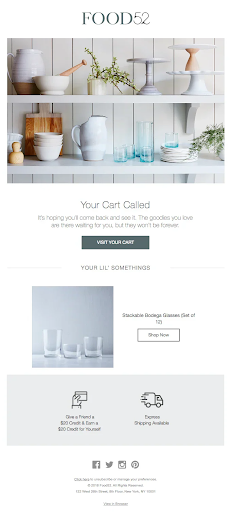
Food52 uses the headline “Your Cart Called” to turn a routine reminder into a more engaging message. Its email displays the abandoned products and provides a route back to the shopping cart.
Why it works
The message is simple and easy to understand. Rather than explaining the benefits of shopping with the brand all over again, it reminds customers of the products they already selected. This approach is particularly useful for shoppers who were distracted or needed more time to make a decision.
What Shopify brands can learn
Keep the first recovery email focused. Display the actual products, show their prices and selected variants, and use one prominent CTA that returns the shopper to their cart. Avoid filling a simple reminder with unrelated product recommendations or multiple competing offers.
Example email template
Subject: Your cart has a message for you
Your picks are still on your mind.
Hi [First Name],
Your cart wanted us to check in.
You found something you liked, and we’ve made it easy to pick up where you left off.
Your cart:
[Dynamic product image]
[Product Name]
[Variant or size]
[Price]
Ready when you are.
CTA: Take Me to My Cart
Best for: Home decor, kitchenware, fashion, and everyday ecommerce products.
6. Casper: Use Customer Reviews to Build Confidence
Approach: Social proof
Subject line: Your next great night’s sleep could be closer
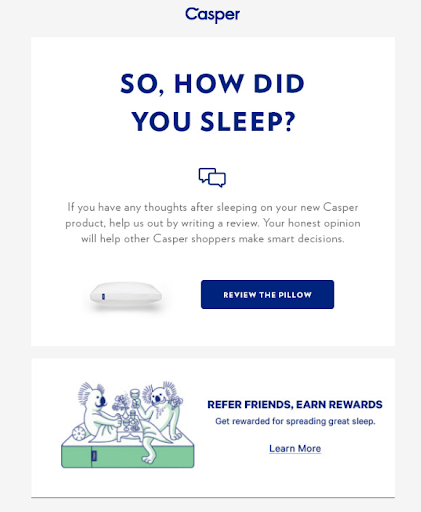
Casper provides another useful lesson for brands selling products that customers want to research before buying. Alongside its cart reminder, the brand includes a customer testimonial and an option to read more reviews.
Why it works
A shopper might like a product but still wonder whether it is worth the price. Customer feedback can help address doubts about product quality, comfort, durability, or suitability. Relevant reviews are more useful than generic statements claiming that a product is popular.
What Shopify brands can learn
Display a short, authentic review of the product the customer abandoned. Where possible, choose feedback that addresses a common buying concern. For example, a clothing brand might feature a verified review about fit, while a skincare brand could highlight a customer’s experience with texture or application, provided the statement is authentic and compliant with applicable advertising rules.
Example email template
Subject: See why customers love [Product Name]
Still considering your pick?
Hi [First Name],
You were looking at [Product Name]. Before you make your decision, here’s what another customer had to say:
“[Insert a genuine customer review relevant to this product.]”
Want to take another look?
[Dynamic product image]
[Product Name] — [Price]
CTA: Return to My Cart
Secondary link: Read More Reviews
Best for: Beauty, fashion, home goods, mattresses, and products where customer experiences influence buying decisions.
Important: Use real customer feedback and don’t present a review as verified unless it has been verified.
7. Society6: Make an Incentive the Main Attraction
Approach: Discount-led recovery
Subject line: Your cart is waiting, with 15% off
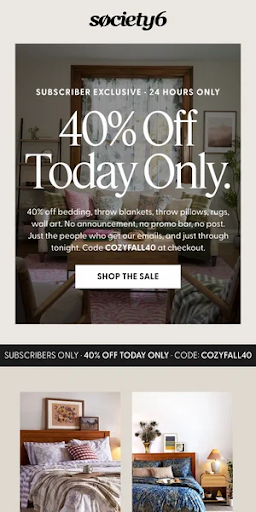
Society6 has used discount-led cart recovery, including an example featuring a 30% discount and a CTA tied directly to the offer. The email also includes additional brand and shopping content.
Why it works
A discount can provide the final nudge to a shopper who likes the product but is hesitant about the price. However, offering discounts in every abandoned cart email can reduce margins and teach customers to wait for a coupon before purchasing.
What Shopify brands can learn
Save discounts for shoppers who haven’t responded to earlier reminders, or test them with segments where price sensitivity appears to be a significant barrier. Consider offering free shipping, a modest percentage discount, or another relevant benefit instead of automatically giving away a large discount.
Example email template
Subject: A little something to help you decide
Your cart comes with an extra perk.
Hi [First Name],
Still thinking about [Product Name]?
Here’s a little extra incentive to help you make your decision.
Use code [DISCOUNT CODE] at checkout to receive [X% off or another approved offer].
Your selected products are waiting.
CTA: Apply My Offer
Offer valid until [genuine expiry date], subject to the stated terms.
Best for: Fashion, home decor, accessories, and price-sensitive customer segments.
Pro tip: Test whether a discount improves completed purchases enough to justify its cost. Measure recovered revenue and profit, not just email clicks.
8. Huckberry: Create Urgency Without Inventing Scarcity
Approach: Inventory-based urgency
Subject line: Still thinking about these?
Huckberry uses a scarcity-based approach, reminding shoppers that inventory is limited and that products left in their carts aren’t necessarily guaranteed to remain available. The email displays the selected items and their prices.
Why it works
Some shoppers intend to buy later and assume their selected products will remain available. A genuine stock warning reminds them that availability can change. This approach works best for limited-stock products rather than items that are consistently available.
What Shopify brands can learn
Use urgency only when it reflects a real condition. If a product has limited stock, communicate that accurately. If a promotion has a deadline, state the actual expiry date. Avoid fake countdown timers, invented customer demand, or repeatedly resetting deadlines.
Example email template
Subject: A quick heads-up about your cart
Your picks may not stay available forever.
Hi [First Name],
You left [Product Name] in your cart.
If you’re still interested, now is a good time to check its availability.
[Dynamic product image]
[Product Name]
[Price and current availability, if supported by live inventory data]
CTA: Check My Cart
We’ll be here whenever you’re ready.
Best for: Limited-edition products, seasonal collections, popular fashion items, and products with genuinely limited inventory.
Best Practices for Writing Abandoned Cart Emails
The examples above offer inspiration, but a successful recovery campaign also depends on how the emails are written, designed, and delivered.
1. Write Subject Lines That Sound Human
Avoid sending the same generic subject line to every customer.
Try options such as:
- Your cart is waiting for you.
- Still thinking about [Product Name]?
- Ready to pick up where you left off?
- Have a question about your order?
- A quick reminder about your selected items.
For a brand with a playful voice, a witty subject line may work well. For a premium or professional brand, a direct reminder may feel more appropriate.
Test different approaches instead of assuming that clever copy will always outperform a simple message.
2. Personalize the Email With Cart Details
Include the product image, name, price, and selected variant wherever possible. This helps shoppers recognize their cart immediately. Use your ecommerce platform’s dynamic email content rather than manually inserting product information into every email. Personalization should also be accurate. An email displaying the wrong product variant or outdated price can create confusion and undermine trust.
3. Use One Primary Call to Action
The main purpose of an abandoned cart email is to bring shoppers back to their purchase. Choose a CTA that clearly communicates the next step, such as:
- Return to Cart
- Complete My Order
- Continue Checkout
- Review My Cart
Make the button easy to find, particularly on mobile devices. Additional links can be included where useful, but avoid giving every element equal visual importance.
4. Address Unexpected Costs
Unexpected shipping fees, taxes, or other charges can discourage customers from completing a purchase. Additional costs are a leading reason for checkout abandonment. Where possible, communicate shipping charges and delivery estimates before checkout. If your business offers free shipping above a minimum order value, make the terms clear. If a shopper has already abandoned a cart, a shipping-related message may be more relevant than a generic product promotion.
5. Use Discounts Strategically
A discount may encourage some customers to complete a purchase, but automatically offering one to everyone can reduce margins. Start with a reminder, then test incentives for suitable customer segments. Measure the additional purchases and profit associated with the offer, rather than counting every order placed after an email as a sale caused by the discount.
6. Make Mobile Emails Easy to Read
Many shoppers check their inboxes on mobile devices. Use a simple layout, readable text, clear product images, and buttons that are easy to tap. Keep the most important information near the top of the email. Customers should be able to identify their product and find the primary CTA without scrolling through several promotional sections.
7. Measure Completed Purchases, Not Just Opens
Email opens and clicks can help you understand engagement, but they don’t necessarily mean that a shopper completed a purchase.
Track:
- Click-through rate: The percentage of delivered emails that generate clicks, according to your reporting definition.
- Conversion rate: The percentage of recipients who complete a purchase.
- Recovered revenue: The revenue attributed to your abandoned cart flow.
- Revenue per recipient: The revenue attributed to the flow divided by the relevant recipient count.
- Discount cost: The value of discounts used in recovered orders.
- Unsubscribe rate: The percentage of recipients who unsubscribe.
Use consistent attribution windows and compare similar customer segments. This will help you understand whether changes to the email sequence are genuinely improving results.
Conclusion
Abandoned cart emails allow ecommerce brands to reconnect with shoppers who have already shown interest in their products. But a reminder alone isn’t always enough.
The strongest approach is to understand why customers hesitate and respond with relevant messaging. Use humor to capture attention, reviews to build confidence, clear policies to reduce uncertainty, and incentives when they make commercial sense.
Start with a simple three-email sequence, personalize each message with accurate cart information, and test different subject lines, CTAs, and offers.
Most importantly, make it easier for customers to complete a purchase rather than simply giving them another reason to open an email.
The goal isn’t just to recover abandoned carts. It’s to create a smoother shopping experience that helps customers feel confident about buying from your store.
Add points, referrals, and VIP rewards to your Shopify store in under 5 minutes.