
How to Choose a Loyalty Program for DTC Brands
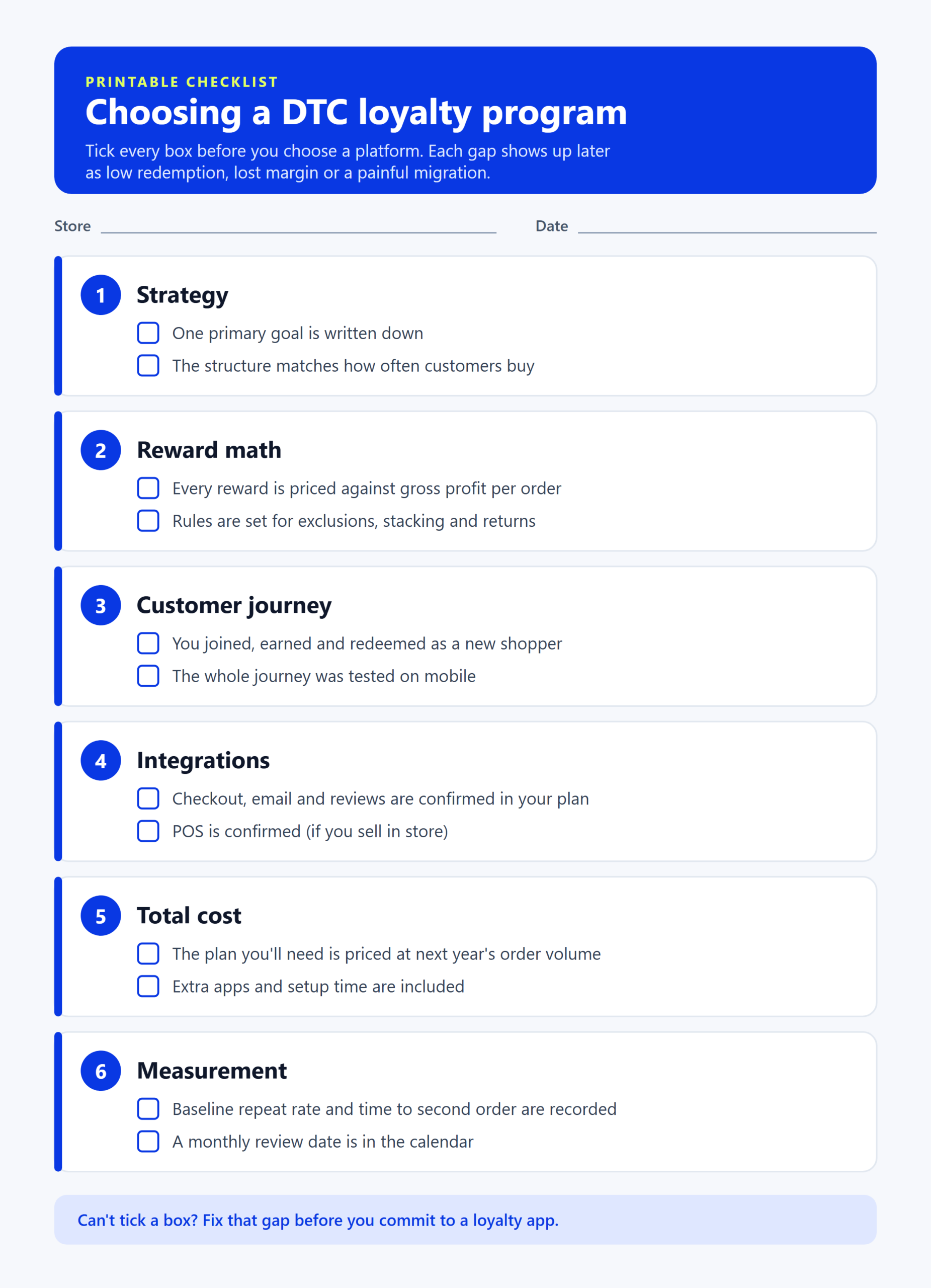
Choosing a loyalty program for a DTC brand starts with your margins, not an app’s feature list. Pick one retention goal, match it to the right program structure, price every reward against real gross profit, test the customer journey, compare total cost at next year’s order volume and measure incremental repeat orders, then use the six-point checklist before you buy.
Your customers already belong to an average of 17.4 loyalty programs, and only 48% of Americans say they are very satisfied with them, according to the 2025 Bond Loyalty Report. That gap is your opening. Knowing how to choose a loyalty program for DTC means picking one your margins can fund and your customers will actually use, before you compare a single app.
Key takeaways
- Pick one retention goal before choosing a structure.
- Price every reward against gross profit per order.
- Test sign-up and redemption as a real shopper.
- Compare total cost at next year’s order volume.
- Judge success on incremental repeat orders, not sign-ups.
Pick one goal, then the structure that serves it
A DTC loyalty program is a set of rewards that gives customers a reason to buy from your store again instead of from a marketplace or a competitor. Choose it by naming the single behavior you want to change, such as a faster second order or more referrals, then pick the program structure built for that behavior.
Most programs fail because they try to do everything at once. A skincare brand with monthly replenishment needs customers to reorder sooner. A premium home brand with a 12-month purchase cycle needs its top 10% of buyers to feel recognized. An apparel brand with fans who post about it needs referrals. Same app category, three different programs. Pick one primary goal and at most one secondary goal for launch, then match it to a structure:
| Structure | Best for | Watch out for |
|---|---|---|
| Points | Frequent, repeat purchases | Low earn rates that feel worthless |
| Loyalty tiers | Recognizing high spenders | Tiers with no real perk behind the name |
| Referrals | Brands people already talk about | Rewards paid before the friend’s order is confirmed |
| Paid membership | Recurring demand and strong perks | A fee customers can’t justify |
The points vs tiered loyalty program question is less of a choice than it looks. Many DTC brands run both. Chubbies, for example, gives 1 point per $1 spent and adds three tiers based on rolling 12-month spend, with the second tier unlocking above $150 and the top tier above $300 (checked on its rewards page in October 2026). Pura Vida’s PV Rewards also combines points with spend-based tiers, recalculated every 12 months.
Referrals deserve a closer look if acquisition is your goal. A study of about 10,000 customers at a German bank by Schmitt, Skiera and Van den Bulte (2011) found referred customers were worth at least 16% more and churned about 18% more slowly than other customers. It’s not ecommerce data, but the direction is useful.
If you’re running a loyalty program for small DTC brands, start with the simplest structure that serves your goal. Add tiers or referrals once you can see which rewards members actually redeem.
Run the reward math before you pick an app
A loyalty reward is only worth offering if the repeat order it creates earns more than the reward costs. Calculate each reward’s cost against your gross profit per order, not your revenue, because that’s where the money comes from. This one step rules out most of the generous-looking programs that quietly erase margin.
Free shipping can still be worth it. In the Baymard Institute’s 2025 checkout research, 40% of US shoppers who abandoned checkout did so because extra costs such as shipping, tax and fees were too high. A free shipping perk for members, like Chubbies’ free shipping on US orders of $50 or more, removes that reason at the moment it matters.
Before you choose an app, write down five rules: the earn rate, the reward values, which products are excluded, whether rewards stack with sales, and what happens to points on returns. Pura Vida, for instance, removes points earned on returned items once the return is processed. If an app can’t enforce your rules, it isn’t the right app.
Test the customer journey before the feature list
The best program on paper fails if customers can’t find it, join it or redeem it. Walk through the full journey as a new shopper on mobile: discover the program, join, earn on an order, check the balance and redeem at checkout. Any step that takes more than a click or two will cost you members.
Pay special attention to sign-up. Baymard found that 18% of US shoppers who abandoned checkout did so because the site required them to create an account. Let shoppers join after their first order, from the thank-you page or a follow-up email, instead of forcing an account up front.
Then check that rewards show up where buying decisions happen. A points rewards program works best when shoppers see what they’ll earn on the product page and what they can redeem in the cart. A rewards page tucked away in the footer gets ignored.
Next, check Shopify loyalty program integrations against your actual stack:
- Checkout: can members redeem rewards without leaving the checkout?
- Email and SMS: can points balances and tier changes trigger flows in your email tool?
- Reviews: can you reward honest reviews, regardless of star rating? Both Chubbies and Pura Vida give points for reviews.
- POS: if you sell in person, can customers earn and redeem in store? Our guide to building an omnichannel loyalty program covers that setup.
- Data: do balances and order history stay in sync with Shopify customer records?
Don’t assume every integration is native. Ask which ones are included in your plan, which need a separate app and which need a higher Shopify plan.
Show members their points on product pages, in the cart and on the thank-you page with Retenzy’s loyalty widget placements, so the reward is visible before they check out.
What does a loyalty program really cost at your order volume?
A loyalty program’s real cost is the app fee plus reward costs plus any extra apps and setup time, measured at the order volume you expect next year, not this month. Most loyalty apps price by monthly orders, so a plan that looks cheap at 300 orders can cost several times more at 2,000. Compare total cost, not the entry price.
How much does a loyalty program cost in practice? Use this checklist to find out before you sign up:
| Cost factor | What to check |
|---|---|
| Subscription | Is pricing fixed, or based on orders, members or revenue? |
| Feature access | Which plan includes tiers, referrals and analytics? |
| Extra apps | Do reviews, referrals or membership perks need separate tools? |
| Usage limits | What happens when you pass the order limit? |
| Setup | Does launch need a developer or paid onboarding? |
| Exit | Can you export points balances and tier status if you switch? |
Measure incremental repeat orders, not sign-ups
A loyalty program is working when members buy again sooner or more often than similar customers who didn’t join. Sign-ups and points issued tell you it’s running, not that it’s paying off. Record your repeat purchase rate and time between orders before launch, then compare members with non-members every month.
Learning how to measure loyalty program ROI comes down to a few numbers:
- Repeat purchase rate: the share of customers who place a second order within your normal buying cycle.
- Time to second order: whether members come back sooner than non-members.
- Redemption rate: whether members find rewards worth claiming. Very low redemption often means rewards are too far away.
- Reward cost: what you spent on redeemed rewards, as a share of gross profit.
- Referral orders: first orders from referred friends, if referrals are part of your program.
Be careful with member versus non-member comparisons. Your best customers are the ones most likely to join, so members will look better even if the program changed nothing. Compare customers with similar order counts, or compare the same cohort before and after launch. Our article on loyalty program KPIs explains which reports to run and how often.
When you shortlist apps, check that the loyalty analytics include cohort or member comparisons, not just totals. Also check that the platform can grow with you, adding rewards, stores or sales channels without a rebuild. The best ecommerce loyalty programs tend to change their rewards several times a year, so flexibility matters more than launch features.
Choose the program your margins can keep
The right answer to how to choose a loyalty program for DTC is rarely the app with the longest feature list. It’s the program that serves one clear goal, rewards customers at a cost your gross profit can carry and shows you whether repeat orders actually went up. Start with the math, test the journey, then choose the tool that fits.
Install Retenzy free on Shopify and set your earn rate and first VIP tier against the margin math above, with points, referrals and reviews in one app.
FAQs
How to choose a loyalty program for DTC brands: where should I start?
Start with one goal, such as a faster second order, higher order value or more referrals. Then pick the structure built for that goal: points for frequent buyers, tiers for top spenders, referrals for brands people already recommend. Only after that should you compare apps, using your margins and expected order volume as the filter.
Is a points or tiered loyalty program better for a small DTC brand?
For most small DTC brands, a simple points program is the better starting point because it’s easy to understand and cheap to run. Tiers work once you have a clear group of repeat, high-value customers to recognize. Many brands combine both, as Chubbies does with 1 point per $1 and two spend-based tiers above $150 and $300.
How much does a loyalty program cost?
The total cost is the app subscription plus the rewards you pay out, any extra apps and setup time. Most Shopify loyalty apps charge by monthly orders, so compare plans at the order volume you expect in 12 months. Price rewards against gross profit per order, where a 5% points reward can equal 12.5% of the profit on a $60 order.
How do I know if my loyalty program is working?
Compare members with similar non-members, or the same customers before and after launch. Track repeat purchase rate, time to second order, redemption rate and reward cost. Sign-ups and points issued only show activity. A program is working when members buy again sooner or more often, and the extra gross profit is higher than what the rewards cost.
How to choose a loyalty program for DTC if you also sell in stores?
Check that customers can earn and redeem rewards both online and at your point of sale, with one balance across channels. Confirm the app supports your POS system on your plan, and that in-store purchases count toward tiers. Test a full in-store purchase and an online redemption before launch, so staff and customers see the same balance.
Add points, referrals, and VIP rewards to your Shopify store in under 5 minutes.