
Referral Program vs Affiliate Program: Which Should Your Shopify Store Run?
You have a group of customers who rave about your products, and a few creators in your niche keep asking about a partnership. Both could bring you new buyers, but you probably can’t run both well right now. That is the real referral program vs affiliate program decision. One pays your customers to share, the other pays partners to promote, and the right first pick depends on your store.
- What Is a Referral Program?
- Affiliate Programs and How They Work
- Referral Program vs Affiliate Program: Key Differences
- Referral Program Pros and Cons for Shopify Stores
- Affiliate Program Pros and Cons for Shopify Stores
- The Best Fit for Different Shopify Businesses
- How to Choose Between a Referral Program and an Affiliate Program
- Final Verdict: Referral Program vs Affiliate Program
Key takeaways
- Referral programs reward customers for bringing friends, usually with credit or points.
- Affiliate programs pay creators and publishers a commission on tracked sales.
- Referrals support repeat purchases, while affiliates mainly add reach.
- Set rewards from your margin, not competitors’ offers.
- Many stores start with one, then add the other.
What Is a Referral Program?
A referral program rewards existing customers when someone they recommend places a qualifying order. The customer gets a unique link or code, shares it with friends, and earns a reward such as store credit or points once the friend buys. Most stores also give the new customer a welcome discount, so both sides benefit.
Picture a Shopify skincare store that offers $10 off a friend’s first order and $10 in store credit to the customer who referred them. The store gains a new customer, and the referrer now has a reason to come back and shop again. That second effect is what makes referrals more than an acquisition tactic.
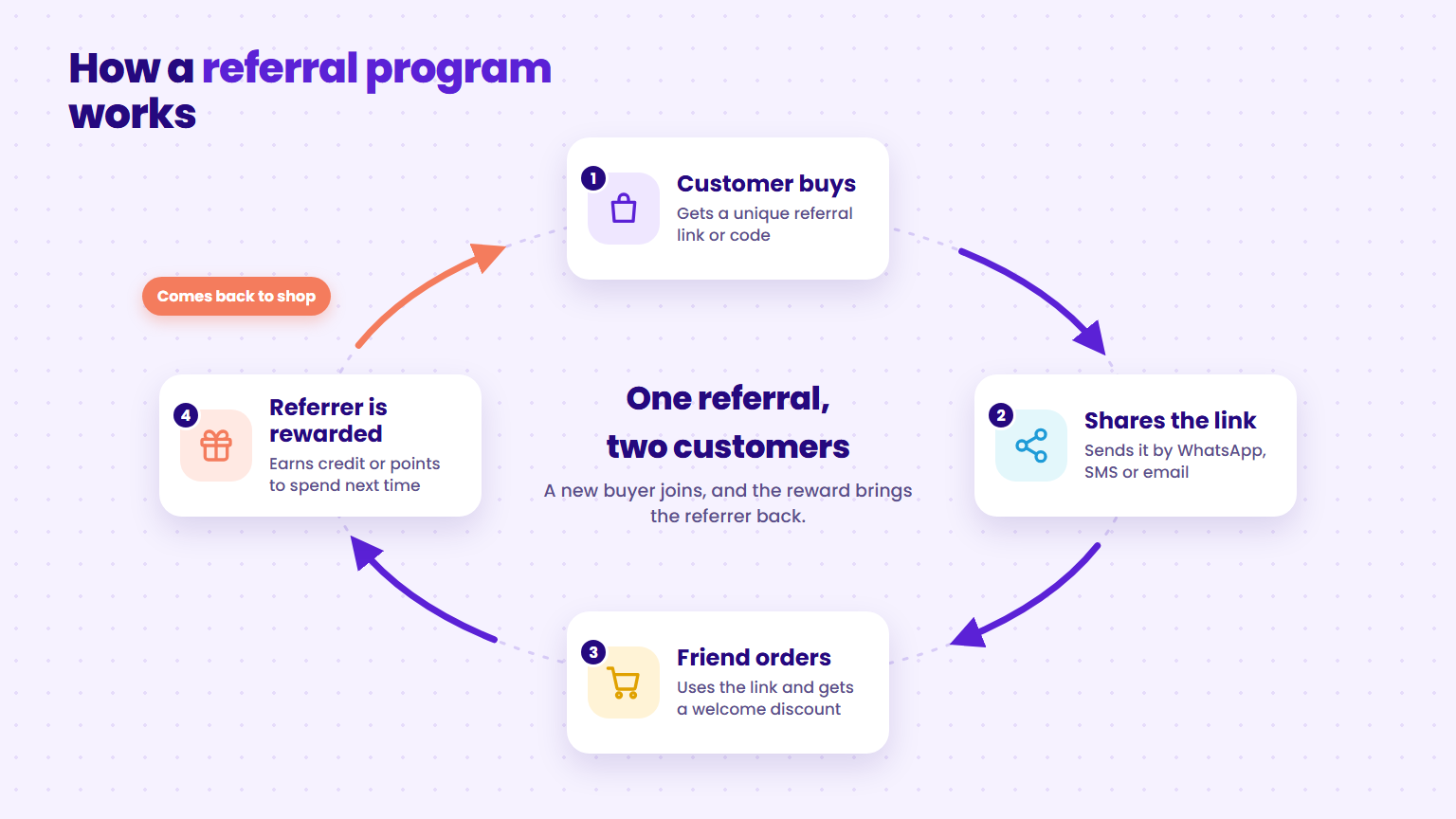
How a referral program works
Most referral programs follow the same five steps, whatever reward you choose:
- A customer buys from your Shopify store.
- They receive a unique referral link or discount code.
- They share it with friends, family or their social network.
- A new customer uses the link or code to place an eligible order.
- Your store confirms the purchase and issues the promised reward.
Common referral program rewards
You can test several kinds of incentives, and each one suits a different margin and buying pattern:
- Discounts: a percentage or fixed amount off for the referrer, the friend or both. Simple to understand, but every dollar comes straight off the order.
- Store credit: a balance the referrer can only spend at your store. It costs you nothing until they come back and buy.
- Loyalty points: if you already run a loyalty points app, referral points land in the same balance customers already earn and spend.
- Free products: a sample or full-size item after a qualifying referral, which also introduces the referrer to another product.
- Tiered rewards: bigger rewards as a customer makes more successful referrals, so your most active advocates earn the most.
For most ecommerce referral program setups, a reward the referrer can only use on a future order works best. It protects your margin today and brings the referrer back to your store tomorrow.
Why referral programs work
People tend to give more weight to a recommendation from a friend than to an ad from a brand they don’t know. A referral gives the new buyer a personal reason to try your store, plus someone they trust who has already used the product.
For you, one referral can do two jobs at once. The referrer returns to spend their reward, and the new customer gets an incentive to place a first order. The catch is that rewards can’t fix a weak product or a poor experience. If customers aren’t happy, they won’t share, however generous the reward.
Affiliate Programs and How They Work
An affiliate program pays outside partners, such as creators, bloggers and niche publishers, a commission on sales they send to your store. Each partner gets a tracked link or code, promotes your products to their audience, and earns an agreed fee on every qualifying order. Unlike referrers, affiliates don’t need to be customers first.
Say a fitness creator reviews a Shopify store’s resistance bands on YouTube and puts an affiliate link in the description. When viewers click and buy, the creator earns a commission under the program’s terms. Many merchants run a Shopify affiliate program through a dedicated app, and Shopify’s own creator app, Shopify Collabs, is built for exactly this kind of partnership.
How an affiliate program works
Affiliate programs take a few more steps than referrals, because you have to find partners before anyone can promote you:
- You recruit affiliates whose audiences match your target customers.
- Each affiliate receives a unique tracking link or promo code.
- Affiliates promote your products through the channels you approve.
- Shoppers click the link or use the code to buy.
- Your affiliate software attributes eligible orders and calculates commissions.
- You review the results and pay commissions on the agreed terms.
Common affiliate commission structures
Affiliates are usually paid on measurable results, and the structure you pick shapes who wants to join:
- Percentage commission: an agreed share of each eligible sale. A 10% commission on a $100 order pays the affiliate $10.
- Fixed commission per sale: a set amount for each qualifying order, which is easy to budget when prices vary.
- Tiered commission: higher rates for partners who drive more sales, which keeps your best affiliates motivated.
- Product-specific commission: different rates by category, so high-margin products can carry a bigger commission.
- Performance bonuses: extra rewards for hitting a sales target in a set period.
Base the structure on your margins, your average order value and how much work it takes to promote your products well.
Why affiliate programs work
Affiliates take your products beyond your current customers. A trusted creator already has an audience that cares about your category, and their reviews, tutorials and comparisons can introduce your brand to people who have never heard of it.
Recruiting the right partners is the hardest part of affiliate marketing for ecommerce, because a big following doesn’t guarantee sales. Partners need a relevant audience, credible content and a commission worth their time. In the US, they also need to disclose that they earn money from their recommendations under the FTC’s Endorsement Guides, so build that requirement into your partner terms.
Referral Program vs Affiliate Program: Key Differences
The biggest difference between a referral program vs affiliate program is who does the promoting. Referral programs activate customers who already bought from you and share with people they know. Affiliate programs recruit partners who may never have bought, but who bring an audience. Rewards, reach, costs and management effort all follow from that difference.
The comparison at a glance
Use this table to compare the two programs side by side:
| Comparison Factor | Referral Program | Affiliate Program |
|---|---|---|
| Who promotes | Existing customers and brand advocates | Creators, bloggers, publishers and other partners |
| Main goal | Word-of-mouth recommendations from trusted relationships | Reach new audiences and generate trackable sales |
| Typical reward | Discounts, store credit, loyalty points or free products | Percentage or fixed commissions |
| Audience reach | Personal networks and customer communities | Larger or more specialized audiences |
| Relationship with your brand | Usually an existing customer | Can be someone who has never bought from you |
| How buyers discover you | A friend’s recommendation | Content such as reviews, videos and guides |
| What you manage | Reward rules, reward delivery, tracking and fraud checks | Recruitment, onboarding, tracking, commissions and brand guidelines |
| Main costs | Referral rewards and the app that runs them | Commissions, software, recruitment and product samples |
| Effect on retention | Rewards can bring the referrer back for another order | Depends on your own retention strategy |
| Best for | Stores with happy, engaged customers | Stores that need to reach buyers beyond their customer base |
| Common channels | Personal messages, email and social sharing | Blogs, social media, videos, newsletters and review sites |
| Metrics to watch | Successful referrals, referred-customer conversion, reward cost and repeat purchases | Attributed sales, conversion rate, commission cost and revenue per affiliate |
What the comparison means for your store
Referral programs make it easy for happy customers to recommend you. Affiliate programs give you a structured way to work with people who can promote you to their own audiences.
Neither one is automatically more profitable. Your results depend on how good your referrals are, how relevant your affiliates’ audiences are, how you set incentives, and how well you manage the program.
Referral Program Pros and Cons for Shopify Stores
Referral programs are inexpensive to run once they’re set up, and they turn happy customers into a steady source of new buyers. The trade-off is that they only grow as fast as your customers share, and generous two-sided rewards can eat into your margin if you don’t plan them carefully.
Advantages of referral programs
Builds on trust you’ve already earned
A friend explaining why they love a product does more to reassure a new buyer than most ads can. Your customers are introducing your brand with their own reputation behind it.
Brings the referrer back for another order
When the reward is store credit or points, the referrer has a reason to return and spend it. Referred friends can also join your tiered loyalty program from their first order, which gives both of them a reason to keep shopping with you.
Adds a customer-led acquisition channel
Referrals give you a source of new customers that doesn’t depend entirely on paid ads. They’re also one of the simplest ways to use a loyalty program for customer acquisition, because the rewards you already offer existing customers start pulling in new ones.
Disadvantages of referral programs
Growth depends on customer participation
Even happy customers may not refer anyone. If people buy from you rarely, or your product isn’t something they talk about, participation can stay low.
Incentives can squeeze margins
Discounts for both the referrer and the friend add up fast, especially on low-margin products. Design rewards around your own numbers, starting with the margin each first order leaves you.
Referral fraud adds cost
Some people will try to refer themselves, open extra accounts or share codes on coupon sites. Clear eligibility rules help, such as paying the reward only after the friend’s order is fulfilled and past your return window.
Reward both the referrer and their friend, and let customers share their link by WhatsApp, SMS or email in one click, with Retenzy’s referral marketing software.
Affiliate Program Pros and Cons for Shopify Stores
Affiliate programs can put your products in front of large new audiences through creators those shoppers already trust, and you usually pay only when a sale happens. In return, you take on partner recruitment, onboarding and ongoing management, and even a large following never guarantees sales.
Advantages of affiliate programs
Reaches new audiences
Affiliates introduce your products to people who have never visited your store. That’s especially useful when you’re trying to break into a new customer segment.
Brings specialist content to your products
Creators and publishers can show how a product works, compare it with alternatives and explain who it’s for. That gives shoppers far more context than a standard ad.
Ties pay to performance
With a commission structure, you pay for qualifying sales rather than for exposure. That makes it easier to connect what you spend with what you get back.
Disadvantages of affiliate programs
Needs ongoing partner management
You’ll need to recruit affiliates, review applications, agree commissions, share product information and keep an eye on performance. That work doesn’t stop after launch.
Sales aren’t guaranteed
An affiliate with a big following can still send very few orders. Audience fit, content quality and trust matter far more than follower count.
Commissions can get expensive
High commission rates set without checking your margins can leave affiliate sales barely profitable. Set rates per product category if your margins vary.
The Best Fit for Different Shopify Businesses
Stores whose customers buy often and talk about their products, like food or skincare, usually get more from referrals. Stores whose products need demonstrating or that must reach buyers beyond their customer base, like fitness gear or home decor, tend to get more from affiliates. Many categories benefit from both once the basics work.
Where to start by store type
Use this table as a starting point, not a fixed rule:
| Shopify Business Type | Recommended Starting Point | Why It May Work |
|---|---|---|
| Skincare and beauty | Both | Customers recommend products to friends, while beauty creators demonstrate and review them. |
| Fashion and apparel | Both | Customers share favourite pieces, while fashion creators show styling ideas. |
| Food and beverage | Referral program | Customers recommend products to friends and family, especially when they reorder often. |
| Fitness and sports products | Affiliate program | Coaches, trainers and creators can demonstrate products to relevant audiences. |
| Home decor | Affiliate program | Designers and home creators can feature products in room makeovers and buying guides. |
| Subscription products | Both | Referrals bring in customers’ friends, while affiliates reach new subscribers. |
| New store with few customers | Affiliate program | Creators can reach buyers before you have a customer base to activate. |
| Established store with loyal customers | Referral program | Your existing customers give you a ready-made group of advocates. |
| High-margin specialty products | Both | You have more room to test customer rewards and affiliate commissions. |
| Low-margin products | Whichever costs less per new customer | Every incentive and commission has to be tightly controlled. |
When to break these rules
Your own customers matter more than your category. A new store with a small but passionate community might do well with referrals from day one, while an established store might need affiliates to reach a customer segment it has never sold to.
How to Choose Between a Referral Program and an Affiliate Program
Choose by looking at five things: how many happy customers you already have, what you want the program to achieve, how much margin you can spend per new customer, how much time your team has, and how you’ll measure results. Work through them in order, and the right starting point usually becomes clear.
1. Assess your existing customer base
Start by asking whether you already have customers who are likely to recommend you. Look at repeat purchases, reviews, customer feedback and social engagement.
If customers already come back and talk about your products, a referral program is a natural next step. If your store is new and has little customer activity, an affiliate program can help you reach buyers while you build that base.
2. Define your primary objective
Be specific about what you want the program to do, because each goal points to a different program:
| Your Main Goal | Program to Consider |
|---|---|
| Win new customers through personal recommendations | Referral program |
| Reach a larger or more specialized audience | Affiliate program |
| Encourage repeat purchases with customer rewards | Referral program |
| Generate sales through creator content | Affiliate program |
| Build customer advocacy and outside partnerships together | Both |
| Test acquisition channels against clear targets | Either, with proper tracking |
3. Calculate your margins before setting rewards
Don’t copy a reward just because a competitor offers it. Both programs are ways to reduce CAC in ecommerce, but only if each new customer costs less than the margin they bring in. Imagine a store with a $60 average order value and a 40% gross margin, so each first order leaves $24 before acquisition costs. This is a hypothetical example, not benchmark data:| Setup | Cost per new customer | Margin left from the first order |
|---|---|---|
| Referral: $10 off for the friend, $10 credit for the referrer | $20 | $4 |
| Referral: $5 off for the friend, points worth $5 for the referrer | $10 | $14 |
| Affiliate: 15% commission | $9 | $15 |
The first referral setup looks expensive, but the referrer’s $10 credit is only spent when they place another order, which earns its own margin. The affiliate figure leaves out app fees and free samples. Run these numbers with your own costs, including fulfillment, payment processing and returns, before you announce any reward.
4. Evaluate your internal resources
Referral programs mostly need a clear customer experience, simple reward rules and some monitoring. Affiliate programs need more hands-on work, including recruitment, onboarding, creative assets, partner communication and commission payouts.
If your team is small, start with the program you can manage well. If you already run an ecommerce loyalty program, adding referrals is usually the lighter lift, because customers already know how to earn and spend rewards with you.
5. Set measurable performance targets
Decide how you’ll judge the program before you launch it. For referrals, track participation, successful referrals, referred-customer conversion, reward redemption and repeat purchases. For affiliates, track clicks, conversion rate, attributed revenue, commissions and margin per partner.
Record a baseline and compare results over a set period. Where you can, use a holdout group to check that the program creates new sales rather than rewarding orders that would have happened anyway.
Final Verdict: Referral Program vs Affiliate Program
The referral program vs affiliate program choice comes down to who you want promoting your store and what resources you already have:
- Choose a referral program if you have happy customers and want rewards that also bring them back.
- Choose an affiliate program if you need to reach new audiences through creators and publishers.
- Choose both if you have the time to manage two programs and want advocacy plus wider reach.
Whichever you pick, start with one clear goal, set rewards your margin can carry and track results from day one.
FAQ
Referral program vs affiliate program: which is cheaper to run?
A referral program is usually cheaper to run day to day, because rewards often come as store credit or points that only cost you when customers redeem them. Affiliate programs add commissions, software fees, recruitment time and product samples. That said, a generous two-sided referral discount can cost more per new customer than a modest affiliate commission, so compare both against your margin.
Referral program vs affiliate program: which is better for a new Shopify store?
An affiliate program is often the better start for a brand-new store, because it doesn’t depend on having many customers yet. Creators bring their own audiences, and you pay mainly when they drive sales. Once you have a group of repeat customers, add a referral program so those buyers can bring in friends.
What is a referral program in ecommerce?
An ecommerce referral program gives customers a unique link or code to share with friends. When a friend places a qualifying order, the customer earns a reward such as store credit, points or a discount, and the friend usually gets a welcome offer too. It turns satisfied customers into a repeatable source of new buyers.
Can a customer also be an affiliate?
Yes. Some customers become creators or reviewers in your niche, and moving them from your referral program into your affiliate program can make sense once they bring in sales from an audience rather than from friends. Keep the two programs’ rules separate, so nobody earns a referral reward and an affiliate commission on the same order.
Do I need a separate app for a Shopify affiliate program?
In most cases, yes. Affiliate programs need commission tracking, partner management and payouts, which is why most Shopify stores use a dedicated affiliate app such as Shopify Collabs. Referral programs, by contrast, often run inside the same app as your loyalty program, so customers earn and spend referral rewards alongside their points.
Add points, referrals, and VIP rewards to your Shopify store in under 5 minutes.