
Zero-Party Data Loyalty: How DTC Brands Learn What Customers Want
Zero-party data loyalty means rewarding customers with points or perks when they willingly share their preferences, interests and buying plans. DTC brands on Shopify can collect it through product quizzes, preference updates, communication surveys and feedback polls, then combine the answers with purchase history to send more relevant recommendations and keep customers coming back.
- What Is Zero-Party Data and Why Does It Matter for DTC Brands?
- Why Loyalty Programmes Are a Good Channel for Collecting Zero-Party Data
- Six Loyalty Tasks That Help Collect Zero-Party Data
- How to Design Loyalty Quiz Incentives That Customers Actually Use
- How Zero-Party Data Supports First-Party Data Retention
- Building a Zero-Party Data Collection Strategy With Loyalty Tasks
- How Retenzy Can Support Loyalty-Based Data Collection
- Conclusion: Turn Loyalty Tasks Into Meaningful Customer Conversations
A customer visits your Shopify store, browses several products, adds one to their cart, and eventually makes a purchase. You can see what they bought, which pages they visited, and how they interacted with your website. But do you know why they chose that product? Do they prefer a particular style, have a specific need, or want recommendations based on a particular budget? Purchase history and browsing behaviour provide useful information, but they don’t always explain customer preferences.
This is where zero-party data loyalty becomes valuable.
A loyalty programme can do more than reward customers for purchases. It can encourage them to share information about their interests, product preferences, shopping habits, and future requirements through quizzes, polls, profile questions, and other interactive activities. In return, customers receive loyalty points, exclusive benefits, personalized recommendations, or early access to products.
For DTC brands, this creates a more meaningful relationship: customers receive experiences that reflect their preferences, while businesses develop a clearer understanding of their audience.
In this guide, we’ll explore how to collect zero-party data through loyalty tasks, which incentives encourage participation, and how to use the information to improve customer retention.
What Is Zero-Party Data and Why Does It Matter for DTC Brands?
Zero-party data is information that customers intentionally and proactively share with a brand. It can include product preferences, personal interests, shopping intentions, communication preferences, and feedback.
For example, a customer might tell a skincare brand that they prefer fragrance-free products or inform a fashion store that they usually shop for casual clothing.
This information comes directly from the customer rather than being inferred from browsing or purchasing behaviour.
Zero-party data vs. first-party data
Although both data types are collected through a brand’s own customer relationships, they serve different purposes.
| Data type | What it tells you | Example |
|---|---|---|
| Zero-party data | What customers say they want | Preferred clothing styles |
| First-party data | What customers do | Products purchased and pages visited |
| Third-party data | Information obtained from external sources | Audience information from data providers |
Consider a fashion Shopify store.
- Zero-party data: A customer selects minimalist clothing as their preferred style.
- First-party data: The store records that the customer purchased two minimalist shirts.
- Third-party data: The brand obtains audience information from an external data provider.
The difference matters because purchase history alone might not reveal what customers want next. Someone who purchased a formal shirt could be shopping for casual clothing next time.
Combining declared preferences with first-party data gives brands a more complete customer profile.
Why DTC brands should collect zero-party data
For direct-to-consumer businesses, understanding customers is important for more than product recommendations.
It can help brands:
- Improve product discovery: Recommend products based on customers’ stated preferences.
- Create relevant campaigns: Send messages about categories customers have expressed interest in.
- Understand purchase intentions: Identify what customers are considering buying.
- Reduce irrelevant communication: Avoid promoting products that don’t match customer interests.
- Build customer relationships: Give customers more control over the experiences they receive.
The objective isn’t to collect as much information as possible. It’s to collect information that helps the brand make better decisions.
Why Loyalty Programmes Are a Good Channel for Collecting Zero-Party Data
Customers don’t necessarily want to complete lengthy forms just because a brand wants more information. A Shopify rewards program changes the interaction by giving customers a reason to participate. Instead of asking shoppers to fill out a questionnaire without any immediate benefit, a brand can introduce small activities that offer loyalty rewards in return for their answers.
For example:
A skincare store could offer 50 loyalty points when a customer completes a short skin preference quiz. The customer shares information about their skincare routine and product preferences, while the brand receives useful information for future recommendations.
Both sides benefit from the interaction.
Three factors make loyalty programmes particularly useful for this purpose:
- A clear value exchange
Customers understand what they receive in return for sharing their preferences. Points, exclusive rewards, or personalised recommendations make participation more worthwhile.
- Multiple opportunities to participate
Brands can introduce different data collection activities throughout the customer journey instead of asking everything during registration.
- A reason to return
New quizzes, preference updates, and feedback activities can give existing members additional reasons to interact with the brand. Loyalty programmes can therefore act as an ongoing channel for collecting and refreshing customer-declared information.
Six Loyalty Tasks That Help Collect Zero-Party Data
Not every loyalty activity needs to revolve around purchases, and quizzes and polls are among the most useful non-purchase ways to earn loyalty points because they also show what customers want. DTC brands can introduce tasks that encourage customers to share information while making the interaction simple and rewarding.
Here are six practical activities worth considering.
1. Product preference quizzes
Product preference quizzes are one of the most practical ways to collect zero-party data.
They ask customers questions about what they like, what they need, and what they are looking for before recommending suitable products.
For example, a skincare brand could ask:
- What is your preferred skincare routine?
- Which product category interests you most?
- Do you prefer lightweight or rich-textured products?
- What are you looking for in your next purchase?
A fashion brand could ask about preferred styles, clothing categories, colours, or occasions.
Suggested loyalty incentive: Award 50–100 points after customers complete the quiz.
The information can help the brand organise customers into interest-based segments and make future product recommendations more relevant.
2. Shopping preference updates
Customer preferences can change over time. Someone who previously preferred casual clothing might start shopping for office wear or occasion-based outfits. A loyalty programme can encourage members to update their shopping preferences through short profile tasks.
Possible questions include:
- Which product categories do you shop most frequently?
- What is your preferred shopping style?
- Which collections would you like to hear about?
- How frequently do you shop online?
Suggested loyalty incentive: Offer points when customers complete or update their shopping preferences.
This is particularly useful for brands with multiple product categories because it helps distinguish customers based on their current interests rather than relying entirely on previous purchases.
3. Communication preference surveys
Not every customer wants to receive the same type of marketing communication.
Some prefer email updates about new collections, while others are more interested in exclusive offers or product announcements. A communication preference task allows customers to choose:
- Product launches and new arrivals
- Discounts and special offers
- Educational content and product guides
- Seasonal collections
- Loyalty programme updates
You can also ask how frequently they prefer to receive updates.
Suggested loyalty incentive: Give members points for completing a communication preference survey. The benefit is straightforward: brands can make their campaigns more relevant while allowing customers to have greater control over the messages they receive.
Importantly, completing a preference survey should not automatically subscribe someone to marketing communications. Keep marketing consent separate and respect the customer’s choices.
4. Product feedback and improvement polls
Customer feedback can reveal what shoppers appreciate and what they would like a brand to improve. Instead of relying only on automated review requests, brands can introduce short polls through loyalty activities.
For example, a home décor brand might ask:
- Which product category should we expand?
- What type of home accessories would you like to see?
- Which product feature matters most when shopping?
- What would improve your shopping experience?
Suggested loyalty incentive: Award points for completing selected feedback polls.
These responses can help businesses understand customer expectations and identify potential opportunities for new products or collections.
However, feedback about an existing purchase and declared preferences are not the same. A customer review describes an experience, while a preference poll can reveal what they want in the future.
5. Birthday and special occasion information
Birthdays and special occasions can help brands create more relevant customer experiences.
A loyalty programme can invite members to share information such as:
- Birthday month
- Anniversary of joining the loyalty programme
- Preferred gifting occasions
- Upcoming celebrations, where relevant
Suggested loyalty incentive: Offer a small points reward for adding eligible information to their profile, alongside a birthday reward where appropriate.
For example, a beauty brand could provide a birthday-month reward that members can use towards their next purchase.
Only request details that have a clear purpose, and make sharing optional.
6. Future shopping intention surveys
Purchase history shows what customers have already bought. Shopping intention surveys can reveal what they may be interested in buying next.
A brand could ask:
- Which product category are you planning to shop for next?
- Are you looking for everyday products or special occasion items?
- Are you interested in upcoming seasonal collections?
- What type of product would you like us to introduce?
Suggested loyalty incentive: Offer points for completing a short shopping intention survey. These responses can help brands plan relevant product announcements, promotional campaigns, and collection launches.
However, purchase intentions should be treated as customer preferences at a particular moment, not guaranteed future purchases.
How to Design Loyalty Quiz Incentives That Customers Actually Use
Offering loyalty points for completing a quiz is a good starting point, but the incentive alone doesn’t guarantee participation.
Customers need to understand why they should answer the questions and how the information will improve their experience.
Here are five ways to make loyalty quiz incentives more effective.
For example:
Make the reward clear before the quiz starts
Tell customers exactly what they will receive for participating.
For example:
- Complete your style quiz and earn 75 points.
- Share your skincare preferences and unlock a personalised product recommendation.
- Update your shopping profile and receive an exclusive member benefit.
Avoid making customers complete an activity before explaining its reward.
Keep quizzes short and relevant
A long questionnaire can discourage participation, particularly when customers are browsing on mobile devices. Start with three to five useful questions. Each question should collect information that the brand can actually use.
For example, a clothing store doesn’t need to ask customers about every aspect of their lifestyle if its immediate objective is to understand their preferred clothing categories.
Offer rewards that match the effort
The reward should reflect the time and effort required to complete the activity.
For example:
| Loyalty activity | Suggested incentive |
|---|---|
| Select shopping preferences | 25 points |
| Complete a short product quiz | 50 points |
| Update customer profile | 30 points |
| Complete a feedback survey | 50 points |
| Complete a detailed preference questionnaire | 100 points |
Give customers something useful immediately
A good quiz should provide value beyond the points.
For example, after completing a skincare quiz, customers could receive product recommendations based on their answers.
A fashion brand could suggest collections that match the customer’s preferred style. This makes the activity feel like a useful shopping experience rather than a data collection exercise.
Let customers update their answers
Preferences aren’t permanent.
A customer might change their preferred product category, budget, or communication choices over time. Give loyalty members an easy way to update their information. This keeps customer profiles more relevant and prevents brands from relying on outdated responses.
How Zero-Party Data Supports First-Party Data Retention
First-party data retention is not just about collecting customer information. It is about using information gathered through direct customer interactions to create experiences that encourage customers to return.
Zero-party data can strengthen this process by adding context to the behavioural and transactional information brands already have.
For example, imagine two customers who purchased the same moisturiser from a skincare store.
Their purchase histories look similar, but their quiz responses reveal different preferences.
- Customer A prefers a simple skincare routine.
- Customer B is interested in a more detailed skincare routine with multiple products.
If the brand sends both customers the same product recommendation, the message may not be equally relevant.
Instead, the store can use their declared preferences to create different follow-up experiences.
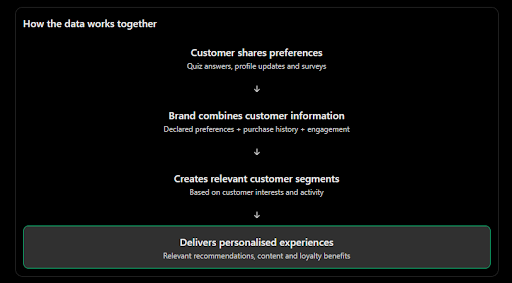
This approach can support retention in several ways.
More relevant product discovery: Customers receive suggestions that reflect their preferences.
Better campaign targeting: Marketing teams can organise campaigns around declared interests rather than relying only on broad customer segments.
More meaningful loyalty interactions: Customers can receive activities and benefits connected to what they actually enjoy.
Improved customer understanding: Brands can identify changes in preferences and adjust their communication accordingly.
The combination of zero-party and first-party data creates a more complete picture of the customer. Shopify also highlights the value of bringing these data sources together within a unified customer profile.
Building a Zero-Party Data Collection Strategy With Loyalty Tasks
DTC brands don’t need to introduce multiple quizzes and surveys immediately. A structured approach can help them begin with the information that matters most.
Here is a practical implementation framework.
Step 1: Identify the information you need
Start by identifying gaps in your customer understanding.
For example, a beauty brand might know what customers purchase but not their preferred product textures, skincare routines, or product interests.
Choose two or three information gaps to address first.
Step 2: Match questions with loyalty activities
Choose the activity that makes the information easiest to collect.
| Loyalty activity | Suggested incentive |
|---|---|
| Select shopping preferences | 25 points |
| Complete a short product quiz | 50 points |
| Update customer profile | 30 points |
| Complete a feedback survey | 50 points |
| Complete a detailed preference questionnaire | 100 points |
Step 3: Decide on the value exchange
Choose an appropriate reward for each activity. Points are a straightforward option, but brands can also consider exclusive access, personalised recommendations, or member-only benefits.
Step 4: Introduce tasks at relevant touchpoints
Don’t ask every question during registration. Instead, introduce activities when they make sense:
- During account creation: Ask for basic shopping preferences.
- After the first purchase: Invite customers to complete a product preference quiz.
- During repeat visits: Offer new profile update tasks.
- After product interactions: Request feedback through a short poll.
Step 5: Organise the information
Ensure that responses are associated with the appropriate customer profile and can be accessed by the relevant marketing and retention tools.
Avoid creating disconnected spreadsheets or duplicate customer records.
Step 6: Use the information in campaigns
Create customer segments using declared preferences and relevant first-party activity.
For example, customers who select a particular product category can receive relevant collection updates rather than general promotional messages.
Step 7: Measure and improve
Review whether customers are participating and whether the information collected is actually useful. Track quiz completion, reward redemption, profile updates, engagement with segmented campaigns, and repeat purchase behaviour.
If a task has low participation, reconsider its length, placement, questions, and reward.
How Retenzy Can Support Loyalty-Based Data Collection
A well-designed loyalty programme needs more than points and redemption options. It should give customers meaningful reasons to interact with the brand beyond making purchases.
This is where a platform like Retenzy can fit into a broader customer retention strategy. Retenzy is a loyalty and reviews app for Shopify that brings rewards, referrals and membership features together in one place. These capabilities can help brands create more opportunities for customer participation and engagement.
For example, Shopify merchants can build a loyalty experience around activities such as:
- Reward-based engagement: Encourage customers to participate in eligible non-purchase activities.
- Customer reviews: Invite customers to share feedback about their shopping experiences.
- Referral activities: Encourage existing members to introduce the brand to new shoppers.
- Membership experiences: Give customers reasons to remain connected with the store.
For zero-party data collection specifically, merchants should consider how quizzes, surveys, and preference questions can work alongside their loyalty programme. The availability of specific quiz or survey integrations will depend on the tools connected to the store.
The broader objective is to connect customer participation with a more useful retention experience, so your loyalty marketing runs on what customers tell you rather than on points and discounts alone.
Conclusion: Turn Loyalty Tasks Into Meaningful Customer Conversations
Zero-party data gives DTC brands something that purchase history and browsing activity cannot provide on their own: customers’ own explanations of what they like, want, and expect.
By incorporating quizzes, preference updates, surveys, and shopping intention activities into loyalty programmes, Shopify merchants can make information sharing more engaging.
The key is to create a fair exchange. Customers should receive something useful for participating, whether that’s loyalty points, personalised recommendations, or exclusive benefits.
More importantly, the information collected should have a clear purpose. Use it to improve product discovery, organise relevant customer segments, and create experiences that encourage shoppers to return.
A successful loyalty programme doesn’t just reward customers for buying. It gives brands more opportunities to understand what customers value and respond accordingly.
Frequently Asked Questions
1. What is zero-party data loyalty?
Zero-party data loyalty refers to using loyalty programmes to encourage customers to voluntarily share information about their preferences, interests, and shopping intentions. Brands can offer loyalty points, exclusive benefits, or personalised recommendations in exchange for participation.
2. How can loyalty programmes collect zero-party data?
Loyalty programmes can collect zero-party data through product quizzes, shopping preference surveys, profile updates, feedback polls, and communication preference activities. Customers receive rewards or other benefits for completing these tasks.
3. What are loyalty quiz incentives?
Loyalty quiz incentives are rewards offered to customers for answering questions about their interests, preferences, and requirements. These can include loyalty points, exclusive discounts, early access, and personalised product recommendations.
4. What is the difference between zero-party data and first-party data retention?
Zero-party data is information customers deliberately share, such as product preferences and shopping intentions. First-party data includes information collected through direct customer interactions, such as purchase history and website activity. Combining both can support customer segmentation and retention strategies.
5. Why is zero-party data important for DTC brands?
It helps DTC brands understand customer preferences directly rather than relying entirely on assumptions based on browsing and purchasing behaviour. This information can support relevant product recommendations, targeted campaigns, and more personalised shopping experiences.
6. How often should brands ask customers to update their preferences?
There is no universal frequency. Brands should offer updates when customer interests may have changed or when new information would improve the shopping experience. They should avoid repeatedly asking questions customers have already answered.
7. Does collecting zero-party data require a loyalty programme?
No. Brands can collect it through quizzes, surveys, preference centres, and account forms. However, a loyalty programme can provide an additional incentive for customers to participate and keep their profiles updated.
Add points, referrals, and VIP rewards to your Shopify store in under 5 minutes.